Old National Presents: Roundball Roundup

Purdue Roundball Roundup is a Boilermaker basketball-focused information and analysis clearinghouse/ thinkpiece posted periodically throughout the season, typically during breaks in the schedule.
FLETCHER LOYER’S BLAZING START
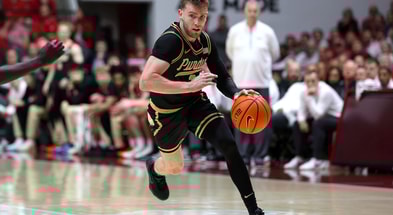
Through seven games, senior Fletcher Loyer leads Purdue in scoring by a comfortable margin at 16.1 points per game.

That may or may not hold up as Braden Smith and Trey Kaufman-Renn have to assert themselves more as scorers in Big Ten play and defenses keep treating Loyer as a foremost priority defensively — which isn’t to say they’re not now, because they are — but there are some notable undercurrents to Loyer’s start.
• He is shooting a whopping 52.2 percent from three-point range. Long barred from the NCAA statistical leaderboard elites by its unreasonable threshold of 2.5 makes per game, Loyer currently qualifies.
• Loyer is averaging 16-plus points on just 9.4 field goal attempts per game (barely up from his 9.2 average last season), reflecting both his 50-percent overall shooting and blistering three-point percentage, but also his ability to get to the foul line, where he’s 23-of-24, 96 percent.
The senior is averaging 1.7 points per shot attempt and is coming off a game in which he needed just four field goal attempts to score 16 vs. Eastern Illinois.
None of this means Loyer should shoot more.
What it really does is reflect how Purdue is generating more fast breaks this season, getting Loyer more of his strong-suit shots. Six of his threes this season have come in transition or at least secondary transition.
And it reflects Purdue’s beefed-up offensive rebounding infrastructure. Four of Loyer’s threes have come after offensive rebounds, three directly off passes from the rebounder.
Purdue, though, has seemed in several games this season to make a concerted play-calling effort to get Loyer shots early in games. That’s both for his sake but also part of the chess match; Purdue wants opponents thinking about Loyer when they’re already pre-occupied by Braden Smith and Trey Kaufman-Renn and keeping the centers off the offensive glass.
TRACKING THE CENTERS
Purdue centers Oscar Cluff‘s and Daniel Jacobsen‘s combined productivity through seven games: 22 points, 15.1 rebounds, 2.9 assists, 3.6 blocked shots and 4.9 fouls drawn. There have been only nine total turnovers.
While viewing the two as one entity is flawed — they are different players with different limitations — the aggregate production has, as expected, transformed Purdue.
Cluff and Jacobsen are shooting a combined 75 percent on two-point goals, the driving force behind the Boilermakers being 24-of-25 on dunks this season after missing roughly a quarter of such opportunities last season.
Another really notable stat: The two centers have combined to shoot 77 percent at the foul line, an invaluable skill for the players who are going to draw cheap fouls — Cluff has drawn 19 fouls, second to only Braden Smith‘s 20, while Jacobsen has drawn 15 — and are most likely to be getting rebounds late in games.
It is clear, too, that Trey Kaufman-Renn‘s elite rebounding through his first five games is closely tied to the legitimate size flanking him now and an already formidable offense has benefited from playing two big men together. According to assistant coach P.J. Thompson, Matt Painter rewrote some of the motion-offense basics he’s relied on for years in order to better leverage bigs playing together.
MTE OUTLOOK
Purdue does not formally have its Feast Week event/MTE lined up yet for next season, at least not officially. It used to be that these events were set years in advance. Literally years.
“Those days are over, for the short term anyway,” said Elliot Bloom, who handles Purdue’s scheduling. “I look at it like everything else in our business right now, kind of a reset and recalibration of everything.”
The Players Era Festival in Las Vegas has been a disruptor since its inception due largely to the payouts it promises those who participate, schools that previously needed NIL warchests built up and now need their revenue-sharing numbers squared up. Meanwhile, tradition-rich events like the Maui Invitational and Battle 4 Atlantis are expensive and travel intensive.
Top 10
- 1Breaking
Will Stein
Set to become Kentucky HC
- 2New
Jon Sumrall
Makes Lane Kiffin joke at presser
- 3Hot
UCLA coach search
Bruins tab Bob Chesney
- 4Trending
Lane Kiffin contract
Details on LSU contract
- 5
Mark Stoops
Kentucky to fire head coach
Get the Daily On3 Newsletter in your inbox every morning
By clicking "Subscribe to Newsletter", I agree to On3's Privacy Notice, Terms, and use of my personal information described therein.
Purdue still values those events, but values high-end competition more.
“We’re trying to play good competition in warm weather,” Coach Matt Painter said. “I think our fans like traveling, I think they like the warm weather. And then when we don’t go to warm weather, it’s going to be elite competition. It doesn’t mean the other one isn’t elite competition, but that’s what we want to do.”
The only time during Purdue’s five-MTE win streak that wouldn’t have qualified as warm weather: The Hall of Fame Tip-Off in Connecticut in 2022, an event that wound up pitting Purdue against Duke and Villanona, and the PK85 in Portland the following year, where Purdue beat Duke, Gonzaga and West Virginia.
Those events provided cream-of-the-crop competition, which is the most important consideration for Purdue but not the only consideration.
Purdue covets destination sites, given that its fans travel incredibly well. Those pro-Purdue crowds you see in those small venues on TV, many of them are the same people every year. It has allowed for collaboration with the John Purdue Club, which routinely operates on-site events, getting face time with stakeholders who may not get to campus very often.
One issue that might come into play when Purdue assesses its future options is format.
Painter isn’t anti-Vegas, necessarily, but he was not sold on the event’s bracket-less pool-play format, which negates participants’ ability to at least have a general idea who Purdue might play. In one of the least popular components to Players Era, matchups after the first rounds of games are determined by point differential.
Another really important consideration: Scheduling flexibility.
Maui and Atlantis and other events are three games in as many days.
Purdue’s goal is to lock in six premier games every preseason: A home game, a road game, the Indy Classic and its MTE games.
If there are three MTE games, Bloom said, that’s six, and thus when Purdue might have the option to play Alabama in Toronto or play a neutral-site return game for the Indy Classic, its six high-major games are spoken for, so it would have to load up its schedule beyond its intention, while still having to make all the dates work somehow.
Purdue’s preference: Two games, with a day off between.
“That was you’re simulating what you’ll see in the NCAA Tournament,” Bloom said.
RANDOM PURDUE NOTES
• Not that the Boilermakers need help scoring, but why can’t Purdue get to the foul line? At present, its free throw rate of 27 percent is 329th nationally. Kentucky and Houston are the only high-majors worse, which makes for good company at least.
Yes, Purdue shoots a fair amount of threes and takes more mid-range shots than most, but it also has size enough to draw bulk fouls, a highly physical front-line scorer in Trey Kaufman-Renn (five free attempts in as many games) and dynamic guards.
Purdue’s averaging 17.3 foul shots per game. It was 19.5 last season.
• Kaufman-Renn has long aspired to much more as a rebounder and has delivered and then some through his first five games. He set a new career-high with 15 rebounds at Alabama then matched it a game later. His three double-digit rebounding games so far are one shy of his total from all of last season.
His offensive rebounding percentage of 22.3 is fourth nationally, while he’s also top 100 in defensive rebounding percentage.