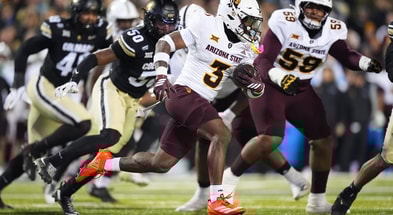
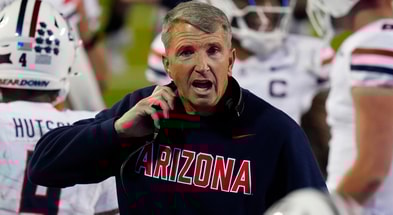
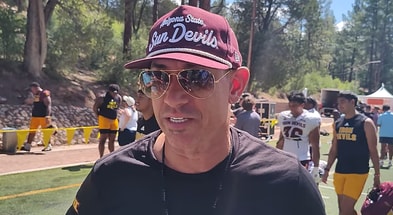
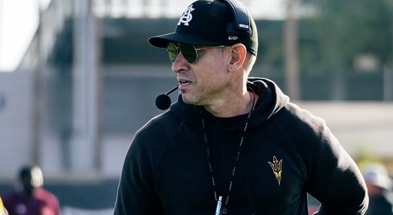
Offense falls apart behind Jeff Sims in 23-7 Territorial Cup game loss

Seasons can unravel in an instant, faster than anyone is ready for.
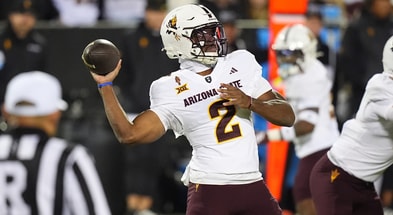
Less than a month ago, senior quarterback Jeff Sims stepped in with almost no expectation. He tore through Iowa State, breaking ASU’s single-game quarterback rushing record. He carved up West Virginia with three touchdown passes. He orchestrated a 42-point eruption against Colorado. Week by week, he grew sharper, stronger, more confident. By the Territorial Cup, Sims was the spark, the quarterback dragging ASU back toward hope.
But college football does not bend to hope.
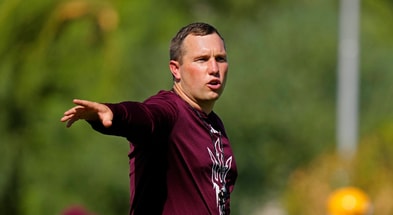
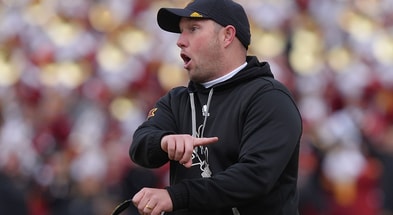
In head coach Kenny Dillingham’s words, “Not all stories end with a happy ending.” Sims’ rejuvenating run—his story in his sixth and final college season—came crashing down. Four turnovers, each more costly than the last, sapped the energy that had seemed unstoppable. The offense sputtered and stalled, the lines between missed opportunities and mistakes blurred with every snap. Arizona seized control and never looked back, its revival unfolding at ASU’s expense.
The Sun Devils produced a season-low 214 yards of total offense. The crowd, desperate for a storybook ending, watched as the team folded under pressure. What had been a month of sparks, of sudden momentum and fleeting magic, ended in smoke and silence. A 23-7 Territorial Cup loss left the deepest scar on a season that had teetered so precariously between failure and redemption.
“I feel for (Sims) tonight, I really do,” Dillingham said. “But I feel for him because he’s a great person, and, you know, he’s a guy who’s going to be successful in life—I can almost guarantee that. And even though it didn’t work out tonight, like I said, I just have so much respect and love for him. He’s just such a good human being.”
Up until the fleeting minutes of the game, the start felt like any other ASU contest. Frustration simmered beneath a slow opening as the Sun Devils continued their streak without a first-quarter touchdown since Week 1, a pattern Dillingham has repeatedly voiced frustration over, alongside other lingering issues in the offensive operation.
Early in the season, red-zone inefficiency, missed opportunities, a lack of explosive plays, and limited ball distribution had defined ASU’s struggles. Those areas had improved in spurts, but the offense as a whole remained uneven, unable to sustain momentum for long stretches.
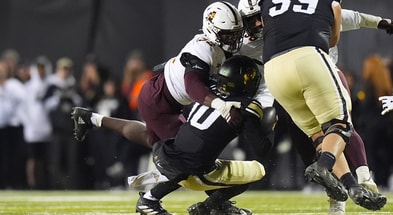
The defense carried the team early, and fortune briefly smiled with three missed Arizona field goals. It was the script of so many games before, yet the spark never ignited this time; the flip that had pulled ASU back from the brink in the past never came.
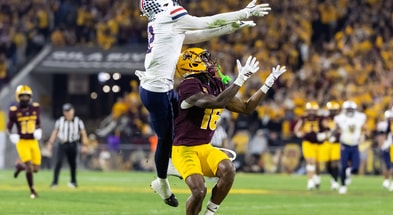
Early in the second quarter, Sims attempted an outside pass that was intercepted by senior defensive back Michael Dansby. It was a misfire, but he bounced back immediately, dashing 27 yards on the very next drive to put ASU on the board first. It was a fleeting glimpse of the quarterback who had carried the team through recent weeks, but as the game unfolded, that version of Sims vanished. That lone scoring drive, brief as it was, came to feel like an anomaly in a game increasingly dominated by Arizona.
Turnovers ultimately became ASU and Sims’ undoing. The Sun Devils had survived costly mistakes in recent weeks—three turnovers against Iowa State, four against Colorado—and still eked out wins. Dillingham had warned then that luck cannot sustain you forever, and he was proven right.
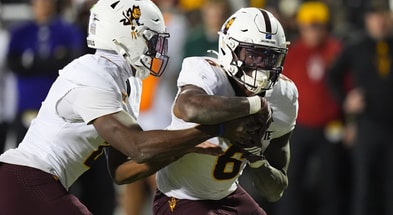
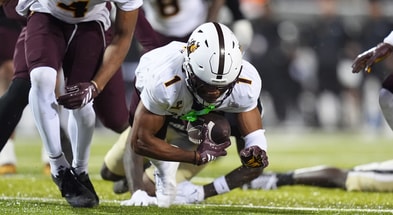
By the final tally, Sims and ASU had turned the ball over five times. Following the initial interception, a fumble on a handoff to junior Raleek Brown in the red zone early in the third quarter led directly to an Arizona touchdown. Another interception came when Sims forced a deep ball to sophomore wide receiver Jaren Hamilton, resulting in an Arizona field goal.
“You can’t hurt five turnovers,” Dillingham said. “That’s pretty much it. All the other stuff is kind of irrelevant.”
Later, a fourth-quarter fumble in Arizona territory popped free at the 16-yard line, crushing ASU’s final push and allowing Arizona to score. Finally, with the game already out of reach, Sims misfired over the middle on the last play, ending the contest with a pick. Seventeen of Arizona’s 23 points came directly off Sun Devil turnovers, a stark reflection of a game—and a season—undone by mistakes.
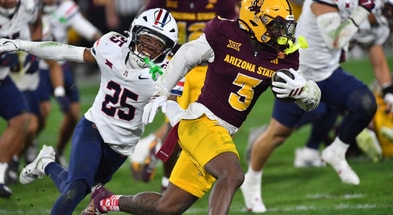
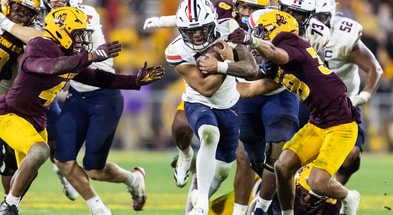
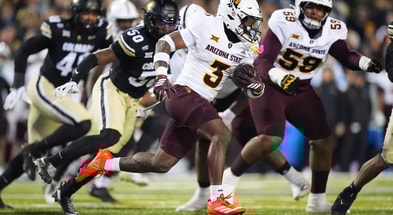
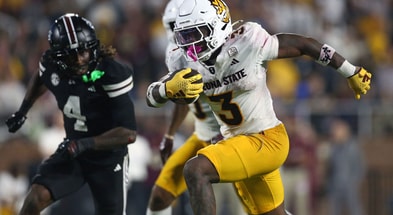
When the dust settled, Sims finished 11 of 25 for 114 yards, his struggles laid bare without the support that had masked mistakes in previous games. Last week, Raleek Brown’s 255 rushing yards had softened the impact of turnovers; this time, Brown was held to 63 yards and Sims to 43. ASU’s total rushing yardage, 100, was the lowest since its loss to Houston, as Sims’ strength on the ground was stifled and his passing game already lacked a margin for error.
Compounding the challenge, Tyson left early in the second quarter, and Eusebio was limited to two catches for 19 yards. Arizona’s relentless pressure disrupted any rhythm Sims might have found, forcing throws into tight coverage and magnifying errors. The Wildcats ran 89 plays to ASU’s 52 and held the ball nearly 20 minutes longer.
“We didn’t have enough plays,” Dillingham said. “And when you don’t have enough plays, and your time of possession is 40 to 19—that’s because of turnovers. And then they get to wear on your defense… If they were to play fewer snaps, they would have played better statistically, even though they already played really, really well. You turn the ball over five times, you give them short fields…puts your defense backs against the wall.”
The Sun Devils’ defense held as long as it could, but quick three-and-outs and turnovers flattened momentum, and eventually the unit cracked under both physical and mental strain.
Still, ASU has a bowl game ahead. It may not be the Big 12 championship, and it may not be a bowl anyone remembers, but it’s a chance for Sims and the Sun Devils to leave 2025 on a positive note, ensuring the last thing fans recall isn’t a turnover-filled collapse, but the fight and flashes of brilliance that defined much of Sims’ season.
“I think sometimes people need to stop, think, and be like, ‘Man, this dude chose to be a Sun Devil. This dude fought,” Dillingham said. “This dude had 228 yards against Iowa State to keep us alive. This dude battled for Arizona State football.’ And sometimes the ball doesn’t go your way. And I hope that doesn’t define him here. What defines him here is wanting to be a Sun Devil, fighting, competing, and doing whatever he can to try to win games.”