

The Loudest Moment in Smith Center History
by Matt Morgan
When Steve Kirschner thinks of the loudest moments in North Carolina basketball history, he thinks of Rick Pitino’s towel and a microphone. It was December 10, 1990 and North Carolina (4-1) was playing Kentucky (4-0) at the Smith Center. Carolina was down four with 1:30 left, seemingly dead in the water. Then, Carolina basketball happened.
Rick Fox hit a three from the top of the key. Kentucky guard Sean Woods missed a shot on the other end, John Pelphrey gathered the offensive rebound then lost it, setting into motion an elaborate scrum. Fox scooped up the ball around mid-court and as he was falling out of bounds passed it to a seated King Rice, who crisply get it to the top of the key to George Lynch, who whipped it to a slashing Pete Chilcutt in stride for a double pump dunk.
The Smith Center erupted.
After another quick miss, this time by Kentucky guard Reggie Hanson, Carolina rebounded the ball with a one-point lead and 38 seconds left (on a 45-second shot clock). That’s when Pitino and his towel came into play.
“Pitino was irate trying to get his players to foul and they couldn’t hear. He was so mad he threw his towel down at the scorer’s table (with 11 seconds left) and it hit the microphone—boom,” Kirschner, the Senior Associate Athletic Director for UNC basketball, says. “We literally dribbled the clock out because they couldn’t foul.”
For 38 continuous seconds the crowd was so loud it changed the outcome of the game. It was amazing. The only thing that ultimately got the attention of Kentucky’s players enough to even attempt to foul—a feat they didn’t actually accomplish until some 10 seconds later after Carolina surgically zipped the ball over scrambling Kentucky defenders—was the towel hitting the mic. If you wanted to describe to someone the magic of Dean Smith basketball, you could do worse than starting with these 90 seconds.
That moment was the loudest Kirschner had ever heard in the Smith Center. That opinion would last about 15 years until a whistle, a bank, and a bucket changed the conversation.
Kirschner didn’t see Marvin Williams’s shot against Duke on March 6, 2005, at least not live, but he heard it. From where he’s positioned on the North Carolina sideline—the first seat at the scorer’s table, next to the bench, the same spot he’s had for more than 20 years—he gets blocked easily. When exciting things happen, assistant coaches and players jump up and Kirschner doesn’t—he’s not supposed to—so his view is non-existent.
“The angle I have I’m tucked in right behind the coaches,” Kirschner says. “They stand up and if the play is right there at the basket, I have no chance.”
Kirschner doesn’t remember a lot of details about the play—it was hard enough to decipher in real time, let alone recount 15 years later. He obviously remembers Felton’s missed free throw and Marvin tracking it down and flipping it up. That’s about it. Instead what’s more vivid are the seasons that led up to it. He can run down the full litany of heartache that Carolina basketball endured the five years previous—from 8-20 and Duhon’s layup to snubbed handshakes from Johnny Dawkins and blowouts in 2001 and 2002.
“We just really needed to win that game,” he concludes.
And that need is what fueled the explosion that Roy Williams calls the loudest in Smith Center history. It was a release. Not just for the fans in the crowd but the players on the court. It was the collective will of more than 20,000 people maybe not affecting the outcome of a game but perhaps changing the luck and destiny of a team that at times seemed to have neither.
“For one sheer instant, yeah that ’05 play is the loudest I’ve ever heard it.”
***
Long Beach was a disaster. Let’s get that out of the way. Long Beach was such a disaster that the only reason most people know the offensive set by name is because of the extent to which it was a disaster.
The final play against Duke on February 9, 2005 was the blueprint to every insecurity Carolina players, coaches and fans had about the 2005 team, a case study in its perceived weaknesses: lack of aggression, aloofness, questionable toughness. All the red flags people saw in glimpses—in the opener against Santa Clara or in a lopsided loss at Wake Forest—but didn’t want to say too loudly in case they might be true. That this team in the biggest moments facing teams that were tougher or played harder would blink.
A year before, Long Beach had worked perfectly. Against No. 1 Connecticut in a tied game at the Smith Center, Felton dribbled to his left to a double screen set by Sean May and Rashad McCants before reversing back to the center of the court. May and McCants both slid down to the block, May stepped out to set a screen for McCants who sprinted back to the three-point line for an open three pointer. Ballgame.
But let’s go back to the play. The bad one at Cameron. What was beautiful against UConn was every bit as ugly against Duke.
Down by 1 with 18 seconds left, Felton dribbled the ball to his left but instead of reaching the double screen set by May and McCants near the three-point line, Felton—denied by Daniel Ewing—stopped about eight feet short and started his motion back to the center of the court way too early. This was the first sign of disaster. J.J. Redick, who was guarding McCants, knew the play call and sold out, allowing McCants a lane to the basket while opening up to Felton and guarding the three-point line and making it impossible for May’s pick to be set. That’s sign two. When McCants reversed to brush past May, Redick had already cut off his lane to Felton, who could barely turn to attempt the pass because Ewing overplayed the screen side. In a panic, Felton reversed course again—that’s sign three—and passed to David Noel, who did all he could to hurl a wild dribble in front of him before it fumbled past a Duke defender out of bounds.
Felton and McCants stood frozen and dumbfounded on the court as the celebration commenced. This play was such a disaster no one noticed or cared that there was about a half second left on the clock or that a Duke defender might’ve touched the ball last. Carolina—apparently confident it got the outcome it deserved—conceded defeat.
Breaking the play down for its parts, each Carolina player near the ball lost his individual battle and everyone away from the ball had no Plan B. Felton was forced off his spots by Ewing. Redick guessed the play and McCants didn’t adjust. Pretty much the same for May, who failed to seal Redick or abandon the play quickly enough for a post-up. Even Noel was beaten to his spot by Nelson, who ushered the junior forward to the corner. But to tie a tighter bow on it, the play was all about aggression. Duke was aggressive and dictated what happened on the play. Carolina blinked.
None of this seemed right in the moment. Redick is one of the greatest players in ACC history. Shelden Williams was a lottery pick. But when you look at the rosters and certainly the way it felt at the time, that Duke team shouldn’t have beaten that Carolina team. So what happened? Were the narratives of these two teams true? That Duke was tough, physical and smart. That this Carolina group was talented but aloof. That Duke never blinked in tight spots and that this Carolina team did. That this Carolina team would never learn.
And to not even get off a shot at the end? It was a helpless feeling.
“We knew we gave that away. We knew they didn’t win that game,” May says. “Coach K and their staff did a great job knowing what we were going to run and putting their guys in a position, so they did actually win but in the moment we didn’t feel that way… We always felt like we gave games away rather than winning them.”
“Every time we lost a game, we never felt like the team beat us,” Jawad Williams says. “We never felt like anybody came out and just destroyed us. We always felt we beat ourselves. We didn’t do something we knew we could do. That was always our mindset no matter what.”
***
“When the ball went through the bucket, the dome popped off. That’s the loudest I’ve ever heard the building.”—Eric Hoots
***
Coach Williams talked to the 2005 team a lot about seizing the moment. He had this demonstration where he’d put a magazine on the table and tell somebody to grab it. As they reached for it, he’d snatch it
“He’d say, ‘That’s how you have to be with everything you approach in life,’” Jawad Williams remembers. “You have to want it more than the next person because someone is always trying to outwork you. Someone always wants what you have.”
Jawad says he saw this demonstration more than once. Maybe it was because this team needed the lesson more than others. Normally there’s a progression of a championship team. You make it into the tournament one year, make a run the next, and compete for a championship the year after. The coaching transition derailed that progression. Nothing could be built on past successes. They had to start over again when Roy Williams arrived.
All of that is to say that back then there was legitimate reason to doubt the team’s chances, which might seem silly now. In 2003, Carolina went to the NIT. In 2004, the Tar Heels were a six seed and lost in the second round to Texas. Competing for a national title in 2005 wasn’t a given. Using Coach Williams’s magazine demonstration, Carolina didn’t have anything anyone wanted. They were the ones who needed to steal the magazine.
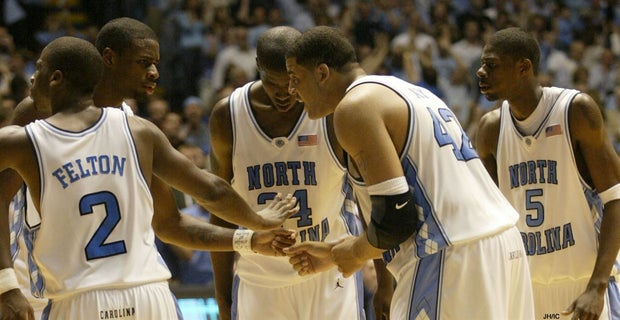
As impressive as Carolina’s run in Maui was—beating BYU, Tennessee and Iowa each by double digits—none were world beaters and meanwhile the Heels faltered in the big tests early that season. In a Saturday afternoon game against Chris Paul and Eric Williams in Winston Salem, the Heels came out completely flat and looked out-classed for stretches before losing by 13. Then there was the finish at Cameron where it looked like nothing had changed.
Carolina was 13-2 and in first place in the ACC—surviving the prior three games missed by Rashad McCants due to a stomach ailment. The Tar Heels had good wins—a 13-point win over Rajon Rondo-led Kentucky and a seven-point road win over Charlie Villanueva and UConn—but they were the experienced teams in those matchups.
To prove it was the best team in the country, Carolina had to beat someone that was better than itself—if that made sense.
***
“It was deafening. It felt like the Smith Center was shaking. You couldn’t really hear, you could just see the reaction and you know people are yelling but you couldn’t really hear anything. I’ve never heard anything like that before.” —Jawad Williams
***
Carolina’s collapse against Duke at home was far less dramatic than the one at Cameron. It was fast but methodical, bordering on boring. The Heels built a seven-point second half lead but went cold down the stretch—shooting 27 percent through the first 14 minutes of the second half and 1-for-11 from three-point range for the game. Duke chipped away at the lead and the two teams traded the lead back and forth.
With 5:19 left, Felton gathered a rebound and quickly passed ahead for a Jackie Manuel alley-oop lay-up that tied the game. Duke had this Carolina team’s number but this play felt important, like the Heels had gotten out of their own head.
Instead, Carolina — without the ill McCants, who watched the game from the bench in street clothes — stopped scoring.
For the next two minutes, Daniel Ewing jogged the ball up the floor with no urgency and Duke calmly ran its offense with a maddeningly bland efficiency while Carolina slowly worked itself into a panic. A lay-up by Shelden Williams was followed up by a turnaround miss by Jawad Williams. Another Shelden Williams hook shot was answered by a wild pass by Felton that was fumbled by Noel. Redick avoided forcing a three and drove and dished to Shelden Williams again. May had thoroughly out-played Shelden Williams all afternoon and was suddenly getting beat on one end and unable to finish on the other. On Carolina’s next possession, you could see fear in Felton as he drove and fell down before being bailed out by Shelden Williams needlessly tipping it out of bounds.
During the dead ball, CBS played the final hapless play at Cameron and it all felt too familiar. May was promptly stripped on an aggressive move in the lane which led to a Ewing baseline drive and kick to Melchionni for a wide open three.
Duke had scored nine straight points in the most boring fashion possible, by not panicking and simply making shots. The Blue Devils were dictating the tempo and tone—again. They were active on defense, purposeful and poised on offense. Carolina was flailing. It was happening again, but was also somehow worse. Getting beat by Redick was one thing, but Lee Melchionni?
***
“Oh my goodness the roof came off of that building. I’ve heard the building pretty loud, but not that loud. In that moment, the energy in the building, it gave you so much confidence. It was one of the true home court advantages. That’s what that season was for us. That whole year was a home court advantage for us. When you came in there, our building was intimidating. Not just the banners or the players on the court, our fanbase was loud.” —Jackie Manuel
During the time out following Melchionni’s basket, Roy Williams had a heart to heart with his team. A group of kids that hadn’t won anything yet and didn’t have any reason to have confidence in this situation, found confidence in their coach.
“Coach said, ‘If you do everything I tell you to do, how I tell you to do it, I promise you’ll have a chance at the end,’” May recalls. “The crazy thing is he said that and looked at us and we all believed it. It’s kind of a cliché moment but your hair raises on your arm and we literally all believed it. Why? I don’t know.”
“Him speaking that and us going out and doing it, that started to build confidence that if he said it, yeah, that’s what we’re about to do,” Manuel says. “And it happened over and over and over again, we just had that belief, if there’s time still left on the clock, we still have a chance.”
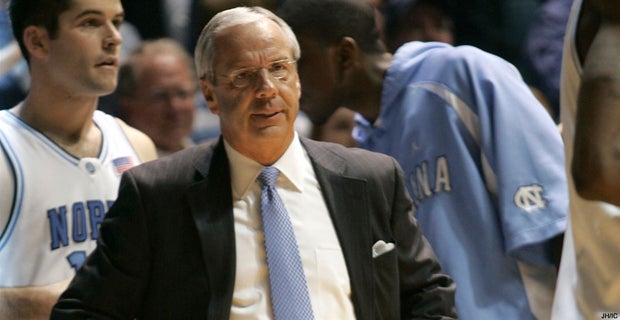
Coming back from nine down with three minutes to go has been done before, but you need everything to go right at the right time, May says. Then once everything goes right, you need to catch a break, too. Probably a few.
Moving past melodramatic promises of a coach, in real terms, Carolina became the aggressor the same way Duke had in Cameron. On offense, everything was attacking the rim. On defense, the three-quarters court trap Carolina had started just before the time out took on a greater intensity. Ewing wasn’t allowed to casually dribble up the floor. It didn’t take long before it became obvious that in a three-guard offense with Ewing, Redick and Nelson that Duke didn’t have a natural ball handler.
Just 16 seconds later — after a Jawad Williams tip-in – Ewing kicked his dribble into his own bench. Suddenly, Carolina wasn’t the nervous team anymore.
“The one thing I always felt and I always tell people is I never thought we were going to lose that game,” Marvin Williams says. “We had a feeling about that team, we always felt we were going to win every game we played. … I felt like everything happened for us to keep believing, to keep pushing forward.”
Felton smelled blood, driving the lane and setting up Marvin Williams to draw a foul on Shelden Williams.
73-68
On the next Duke possession, David Noel was called for a hand check foul against Nelson but Nelson—because just that quickly Duke was now the tight team—badly missed the front end of the one and one. On the other end, Felton again got into the lane and passed to May, who was blocked by Shelden Williams, but May collected the rebound and got a lay-in and the foul.
73-71
After exchanging misses, Carolina got the break May was talking about. With 36.8 seconds left, Melchionni inbounded to Ewing, who was guarded by Noel. As Ewing crossed midcourt and turned the corner, Noel did the one thing you’re never supposed to do as a defender—he reached around the back side after getting beat.
But instead of getting called for a foul, Noel tipped the ball out and Felton dove on the floor, collected the ball and called time out.
“That was the break,” May says. “And I say that because literally the time out before that Coach told David not to do that.”
After the time out, Felton drove yet again—the fifth consecutive possession where a Carolina ball handler got into the lane—and drew a foul on the floater and headed to the line with a chance to tie the game.
***
“When we played them at Cameron we felt like we should’ve beat them then,” Marvin Williams says. “Obviously they made a couple of big plays that sealed the win for them but we felt like we did want another crack at them.”
Jawad wasn’t on the court for Marvin’s shot, even though he had been instrumental in the comeback that preceded the shot. Jawad was a senior and a leader but was in a unique position. On just about any other team in the country, he was a clear starter and go-to guy. On this team, he had a future No. 2 pick who played the same position as him as a sixth man. Jawad maintained his starting status and his stats, but he did give up some minutes and opportunities. The reason that worked is because of his close relationship with Marvin.
So in one of the biggest moments of the season with the ACC regular season championship on the line and Jawad on the bench, Marvin sought out Jawad.
“Marvin walks over to me and he said ‘I guarantee, man, I’m not going to let you lose your last game here. We’re not going to let y’all go out like this.’ He said this out loud and everybody heard it.”
And that’s exactly what Marvin did. After Felton’s first free throw cut the deficit to one point, his second bounced off and was collected by Marvin Williams, who made a putback and was fouled.
“Honestly It was just a tough bounce,” Marvin Williams says. “I’ve been in his position many times before and sometimes when you play basketball you’re in position for a box out and the ball just kind of comes over your head. … It’s just instincts. Everybody’s trying to get the ball and it just fell into my hands.”
Marvin Williams thinks his rebound and putback were luck. Here’s an alternative theory: Duke blinked, even if it was just a little.
Let’s give Marvin’s shot the Cameron treatment. Ten guys on the floor, essentially five matchups determining who gets the loose ball.
May vs. Shelden Williams
Felton vs. J.J. Redick
Manuel vs. Ewing
Marvin Williams vs. Patrick Johnson
David Noel vs. Lee Melchionni
Top 10
- 1Hot
Postseason Meetings
Greg on start of portal season
- 2Trending
Portal Tracker
Who's leaving?
- 3Trending
Mingo Update
Latest on top target
- 4Trending
Signing Day Revelation
Greg column
- 5
Meet the Class
UNC's 39 signees
Get the Daily On3 Newsletter in your inbox every morning
By clicking "Subscribe to Newsletter", I agree to On3's Privacy Notice, Terms, and use of my personal information described therein.
Before Felton’s second free throw attempt, Mike Krzyzewski prepared for a miss. DeMarcus Nelson, who was lined up next to May and Shelden Williams to Felton’s left, was subbed out for Patrick Johnson. Normally this would’ve been Shavlik Randolph but with Randolph fouled out, Krzyzewski turned to Johnson, who had played just two minutes that night and logged 23 minutes all season. Johnson switched positions with Melchionni, putting him next to Marvin and leaving Melchionni to keep Noel from sneaking into the lane from the top of the key.
When the ball went up, May got a good push on Williams—a rivalry that went back to their AAU days— putting him flat footed and under the basket (this comes into play later). Johnson got a decent seal, but was also flat footed once the ball caromed back toward the free throw line.
Where the play started to take shape was with Redick and Felton. Redick didn’t attempt to box out the shooter and instead jumped for the rebound. He got two hands on it but bumped bodies with Melchionni while Felton outjumped him by a hair and popped it out of his hands once, then again when they landed, which squirted it toward the baseline.
From there, it was a four-man footrace between Marvin Williams, Ewing (at the free throw line), Johnson (who had his back turned) and Shelden Williams, who May pushed deep under the basket.
Marvin Williams not only tracked down the ball first but Shelden Williams was so far from the play that he was not in position to truly contest the shot (he had six blocks in the game) and Johnson was still so turned around that he dove backward into Marvin for the foul.
Marvin can say it was luck, but it’s the kind of luck that comes from preparation meeting opportunity.
“That’s the magazine demonstration,” Jawad Williams says. “Marvin wanted it more so he went and got it.”
And it wasn’t just Marvin, every Carolina player on the court was ready. To take it a step further, if Marvin’s shot missed, May was at the front of the rim to clean it up—”I thought Shelden would be able to get a hand on it and block it so my focus was just try to get a tip,” May says—and Noel was swooping down the weak side baseline past Melchionni (who didn’t attempt to box him out) for a possible putback dunk. Marvin got the game winner, but it could’ve been three different players.
“When you’ve got two talented teams playing against each other, eventually somebody is going to give in,” Manuel says. “Somebody is going to (get tired) and things are going to start going one team’s way and the other team is going to give in and start to make multiple mistakes. Coach Williams used to say that to us all the time when we were practicing. He would let us go up and down six to eight trips, no whistle blowing, no stoppages and he’d say, ‘Who’s going to give in? Which team is going to give in? I’m going to see which one.’ And it was kind of preparing us for when that moment happened.”
And then there was the noise. The deafening, building-shaking noise.
“Honestly I didn’t even know they called the foul because you couldn’t hear it. I didn’t hear a whistle,” Jawad Williams says. “It was No. 1—No. 1 by far. Out of all the championships and everything that I’ve won throughout my career, that was the loudest.”
“It was crazy how loud it was,” May says. “I do think fans forget how big a part they play. I do think the noise and the crowd and the atmosphere in that building is a huge part — if not the biggest part — of us winning.”
Manuel was the first one to respond to Marvin Williams’s shot going in. You can see him at the top of the court sprinting away from the play for no particular reason. Then Noel picked up Marvin from behind and somehow Manuel was back in Marvin’s face whispering something to him.
“I was going toward Marvin to hug and we were both so excited, he lifted his knees up and kneed me in my stomach and it kind of took the wind out of me,” Manuel says. “I have no idea what I said to Marvin. My wife gives me a hard time and she always tells me that I went up to Marvin and said ‘I love you, man’ and—I don’t know what I said. I don’t know if I said that. My wife is trying to make it poetry but I probably just screamed.”
This kind of outburst was rare for Manuel. His singular focus on the court was playing defense. He took that seriously and blocked out all external noise and emotion. There were plenty of times he had no idea how much time was left on the clock or what the score was. That was how locked in he got.
“The game at Duke, we should’ve won that game. But this time, we had that moment where you’re like, we’re not about to let this happen again. We’re better than this and I think when Marvin hit that layup and hit the and-one, it was kind of a relief.” Manuel says. “I just let it all out.”
“Everyone was screaming but everyone was trying to keep their composure,” Marvin Williams says. “I remember Ray telling me to focus on the free throw but we were excited about it.”
After Marvin knocked down the free throw, Carolina survived two more near disasters. With eight seconds left, Redick got off a three pointer in front of the Duke bench and Ewing had a flat-footed flip from near the three-point line with three seconds left, but this time it was Carolina’s turn. May gobbled up his 24th rebound to end the game.
***
For the first 13 years he was on staff, Eric Hoots filmed every game—home and away. As Director of Player Development, he doesn’t do that anymore but in 2005 he was still filming. So when Marvin Williams made the game-winner against Duke, he was on the perch connected to mezzanine 225 in the Smith Center.
Earlier that season in Maui, Hoots was filming the final against Iowa, a comfortable 14-point win over Steve Alford’s Hawkeyes, when the team was on the floor celebrating and getting T-shirts. Rather than go down and celebrate, Hoots stayed put and kept filming.
“Afterward coach Joe Holladay told me, ‘If there’s ever a situation like that, you just let the camera run and you come down and celebrate with us,’” Hoots recalls. “‘You’re part of this.’ That was awesome to hear.”
When Redick and then Ewing’s shots fell short and the final buzzer sounded, Hoots climbed the wall and sprinted down to the court. He remembers patting Raymond on the back and hugging Sean.
“For the longest time when you came down the stairs from our offices to the locker room area there was a photo of Raymond Felton on Charlie Everett and C.J. Hooker’s shoulders—and in the background was me,” Hoots laughs. “Coach used to tell the story, ‘Eric how did you climb the wall and get all the way down from the second level and be on the court for that picture?’
“I will never forget that feeling.”
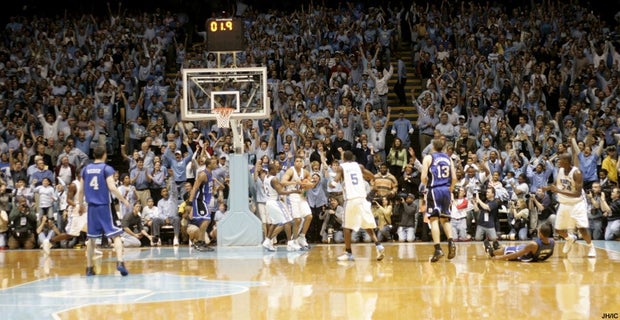
The court filled fast and before long, you couldn’t move. If you were on the court, you were stuck there for a while.
“I just remember all the excitement. Our guys were all fired up and we had to get them off the court,” former assistant coach C.B. McGrath says. “I remember I was actually scared after the game with the court rushing. I understand why people would be scared because you can get stuck between people and scoreboards and all that stuff. … Being a part of it, I’ll have that memory for the rest of my life.”
Marvin says it’s hard to judge whether it was the loudest moment of the Smith Center or even his career. He was yelling himself and everyone around him was yelling, so who knows.
“I’ve seen it a few times. Usually when the Carolina-Duke game comes on they play highlights of the old matchups and I’ve seen that highlight a couple times,” Marvin Williams says. “Shelden Williams and I actually played together in Atlanta for a few years so I always gave him a hard time about it. I still give him a hard time about it. I have a big picture of it in my house. We still joke about it to this day.”
When the fog started to clear after the celebration, May’s legendary stat line—26 points, 24 rebounds—was announced to the crowd. With McCants missing the last four games of the regular season, May became the focal point. The transformation from an outside-in to inside-out team was complete, to say the least. This was his team now.
If there’s one thing Roy Williams’s tenure at Carolina has taught, it’s that narratives don’t matter. Teams don’t come back from 40-12 to win a title like Tyler Hansbrough and company did in 2009. They also don’t come back from a buzzer-beater against Villanova to win the next year. Heck, you don’t go home again after you’ve already said ‘no’ once.
Would Carolina still have won the championship a month later if it’d lost this game? Maybe, but it certainly felt like Carolina needed to exorcise some demons against Duke. No team wins a championship thanks to a regular season game, but this meant something. The Tar Heels didn’t just need to beat Duke, they needed to beat Duke the way Duke beats people.
“For us, I think that’s when we realized we were the best team in the country,” May says.
This was also the start of one of Roy Williams’s traditions at Carolina, something he brought to the program that was entirely his: cutting down the nets for a regular season ACC title. This wasn’t something Carolina had done in years past and it was the perfect year to begin.
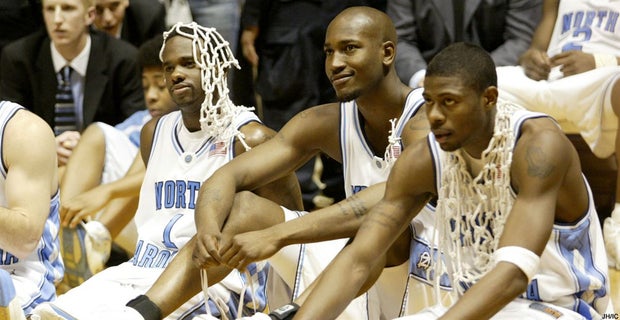
For all the turmoil it endured, the senior class of Jawad Williams, Manuel and Melvin Scott deserved to go out on top.
“They went through a lot and coaching changes and wins and losses and people saying bad things and then good things,” McGrath says. “They realized all the hard work paid off and they did get a ring. Granted everyone wants a national championship ring and that came but this was an ACC championship, something they worked hard for once they got to Carolina and it finally worked out. The emotion of everything—it was senior night, their last time playing in the Smith Center, we won the conference and finally cut down the nets and it came together.”
Manuel says at that point, he, Jawad and Melvin weren’t even thinking about the national championship. They were just thinking about the path they’d been on together, arriving on campus as kids, surviving the bumps and leaving as men.
“You have senior day, which is a wonderful moment but it changes the energy, and the energy is like, now my mom and dad are there and they’re crying,” Manuel says. “My fiancée is there and she’s crying. And other guys’ parents are there and they’re crying. You totally forget about in that moment that we beat Duke. It’s almost like, oh my goodness what happened to my four years? Where’d it go?”
When you watch the Duke-Carolina game on TV as a high school student, Manuel says, you have this perception of what this game is and you can’t wait to play in a game like that. Then you get to college and you play in it and you don’t have a lot of success, so you make plans for what you’ll do when things are better. “I’d say, the next time we beat Duke, I was like I can’t wait to go on Franklin Street. I can’t wait to celebrate with the fans. I can’t wait for any of that.”
The reality of it after this game was, when Manuel was finally mature enough to beat Duke, he was too mature to go crazy. He didn’t even go to Franklin. He was too tired, too happy, ready for what came next.
“I literally went home and hung out with my fiancée the rest of the evening,” Manuel laughs. “It just shows you how things change over the course of a few years.”
******
Beau Estes contributed to this project.