Offensively, Purdue might not be what people think it is

As post-centric as Purdue has been in its modern era, it’s natural for it be perceived a certain way, as a stodgy, un-dynamic, monster truck show of an offense built around static positioning, low tempo and lots of standing around.
It is the opposite.
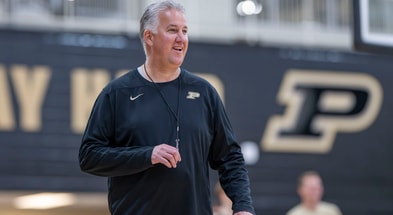
“A lot of people think you have a theory and you’re just going to plug people in,” Coach Matt Painter said, “and a lot of people have systems and are that way. We’re not. We go by the strengths of our players.”
For this Purdue team, led by the game’s pre-eminent low-post offensive threat, feeding the post in a traditional manner is not even the clear No. 1 option offensively anymore. Obviously every game and every opponent are different, so game plans change and can change on the fly, but it wouldn’t be outlandish to now call Purdue a ball-screen team.
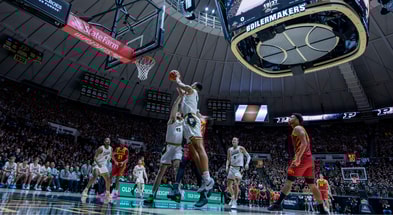
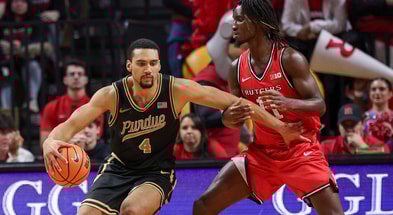
Braden Smith‘s emergence into an elite point guard as a sophomore has driven it, and Zach Edey‘s immersion into it has made them as formidable a 1-2 punch as college basketball has. This is the same Zach Edey — 7-foot-4, 300 pounds — who’s naturally perceived as an anchor at the rim.
“One thing we wanted to change back in the summer was to ball-screen more, to put the ball in Braden’s hands more, (knowing) Zach’s production would stay the same, if not grow, because of it,” said assistant coach P.J. Thompson, who’s now calling Purdue’s offense. “It came from an analytics standpoint, but also just what we’ve seen.”
This season, per Synergy Sports, Purdue’s pick-and-roll game accounts for 12.2 percent of its offense, while posting up is 18.6 percent, percentages that may not reflect how often Purdue uses ball screens to create post-ups. There’s much overlap between those two data points.
But last season, pick-and-roll was merely 9.6 percent of Purdue’s offense, while post-ups were 25.3 percent.
It’s been quantity and quality.
With a smaller body of work last season, Purdue averaged less than eight-tenths of a point per possession last season in pick-and-roll; now, it’s .928, top 94 percent in college basketball, again via Synergy. Using Smith to run pick-and-roll, Purdue averages .927 PPP.
Edey, as a roll man, generates an astronomical 1.625 points per possession; posting him up generates 1.019. Again, there’s a blurred line between the two play types often, because ball screens regularly lead to post-ups.
Ball screens also generate spot-up jumpers, on which Purdue is 97th percentile nationally at 1.116 PPP. That was one of the driving forces behind Smith’s 16-assist game vs. Northwestern, Purdue making those catch-and-shoot threes off the Wildcats’ lingering hedges against Smith, meaning the center would slip out to Smith in containment after the screen, but also hold there to make sure Smith was bottled up.
“We kind of knew they’d be in a hard hedge like that,” Smith said. “I was trying to hold it a little longer (early) just to see how long they’d stay (with me) and see whether the low man (help defender) would choose to stay with Zach or close out to the shooter, so that’s my read. Once I held it a little longer, he usually went (to Edey) and I was able to beat it (for cross-court assists on threes).”
A deeper look into some of the underlying dynamics at play in a Purdue offense that has changed profoundly despite all the names and faces being the same as last season.
BRADEN SMITH’S DECISION-MAKING
There hasn’t been a ball-screen coverage Smith hasn’t been able to solve yet this season.
“They throw a lot of different looks at him,” Painter said, “whether they’re in drop, they’re switching or they’re high-hedging or trapping and Braden’s done a good job of handling it and making the right decision.”
Top 10
- 1Breaking
Michigan
Hires former Ohio State DC
- 2
Donovan Raiola
Nebraska to fire OL coach
- 3Hot
Coaching Carousel Intel
PSU staff, South Carolina OC
- 4
Nick Saban
Fires back at Desmond Howard
- 5Trending
Confirmed Bowl Games
Full list of postseason matchups
Get the Daily On3 Newsletter in your inbox every morning
By clicking "Subscribe to Newsletter", I agree to On3's Privacy Notice, Terms, and use of my personal information described therein.
Smith is averaging 7.5 assists per game. At a program whose traditional motion offense — Purdue now runs a robust number of set plays — has often decentralized assist numbers, Smith is posting numbers never seen before during the Matt Painter — or Gene Keady — years.
Turnovers are a concern for Purdue, but Smith is racking up nearly three assists for every giveaway.
THREE-POINT SHOOTING AND ACTIVATING SCORERS
First of all, Purdue laid the groundwork for all this last spring when it mandated that Smith change his approach to be more scoring-minded, to start popping off screens looking to either rise and fire or get to the rim, figuring his basketball instincts would take it from there as far as a facilitating was concerned.
But that change and all those shots Smith has taken and made, going back to November, they’re now the impetus behind the first decision defenses now have to make. Not as much how to defend the post — that’s still a huge one — but how to cover those screens.
The disruption caused to set defenses by forcing rotations and assignment-diligence away from the ball has clearly made Purdue a better shooting team, thanks to Smith’s virtuoso passing. The Boilermakers are shooting 40.4 percent from three; up markedly from last season’s 32.2 percent, the iron boot that dragged them down at times — the worst times — last season.
It has probably amplified Purdue’s offensive rebounding strength, too, to have defenders rotating even more.
THE OPPOSING 5 MAN
Opposing centers already had one of the worst jobs in sports, having to bang with Edey every night, but their thankless existence is now much worse, because now they have to guard away from the basket, too, containing ball screens, while still responsible for Edey.
That means a few things:
• More to think about and more to screw up
• More running around and hence more wear
• More exposure to fouls not spent on Edey
• Surrendering post-defense and rebounding position from the jump
• Exposure for those particularly slow ones
Purdue’s aim is to make the opposing center do more this season.
EDEY IS BETTER
When Edey decided to come back to Purdue, Thompson told him they’d devise ways to use him away from the basket more, a side benefit to that being what it could mean for his NBA stock.
Edey’s production as a roll man, a screener, a finisher on the move, a dive man, etc., has been outstanding, and as the focal point of Purdue’s dribble-handoff offense, he’s been comfortable playing 18 feet out, too. He’s even been a post-entry guy in high-low sets a handful of times. This is all NBA stuff, but also highly valuable to Purdue in the moment.
“Zach’s gotten a lot better in things people don’t give him credit for,” Thompson said.