#subjectlinesmatter
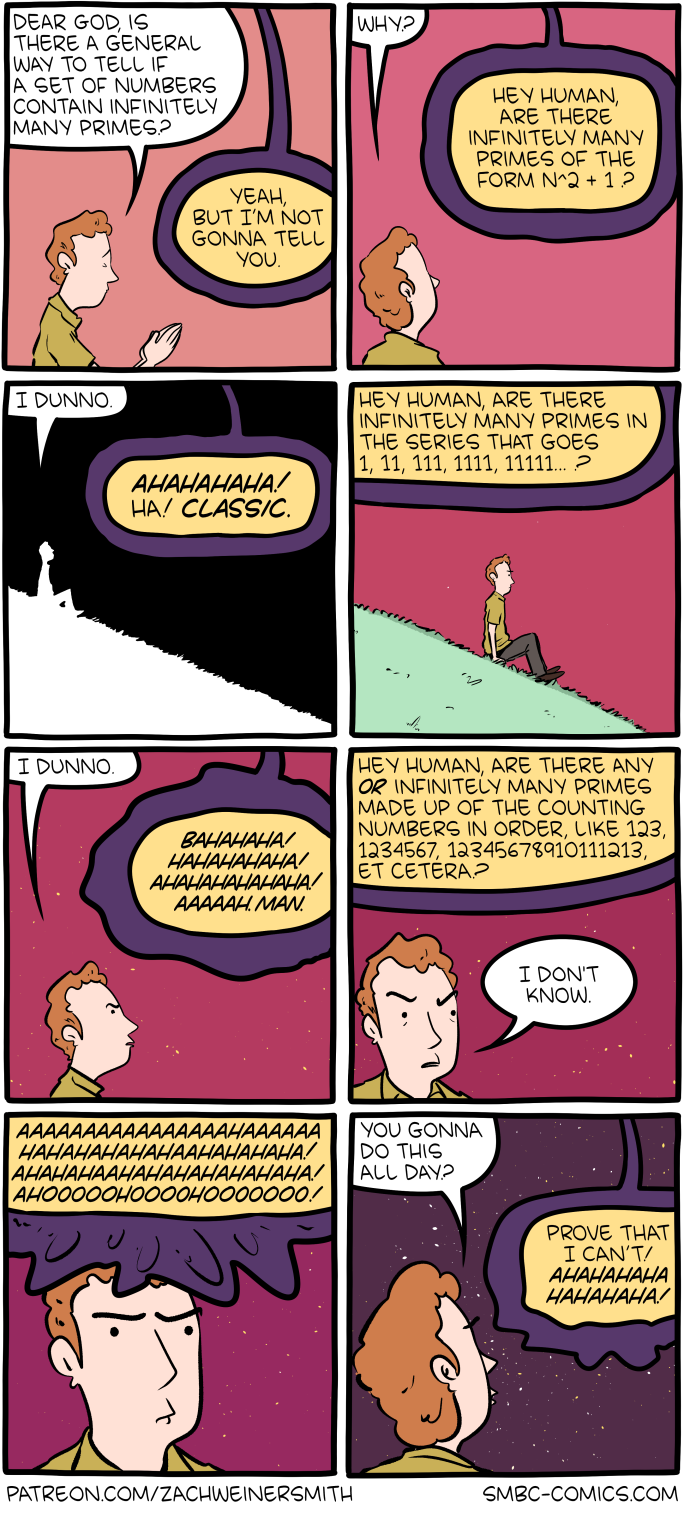
Euclid proved that if S is any finite set of prime numbers then there is some prime number p which is not contained in S. Ergo, there are infinitely many primes. Nice proof, easy to understand.
Now:
8, 9, 10 are three consecutive non-primes.
32, 33, 34, 35, 36 are five consecutive non-primes.
212, 213, 214, 215, 216, 217, 218 are seven consecutive non-primes.
It’s an easy algorithm. To illustrate by using the last example, multiply 2, 3, 5, and 7 together to get 210 and then add 2, 3, 4, 5, 6, 7, 8 in succession to 210. 212 is divisible by 2, 213 by 3, 214 by 2, 215 by 5, 216 by 2, 217 by 7, 218 by 2. So, all non-primes.
So if you take any prime p, you can find a run of p consecutive non-primes. Since there are infinitely many primes, if X is the number of seconds from the Big Bang (13 billion years ago) to the moment I post this, you can find a run of X consecutive non-primes. Every second since the Big Bang, start with a non-prime the next number is itself a non prime. And there are infinitely many primes coming up afterwards. That blows my mind. Infinity is big.
YMMV. Thanks for indulging me. Now, off to the gym!