The Army Preview
Outside of just being aware of game results, I don’t really follow Army very closely for most of the season. Teams evolve, which means the squad that takes the field in August won’t be what Navy faces in December. I usually start to follow Army more closely once they play Air Force. Before then, there are more pressing issues to attend to.
That was my thinking back in August, as I sat in my hotel room on the Friday night before Navy’s home opener against VMI. This would be my first game in the radio booth, and I was far too nervous to do anything other than study the game notes. Watching other games was the last thing on my mind. But then the texts started coming in: “Hey, are you watching the Army game?” Eventually, curiosity got the best of me, and I decided to tune in to see what all the hubbub was about.
The hotel didn’t have CBS Sports Network on the TV, so it took me a minute to pull up the stream on my computer. And when I finally did, I found the third quarter of a dogfight between the Black Knights and Tarleton State. I suppose there’s a certain shock factor when you first gaze upon an upset in the making, so I could understand why people were texting me about it. Still, I think most in-the-know football fans knew Tarleton State was a good team. At the time, Army had a 17-10 lead, so it wasn’t that surprising. But just as I was about to flip back to reading Keydet player bios, a play caught my eye.
Early in the third quarter, Army faced a fourth and two from its own 46-yard line. This is the kind of situation that butters their bread, right? Fourth and two near midfield? We know exactly what’s going to happen: Army’s going to line up under center, run some kind of power with the quarterback, pick up 2.5 yards and a first down, and the caissons keep rolling along.
Except that’s not what happened. Instead, Army lined up in the shotgun, ran some slow-developing counter play that was blown up in the backfield, lost three yards, and gave the Texans the ball on their half of the field.
That was the first sign to me that something had changed with the brave old Army team.
Army-Navy has earned a reputation for being low-scoring and close. In the 15 years leading up to last year’s game, the average score was only 20-14 in favor of Navy, with ten one-score games. Last year, Army head coach Jeff Monken likened the contest to a sledgehammer fight.
“Those games are like if you said, ‘O.K., two guys are going to fight. You each get a sledgehammer and you hit him as hard as you can with a sledgehammer, and then he gets to hit you back with his sledgehammer, and then you hit him back with a sledgehammer, and the last one standing wins,’” he told Sports Illustrated.
It wasn’t only against Navy, either. In service academy games, Army averaged only 108 yards on the ground in 2021 and 2022. That was the primary reason why Monken let longtime offensive coordinator Brent Davis go after the 2022 season: frustration over the inability to move the ball in those games. He hired record-setting coordinator Drew Thatcher from Division II Nebraska-Kearney to implement a new offense in 2023. But it didn’t work, and after a close call against Holy Cross near the end of the season, Monken had seen enough. He switched back to a more traditional option offense in Army’s win over Coastal Carolina the following week, and made the switch permanent the following season, replacing Thatcher with quarterbacks coach Cody Worley.
The move paid immediate dividends. The Army offense was a steamroller in 2024, leading the nation in rushing and paving the way for 12 wins and the American Athletic Conference title. But when it came to the Army-Navy game, it was still the same old sledgehammer fight. Well, it was for Army, anyway. Navy, however, had a new offense with coordinator Drew Cronic that meshed their traditional triple option with new ideas, and it worked in spectacular fashion. The traditional nail-biter became a decisive 31-13 win for the Midshipmen, with Navy holding a 384-179 advantage in total yards.
This was a pivotal moment, both for the series and for Monken. Is it possible that last year’s game was just a one-off fluke? Sure. But if you’re Army, is that an assumption you should make? Probably not. Since Brian Newberry joined Navy’s staff in 2019, Army has yet to score more than one offensive touchdown in the Army-Navy game. Army’s offense has been a constant in this series. The variable has been Navy’s offense. When the Mids have come into the game having moved the ball at all during the season, they’ve won. Maybe Army could’ve hoped that 2024 was an aberration, and that Navy’s offense won’t be as good the next year. Or perhaps they could count on their defense to come up with answers to restore the game’s balance. But just in case neither of those things panned out, they also had to find an offense of their own that could keep up.
And that’s exactly what they tried to do, which brings us back to that fourth-down play against Tarleton State. This was the first taste of the new-look Army, and perhaps not surprisingly, there were growing pains. While some change may have been inevitable after losing star quarterback Bryson Daily and several all-conference offensive linemen, this was more than just fitting the offense around different personnel. Army tried to incorporate some of the ideas that worked so well for Navy in 2024. But like that fourth-down play, they just didn’t look comfortable running it.
This time, Monken wasn’t going to wait until the end of the season to return to his winning formula. After a 1-3 start, Army scaled back on the new stuff and doubled down on the approach that had worked for them in the past: staying on schedule, controlling the clock, reducing the number of possessions, and winning in the fourth quarter. Cale Hellums and Dewayne Coleman had been splitting time at quarterback, but the team finally settled on Hellums, whose physical playing style is closer to Daily’s. And just like before, it’s worked. The Army is 5-2 over its last seven games, including an impressive win over UTSA last time out to clinch bowl eligibility.
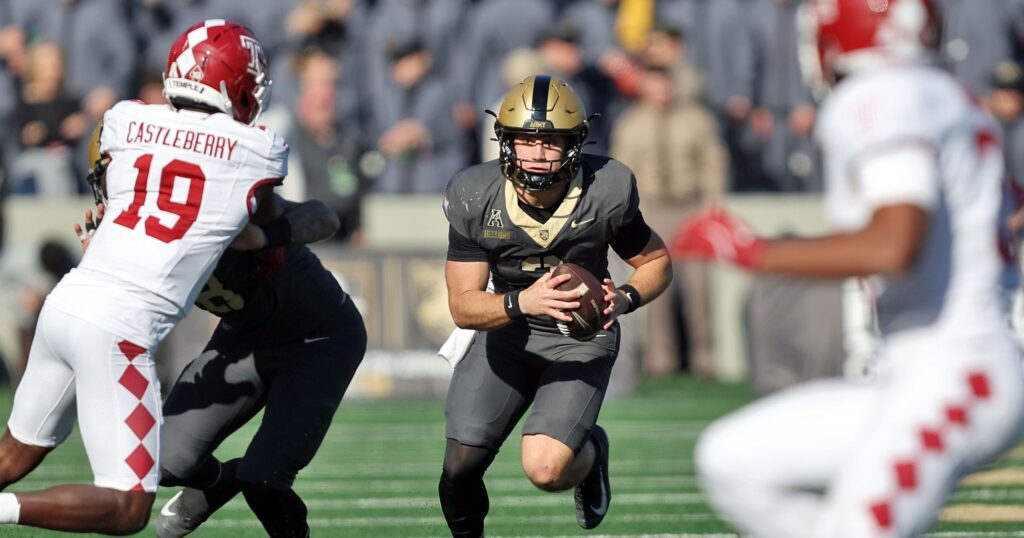
The numbers tell the story. Army leads the nation in time of possession at 35:16 per game, which is 37 seconds more than their 2024 number that also led the country. In their first four games, they averaged nearly 78 plays per game. Over their last seven, it’s been 65 plays per game– much closer to the 63 they ran in 2024. They averaged 13.5 passes per game in their first four. Since then, it’s 7.7. They have made a deliberate effort to control the pace and shorten the game, and it has paid off.
But all of this comes with caveats. While Army has returned to 2024’s methods, they have not achieved 2024’s results. The Black Knights might have seemed like a three-yards-at-a-time offense last year, but they still could lull defenses into giving up big plays. They were second in the country with 103 runs of ten yards or more, and it wasn’t just because they ran the ball a lot in general, either. To prove that point, this year’s Army offense is 70th in the same category, at only 56 with two games remaining. Army is fifth in the nation in rushing yards per game, but 72nd in yards per carry at 4.29. That is more than a yard less than last year’s average. Army is 126th in yards per offensive play (4.81). They averaged 6 yards per play last year. This has downstream effects, too. In 2024, people were amazed at how often Army went for it on fourth down. They had 40 attempts in 14 games. This year, they have 51 in only 11 games. Army goes for it on fourth down so much because they have to.
That isn’t to say that they don’t have players capable of explosive plays. Noah Short had an 81-yard touchdown against UTSA that got the Black Knights moving after a slow start. Receiver Brady Anderson is averaging 29 yards per reception, and Hellums is over 1,000 rushing yards after not beginning the year as the clear starter. But one position that has been conspicuous in its absence is the fullback. Last year, Kanye Udoh ran for 1,117 yards and 11 touchdowns while averaging 6.24 yards per carry. That average– from a fullback— would lead Army’s team this year. Udoh hit the transfer portal after last season, and without the same one-two punch in the backfield, the rest of the offense hasn’t been able to open up.
The end result is a team with a razor-thin margin for error. With the number of one-score and overtime losses they have had this year, Army could easily be a ten-win team right now. They were in a position to beat both Tulane and North Texas, who just played for the American Conference championship. But they could just as easily have nine losses, and they fell to Tulsa in the Golden Hurricane’s only conference win. In the end, a 6-5 record is probably exactly where Army should be. That tells you what the challenge is facing Navy on Saturday.
On paper, the Midshipmen are a far more explosive team. They have more than double Army’s plays of 20+ yards. They lead the nation in rushing offense and are second in yards per carry. They’re third in yards per passing attempt. Navy has more passing plays of over 30 yards (16) than Army has passes of 20 yards (14). Every Navy runner with at least 25 carries– there are six of them– averages at least 5.8 yards. They average over 32 points per game compared to Army’s 23.
But every team that plays Army can say the same thing. They’re all more explosive. It doesn’t matter. The way Army can suffocate a game away with limited possessions is a great equalizer. So the question in front of Navy is: what makes them any different? How can they get the ball to their playmakers in space when so many of Army’s opponents have struggled to do so?
It’s a tough question that gets even tougher when you consider the Army defense. Like their offense, Army’s defense isn’t quite what it was a year ago on paper. But they still have playmakers. Inside linebackers Andon Thomas (96 tackles) and Kalib Fortner (70 tackles, 7 TFLs) are the heart and soul of the unit. Outside linebacker Eric Ford and defensive lineman Jack Bousum have combined for 13 TFLs. Safety Collin Matteson has shown considerable range, leading the team with 7 PBUs but also being credited with two QB hurries. While the offense retooled itself, the defense has been consistently effective.
More importantly for Saturday, though, is that they are well-coached. After the disappointment of last year’s result, you know coordinator Nate Woody will have a new and better plan for Navy. And we may have gotten a sneak peek of it when Army played Air Force.
The Falcons borrowed from Navy’s offense even more heavily than Army did after last year, and for a while, they were seemingly unstoppable, averaging 490 yards per game in the first half of the season. But Army held them to 335 yards and was the first team to keep them under 5 yards per play, winning 20-17. It was an impressive defensive performance.
Early in the game, you could tell that the inside linebackers were keying on the backfield, following the motion and looking for the lead blocker.
The idea is that one ILB would get outside to the perimeter, while the other would be in position if the quarterback kept the ball on something like a power read. At first, Air Force moved the ball fairly well against this. But Army responded by dialing up the pressure.
On these plays, you can see the outside linebacker shooting into the backfield at the mesh point. This forced the quarterback to speed up his read. If he had been able to hold the mesh for a split second longer, it would have kept those ILBs in place, reading the play. But by forcing the quarterback to make a decision more quickly, the ILBs could react before the offensive linemen had a chance to get in front of them.
Inside linebackers scraping outside would normally set up inside zone and other runs between the tackles, but Air Force’s offensive line had a difficult time dealing with Army’s stunts.
You might also think that linebackers scraping outside might set up misdirection, and while Air Force had occasional success with it, for the most part, Army’s backside defenders were disciplined and weren’t caught out of position.
Army also picked their spots to be aggressive with their safeties. On this play, they lined up in a two-deep look, but changed to man coverage with a single deep safety after the snap. Air Force had numbers on the perimeter, but the playside safety was so aggressive that he got to the ballcarrier before his assigned blocker got to him:
Army also ran a stunt where they fired the corner behind the outside linebacker. This was a clever play. If there were pulling linemen on that side of the play, the OLB would go unblocked into the backfield. If that OLB was the read on an option play, the CB would be right behind him to get to the quarterback.
After floundering through the first half, Air Force just decided to load up on blockers and run power, similar to what Navy did against Memphis. This is where they had their most success.
And indeed, Air Force did outgain Army that day, 335-295. But they also gave up three turnovers, which proved decisive.
I don’t know how much of this will translate to what Army does on Saturday, but I suspect it will be quite a bit. If nothing else, Army has a better idea of what’s coming this year, and that will make them more aggressive.
But, like before, there are some caveats. Air Force might have started the season like gangbusters, but it was a different story in the second half, where they averaged only 322 yards per game. Army’s performance wasn’t unique; everyone did better against the Air Force offense, even before Liam Szarka was injured. And even during this game, you could see some of the cracks forming. While Army’s defense was stifling, Air Force’s offensive line also played a terrible game on their own.
On this play, the backside defensive end follows the pulling guard. He goes almost unblocked to the quarterback when the guard and the playside tackle have an assignment mix-up.
On this play, the center gets in front of the inside linebacker, but doesn’t see him and lets him run by:
Some of Air Force’s mistakes were forced by Army, but some they made all on their own.
I also suspect that Navy will have more answers for what we saw here than Air Force did. It’s one thing to incorporate a few concepts from the Navy offense, but it’s another to be the actual architect. Army’s won’t be the first well-coached defense that Navy has faced this season, and Cronic has almost always found a way to slow down aggressive linebackers.
But even if Navy has answers, the longer it takes to find them, the more it plays into Army’s hands. This is where slowing down the game and limiting possessions come into play. Sometimes it takes 2-3 drives to figure out what to do against a good defense. But in this game, you may only get four drives in an entire half. That sets up a few key points in the game.
Unsurprisingly, one key is Navy’s defensive line against Army’s offensive line. Last year, the Mids were dominant. They’ll need a similar performance on Saturday. Keeping Army off schedule is the key to ending drives.
Similarly, field position may be a factor in this game as well. While Army goes for it on fourth down regularly, it’s a lot easier to make that decision from midfield than it is from your own 20. Navy punter Jacob Carlson has shown a knack not just for distance, but for placement, putting 14 punts inside the 20-yard line. He could be a key factor in maximizing the number of possessions that the Navy offense gets in the game.
Navy also can’t give Army any easy ones. As much returning experience as Navy has this season, the secondary is full of first-time starters in the Army-Navy game. Most of them didn’t start at their current positions against Air Force either, making this not only their first service academy game but also their first option game. They’ve played outstanding football in some of Navy’s most challenging games in November, but Saturday will be a new experience across the board. Army will spring some surprises on the Mids, and the new starters in the defensive backfield can’t let their eyes wander to the wrong place.
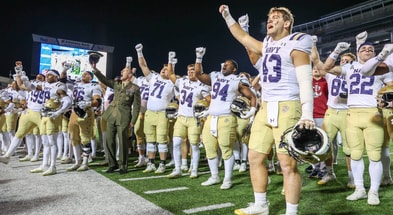
Finally, Navy needs to keep their composure. For whatever reason, Army has made a point to try to get into opponents’ heads this season, to put it charitably. We saw reports from the Air Force and UTSA games about pregame and postgame antics, and even here, you can see the team out onto the field taunting Air Force as they ran out of the tunnel:
The Mids will need to tune that stuff out and stay focused on doing their jobs. As Coach Newberry says, play with emotion, but don’t let emotion play with you.
Over the last decade, we’ve seen Navy football seasons that some would have argued were impossible just 20-30 years ago. We’ve had double-digit wins, national rankings, award-winning players, broken records, incredible wins… You name it. This season ranks right there with the best of them, especially knowing how high a hill there was to climb from the 2020-2023 doldrums. But there is one accomplishment yet to be achieved before we can call this team one of the all-time greats: beating Army. Here’s hoping this group that has given so much over the last four years can put it all together on the biggest stage of all.