The Notre Dame Debrief
There were parts of last weekend that were perfect. It was cold and overcast when I arrived in South Bend, which is exactly what you want to set the scene for an old-school football game at an old-school venue. There was snow in the forecast as well; it might have made travel dicey, but it just felt fitting for the moment. I had come up from Florida, so seeing fall foliage for me was like visiting another planet. This is what November football at Notre Dame is supposed to feel like.
Sadly, though, vibes don’t win football games. But you know what does? Notre Dame. Notre Dame wins football games.
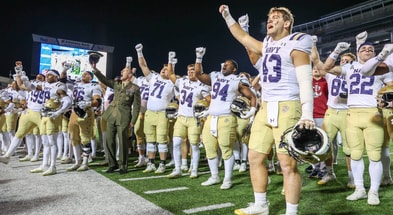
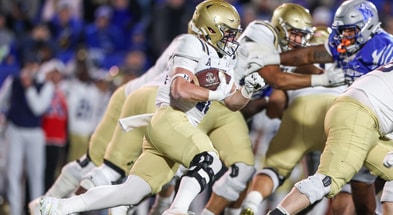
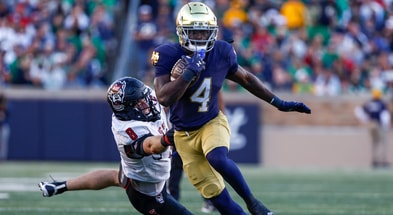
A competitive game turned ugly in the third quarter, as the Irish scored three touchdowns in the span of seven minutes to take a 42-10 lead that eventually turned into a 49-10 final. The Mids had 173 yards of offense in the first half, averaging 5.7 yards per rush. In the second half, those numbers dropped to 55 and 2.9, respectively. Notre Dame, on the other hand, was solid throughout. The Irish ran for 249 yards, while quarterback C.J. Carr was 13-16 for 218 yards and three touchdowns.
It was a tough pill to swallow for Navy, who were looking to redeem themselves after suffering their first loss of the season. And there are certainly things the Mids could be criticized for. But overall, I think the bigger story here is just how good Notre Dame has become under Marcus Freeman. I don’t mean that they are more talented than before, necessarily; they’ve always had great players. At any given moment, there are a dozen or more future NFLers on their roster. But Notre Dame stands out even among the college football elite in how well-coached they are. The Irish don’t take as many transfers as most teams; they only brought in eight this season. For the most part, they develop the talent they have, and it is evident on the field.
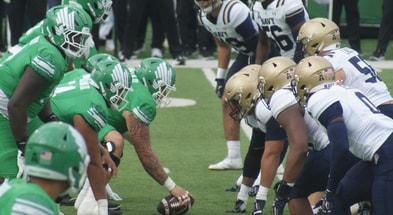
First, let’s examine Notre Dame’s defensive game plan. Over the last two years, the Irish changed defensive fronts on almost every play, sometimes shifting in response to Navy’s own pre-snap movement. Last year, they used a 6-man front, a 5-man front, and an 8-man front. They similar things this year, although they stuck with the 5- and 8-man fronts for the most part. The fourth “linebacker” in the latter was a safety brought down to the second level. The plans in both cases were essentially the same. One inside linebacker would shoot the play side B gap. The other would follow the direction of the motion/play. The deep safety in a 4-4 would play the pitch man. Sometimes, but not always, another defender would rotate to play the deep middle. In practice, it looked like this:
This is a fairly common look that we see from Navy opponents, and it’s one that the Mids have been successful against in the past. They responded in two ways. First, they just used power, both from the quarterback and the fullback. The goal is to outnumber the defense at the point of attack before the extra defenders can rotate over.
Navy also ran a variation of this where they motioned to the same look, but instead ran inside zone as a way to cut behind the shifting defenders.
Other than running power and its variants, the other thing Navy did, unsurprisingly, was run counters and misdirection. They would run the power read to have the quarterback cut behind defenders running outside. They also motioned in one direction while carrying the ball in the opposite direction.
The defense hesitated when they had to think about where the ball was going, so the Mids could get blockers in front of them and hit the perimeter.
And then the cycle would begin again.
On the chalkboard, Navy had plenty of answers. But Saturday’s game was a great demonstration of how games are won on the field with players who execute, not in a diagram with a dry-erase marker.
The difference for Notre Dame defensively was in how their players were taught to stop the option on an individual level. One way they did this was by muddying blockers’ paths as they tried to climb to the next level. Let’s take another look at the first play I showed. On this play, the tight end is supposed to get outside to block the safety, but the cornerback nagged him every step of the way. The play only succeeded because the corner also happened to be the pitch read.
The Mids weren’t so fortunate elsewhere. Here are two examples. The first is a midline option where the defensive end occupies the guard to keep him from getting to the backside linebacker. The second play is a counter option, with the center pulling instead of the backside guard. The center is closer to the defensive end, so in theory, he should have a better chance of getting outside leverage on him. But the DE doesn’t let that happen, which strings out the play. Alex Tecza would normally block the scraping linebacker, but he never sees him coming because of the work of the DE.
There are plenty of other examples of good individual effort on Notre Dame’s part. Sometimes Navy can get a numbers advantage on the perimeter with a two-for-one block. If the secondary is in man coverage, you can send a tight end or split end to block an interior defender, and the defensive back covering him will follow, meaning you account for two defenders with one player. When it works, it looks like this:
But it didn’t work very often. Notre Dame backed off their DBs to give them a chance to read and react to the play.
On this play, the Mids tried to run a fullback trap, which you’d expect after running so much counter option. But the defensive end didn’t squat; he played the fullback immediately. The pulling guard never had a chance.
Here’s a fullback trap where the defensive end did squat, but the outside linebacker wasn’t fooled by the counter motion:
Here’s the cornerback doing a tremendous job against Navy’s quarterback power, shooting the gap at the snap and making a play from behind:
The fatal blow came in the third quarter when the offense failed to convert on fourth down from its own 33-yard line. The Mids ran the power play again, but Eli Heidenreich didn’t block the backside ILB, who ended up making the stop.
You could argue that it was just bad luck, but I would say that it was more the result of Notre Dame’s aggression, and maybe Navy drawing from that well one too many times. Heidenreich had to duck inside the playside ILB to get to his assignment, but that knocked him off his path.
While I don’t think that this was a missed assignment on Heidenreich’s part, there were other errors from the Mids. On this play, the left tackle appears to… Well, I don’t know. Braxton Woodson is tackled by the deep safety, which leads me to think that the assignment here was an outside release to that safety. Instead, he takes a knee as if he’s looking back for the play, but the ball is snapped, and he sort of stumbles into the defensive end.
I might be wrong on the assignment, but I am confident it wasn’t supposed to look like that.
Defensively, I think the numbers don’t tell the whole story for the Mids. It was clear from the outset that the plan was to stop the run first and foremost, and they did a commendable job of it. Notre Dame only had 58 rushing yards in the first half. Brian Newberry said before the game that his team would “swing the bat,” and the defense certainly didn’t hold back. The Mids often brought the safeties up in run support, leaving the corners in single coverage.
On the first drive, the Mids stopped Jeremiyah Love for no gain on his first two carries. Then Notre Dame completed passes of 27 and 52 yards, ultimately leading to a touchdown. But the Mids forced a three-and-out on their second series, giving the offense a chance to respond with a touchdown of their own and tie the game. After that, Notre Dame started to mix up their playcalling a bit more, throwing more often on first down and keeping the defense guessing. Once that happened, the Irish fell into a rhythm.
I’ve seen numerous comments from fans expressing dissatisfaction with the secondary, and it’s fair to a point. Justin Ross had a rough day. The coaches share part of the blame for the frustration, as they were unusually effusive in their praise for the cornerbacks before the season. I think it led people to forget that these guys are only sophomores. Physically, they’re everything you want in a defensive back, but they are still learning the finer points of the position. Ross was able to stay with his receiver for the most part, but he got called for pass interference penalties that could have easily been interceptions if he had just turned around. That’s easier said than done, though; knowing when to turn around is a skill that has to be developed, because turning around also slows you down. You don’t want to do it too early. I’d argue that fans need to be patient, but we know how likely that is.
Regardless, I don’t think coverage was a bigger issue than the lack of pressure on Carr. The whole point of leaving the DBs in single coverage was to bring more pass rushers after the quarterback. If Carr had to rush his throws in the pocket, he would’ve had a chance to get the ball downfield. Instead, he was never seriously threatened. Notre Dame’s offensive line did a tremendous job handling Navy’s pass rush.
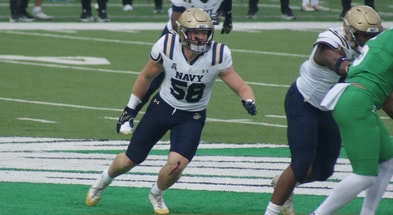
In fact, there were elements of the Navy secondary that I was encouraged by. Phillip Hamilton looks more and more comfortable at safety. He’s not the biggest DB in the world, but when you see him willing to make plays at the line of scrimmage like this:
…it bodes well for the Mids, especially with the Army game on the horizon.
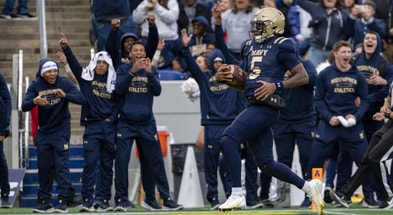
Another silver lining to this dark cloud of a game was the play of Braxton Woodson. This was one of those games where the struggles elsewhere in the offense made it look like the quarterback was having trouble making his reads. But Woodson ran the show pretty well, I thought. I’m not sure if anything was held back in playcalling with him in the game, but it didn’t seem that way to me. In what he was asked to do, I thought Woodson looked pretty good, and he was the first 100-yard rusher that Notre Dame has allowed this year.
His passing game was frustrating. He seems to struggle on shorter routes and slants, but then he’ll deliver a perfect 15-yard out from the far hash, like this:
Once he finds the consistency to match his arm strength, look out.
That brings up another issue in the game, and that was Navy’s general inability to pass. Notre Dame doesn’t have many flaws, but they do give up a lot of yards through the air. The Mids were never able to take advantage of that, which was frustrating considering how often the defense lined up with a single deep safety. Part of the reason for that was the Irish pass rush; Woodson did have some effective scrambles, but he rarely had time to look downfield. When a defense lines up the way Notre Dame often did, the Mids have to find ways to make them pay.
Overall, as frustrating as the game was, one should probably keep in mind that Notre Dame played for a national championship last year. While you don’t want to lean too heavily on the “we have to play a perfect game to beat them” talk, the margin for error is slim. Fortunately, the game was mostly just for pride; the Mids still have their conference race in front of them. With any luck, the painful lessons learned in South Bend can be applied to the team’s larger goals.