
The Mid Report Football
The UAB Preview
One of the things I’ve always appreciated about the American is that when it comes to membership, the conference has tried hard to maintain an identity.
Conferences originally formed in the primordial days of college sports, when regulations were both few and loosely defined. Like-minded schools within a region came together to agree on a set of rules and to create championships to play for. Last weekend, Rutgers and USC played a league game against one another, which is all the evidence you need to know that “regional” and “like-minded” are no longer priorities.
Instead, today’s primary motivation is shared commercial interests. For the privileged few, that means seeking out popular brand names to assemble an appealing television product and to gain leverage for shaping the future of college sports. For everyone else, it’s a fight for survival.
Most conferences, after they’ve had members plucked away, make the immediate, pragmatic, and more obvious choice. When selecting replacements, they look for whatever programs are available that have had the most success in recent years, preferably– but not always– within the same geographic footprint to help with travel costs. Those are the choices that need no explanation; they make sense to the sports media and keep Twitter off your back. If perception is your primary concern– and it is a valid one– then inviting the winning program du jour makes perfect sense.
But the American still values like-minded institutions. After the initial idea of a coast-to-coast “best of the rest” conference ended up being too cumbersome, the league focused primarily on large, urban state schools wanting to carve out a unique identity by associating closely to the cities they serve. These schools use sports as part of a broad strategic vision to shed commuter-school perceptions and create connections with alumni, residents, businesses, and prospective students throughout a metro area. It makes them motivated to invest in their athletic departments, and that motivation for investment is what the American wants in its members. Even the American’s private schools, while they have different institutional goals, have stressed their city-first identities.
That doesn’t mean the American isn’t as interested in making money as every other league; they absolutely are. But the conference sees institutional alignment as a means to that end, along with bringing other benefits. So when it has needed to replace departed members, the American has sought out colleges that fit into the same institutional vision, even if their football programs’ recent histories are spotty.
In that sense, UAB was the best of both worlds when the American announced their invitation back in 2021. On an institutional level, they had completed a billion-dollar fundraising campaign, increased on-campus housing by 53%, and saw an explosion of research funding (especially at their medical school), all in the preceding decade. But they were also enjoying on-field success. After the football program was reinstated in 2017, they had six consecutive winning seasons. They played in three Conference-USA championship games, winning two of them. In 2021, the program moved into a new $200 million stadium. UAB would have been a good fit for the American even if the conference didn’t need to replace any departures.
But the good times came to a sudden end when beloved head coach Bill Clark, who had stayed with the school to fight for football’s reinstatement after it was cut in 2014, suddenly retired before the 2022 season. After a year under interim Bryant Vincent, the school made the curious decision to hire Trent Dilfer to lead the program.
A few years ago, there was a micro-trend of former NFL players getting Division I head coaching jobs without any other college coaching experience. Ed McCaffrey was an early example, hired by Northern Colorado in 2019 after winning a state championship coaching high school football. Deion Sanders was the most famous and successful example at Jackson State, who hired him in 2020. Tennessee State brought in Eddie George in 2021. Dilfer is part of the same trend. While he had been successful as a high school head coach, UAB’s AD at the time, Mark Ingram, made it clear that Dilfer’s high school experience was a footnote compared to the rest of his resume.
“I’m not hiring a high school football coach,” Ingram said. “I’m hiring the No. 6 pick in the NFL draft. A guy who spent 14 years playing quarterback at the highest level. I’m hiring a guy that’s a pro bowler who was a starting quarterback on a Super Bowl championship team. A guy who spent nine years with ESPN doing analytics, commentary, and draft coverage. A guy who’s the head coach of the nation’s premier passing academy, Elite 11, and has coached countless college and NFL quarterbacks.”
The theme there is not subtle: Dilfer was hired to essentially be a quarterback whisperer. It was an interesting strategy for the transfer portal era. Could Dilfer’s background make his program the destination for quarterbacks looking to hone their craft, whether out of high school or from the portal? It worked for Sanders when he persuaded fellow cornerback Travis Hunter— the nation’s top recruit– to play for him. Granted, the name-brand cachet and celebrity appeal of Sanders is at a much different level, but Dilfer had been far more hands-on with grassroots player development. That had to be worth something. So if Jackson State could do it, why not UAB?
Well, there was at least one reason, apparently, because it didn’t happen. NIL probably had something to do with it; the bird in hand of NIL makes preparing for uncertain NFL opportunities less of a priority for players. But whatever factors were involved, one wonders if the attempt needed to be made in the first place.
There are arguments one can make in favor of unconventional coaching hires, especially at programs that haven’t had much historical success or those lacking resources. But at the time of Dilfer’s hiring, that wasn’t the case at UAB. Clark had built a winner, but rather than leaning into what was working, Ingram attempted to fix what wasn’t broken.
Admittedly, all of this is overkill for a game preview. But I bring it up because it sets the stage for this year’s Blazers.
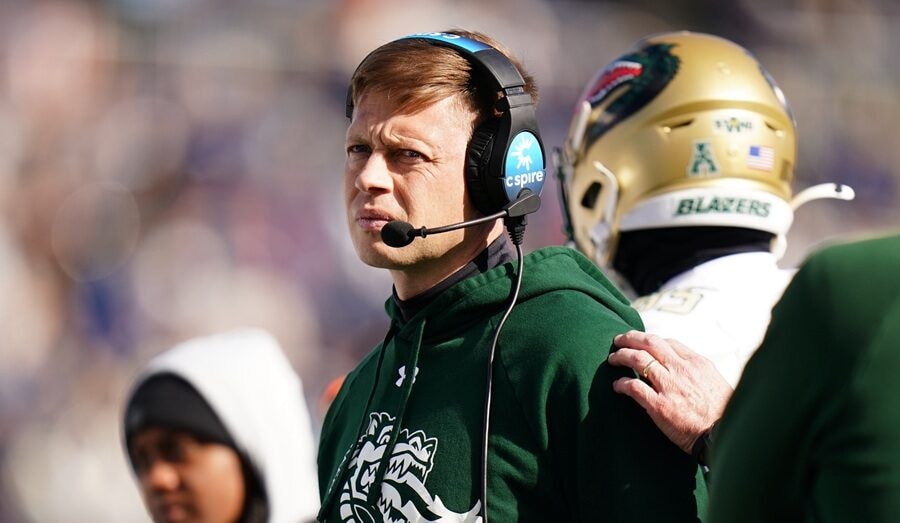
UAB’s new head coach is Alex Mortensen, Dilfer’s former offensive coordinator. On the surface, it seems like a strange hire; Dilfer was an offense guy, and hiring the fired offense guy’s offense guy is a bit counterintuitive. But when you look at Mortensen’s results as interim head coach last year, you can see the appeal. While the program wasn’t suddenly reborn in the second half of the season, their two best performances happened under Mortensen’s watch: a 31-24 upset of Memphis in his first game, and a season-ending win at Tulsa by the same score. At least in those moments, Mortensen had the Blazers showing what they were capable of. The trick now is figuring out how to get that kind of performance every week.
If the Dilfer experiment was about trying to attract top talent to Birmingham, then the Mortensen era is about maximizing the talent they can actually get. In the coaching search, UAB showed interest in Navy’s Drew Cronic, which provides an interesting lens through which to view the current team. Navy fans know what their offensive coordinator is all about: culture, player development, and a run-first offense. That may be an indication of the vision UAB has for its football program and explain a lot about the team the Mids will face on Friday night.
We’ve talked a lot about the advantages that come from being a developmental program in the transfer portal era. But the player retention necessary for development is easier said than done. Schools with large NIL war chests overcome this by just acquiring the best talent money can buy. Everyone else needs a different strategy. For UAB, which has only three returning starters from last year, it means targeting players in the portal who already have extensive playing experience. Those players may sometimes come from FCS or even Division II programs, but the thinking is that playing experience indicates a level of earned coach trust and maximized development.
This creates an unusual dynamic. Defensively, UAB has only one returning starter. But in terms of career snaps played, they are the most experienced defense in the country. In contrast, Navy is 134th out of 138 (as a whole team) by that same metric. In Navy’s case, that isn’t unexpected; part of being a developmental program means that you often have guys who don’t start until they’re seniors. But it makes Friday’s game a fascinating case study: can UAB’s attempt to reverse engineer culture and development match up with Navy’s genuine article?
With that question in mind, Mortensen’s choice to lead his defense makes a lot of sense. Todd Grantham, a 36-year coaching veteran who has called defenses everywhere from the SEC to the Cleveland Browns, now does the same for UAB. If you need to build an entirely new defense around a group of players with playing experience in a number of different systems, it helps to have someone who has seen everything.
It also helps to value versatility. If you’re rebuilding a defense through the portal, you aren’t necessarily going to find the ideal player for every position in your system. You need to identify players who can contribute and figure out how to use them effectively. On paper, Grantham’s defense is a 4-2-5, but that doesn’t tell the full story. He uses multiple hybrid positions, which allows him to find the right fits for those players and create the matchups he wants against the offenses they face.
This sets up a few challenges for the Mids. Structurally, UAB looks a lot like Florida Atlantic, who also is a 4-2-5 on paper but lined up more in a 4-3 against Navy. Also like FAU, the Blazers have a tackling machine at linebacker. Muaaz Byard is a 6-2, 230-lb redshirt senior who spent the last two seasons at Middle Tennessee State, where he appeared in 20 games. He is second in the conference and 10th nationally in tackles per game, with 10. One of the keys to Navy’s offense is to get linebackers following misdirection as a way to open up running lanes. Byard’s production suggests that he doesn’t get fooled very often, which could make explosive runs difficult to come by for the Mids.
That production might also be a nod to who lines up in front of him. UAB is very big along the defensive line. Starting nose tackle Cam Cunningham is 6-1, 325. At the other defensive tackle spot is the 6-5, 290-lb Chris Spencer and all 6-3, 330 lbs of Nigel Tate (although the latter has some injury questions). At center, Navy’s Toran Smith has played well, but is relatively undersized at 6-2, 277. All the offensive linemen have cross-trained, and Cam Nichols is a bigger body with experience at center. I wouldn’t be surprised to see some shuffling up front for the Mids. Either way, the fight to get movement in the trenches will be a game within the game to keep an eye on.
Another thing that stands out about UAB’s defense is their length in the secondary, with all five starting defensive backs measuring six feet or taller. If what we saw against FAU is the blueprint for defenses facing Navy this year, that could mean a lot of man coverage. The Mids aren’t undersized at their receiver positions other than Snipe A, but it’s still not a situation where you want the passing game to come down to 50/50 balls. Navy will have to do a better job of getting open one-on-one than they did in the last game.
UAB has a slightly different approach on the other side of the ball. Turnover is still an issue, with only two offensive starters returning. And like the defense, there are transfers with playing experience. Running back Bam McReynolds started nine games at ULM last year. Receiver Ty Mims twice led Southern Miss in receptions. But unlike the defense, there isn’t as much emphasis on previous experience with the offense. That makes sense, since Mortensen has players who learned his system last year, even if they weren’t starters. His approach, then, has been to evaluate what his returning players do best, then find players in the portal who match and complement that skill set.
When Mortensen looked over his roster this year, he saw an offensive line averaging 319 pounds and a returning quarterback who was very efficient underneath, but only completed 38.6 percent of throws greater than 10 yards downfield. And that is a great formula for running the football.
If you want to improve your team in a hurry, running the ball is a great way to do it. If you’re effective, you’ll make the entire team better. Your defense will improve because you can control the clock and keep them off the field. A good run game takes pressure off of your quarterback and opens up play action. You’ll be better on first down, which in turn makes you better on third down. You’ll have more ways to finish drives, which will improve red zone performance. There is a reason why so many coaches adhere to a mantra of “run the damn ball.”
And this year, UAB is doing everything they can to make that their calling card. They ran for 190 yards against Illinois and 266 against ULM. Last week, they hit a snag at Louisiana and were held to only 74 yards on 31 attempts. Even in defeat, though, the intent is clear. Through three games, UAB has run the ball on nearly two-thirds of their plays. Compare that to last year, when they passed 52.5% of the time. But even then, it was the running game that was the biggest factor in UAB’s success. Three of their four wins came in the Blazers’ three best rushing performances, including a 219-yard outing against Memphis. UAB wants to establish their new identity around what has already been proven to succeed.
Schematically, UAB does not hide their intent. Of their 124 runs this season, 38 percent have been between the tackles. When they run outside, it’s usually behind a tight end. In an era where spread offenses are the rage, UAB is more than happy to line up under center with 12 personnel. Their most prolific tailback is Georgia transfer Rod Robinson II, who has 225 yards on 48 carries. McReynolds and Coastal Carolina transfer Ja’Vin Simpkins also share the load. Quarterback Ryder Burton will get 8-10 scrambles per game. Robinson and McReynolds split most of the carries, which helps to reduce their wear and tear in an offense that runs 43 times per game.
The question is how all this translates to Friday night. On the one hand, UAB is trying to establish an identity, and running the ball is what they do. On the other hand, Navy is dead last in the country in pass efficiency defense. Sure, it’s a small sample size, but if you’re looking for something to attack, you can’t ignore it. So how do you balance staying true to yourself while taking advantage of your opponents’ weaknesses?
Last year’s game might offer up some clues. It was tied 24-24 at the half before the Mids pulled away for a 38-24 victory. For a while, UAB’s offense could do no wrong. The Blazers averaged 10.1 yards per play and almost five yards per carry on the ground. Jalen Kitna was 11-13 for 205 yards and two touchdowns. UAB was 4-6 on third down and 1-1 on fourth down. But in the second half, UAB was limited to only 24 rushing yards on 1.8 yards per carry, and everything else fell apart. We’re all familiar with Brian Newberry‘s “Get 6” standard for the Navy defense, which requires a combination of six three-and-outs, fourth-down stops, and/or turnovers. The Mids got all six in UAB’s six second-half possessions.
The lesson here is that even with last year’s more downfield-oriented UAB offense, running the ball had to come first. The same will almost certainly be true this week.
If that’s the case, then this could be a short game. Two ball-control teams usually mean limited possessions, which puts an emphasis on efficiency. UAB gives up a lot of rushing yards: 192 per game and 4.72 per carry. But they don’t give up a lot of explosive plays, allowing only six plays of 20+ yards through three games. Can the Mids put together extended drives? Can they do it with Jackson Gutierrez at quarterback? UAB wants to run the ball, but that means they also want to stay on schedule. How often can they risk an incompletion leading to second and long or third and long? The Blazers also give up more than 7 tackles for loss per game. They’ve allowed seven sacks, which is bad, but it’s worse when you consider that they’ve only thrown 74 passes. Their 8.64% sack rate is 121st in the country. How much can UAB afford to roll the dice?
That’s a lot of questions, and with neither team having many data points, the answers aren’t readily apparent. But they need to be found quickly. After laying an egg their last time out, the Mids want to prove that the real Navy team has yet to stand up. A solid performance here would go a long way toward putting the FAU game behind them as they gear up for the rest of the season.
RECOMMENDATIONS
Curated by editors


More The Mid Report News
The Towson Debrief
Navy vs Towson - Game Photos Part 2
Navy vs Towson - Game Photo Gallery, Part 1

College Football Bowl Projections Week 2: Full list of matchups, playoff predictions
Discuss This Article
Join the conversation and talk about this article and all things The Mid Report in the The Gouge.
The Gouge