A program that has spent several years recruiting specifically for a traditional Air Raid offense can have a harder time transitioning to another offensive system than a program running a more balanced offense. The difficulty depends heavily on what offense replaces it.
Mississippi State’s transition away from Mike Leach’s Air Raid in 2023 is a particularly good example.
Why the Air Raid can be difficult to transition away from
The Air Raid doesn’t just change play-calling. Over several recruiting cycles, it changes the composition of your roster, the skills players develop, and even how your offensive linemen are trained.
| Position | Traditional Air Raid emphasis | Potential transition problem |
| Quarterback | Quick decisions, accuracy, processing coverage | May lack experience with under-center snaps, play-action and more complex run-game responsibilities |
| Offensive line | Pass protection, wide splits, limited run concepts | Must learn additional run-blocking schemes and different physical techniques |
| Running back | Pass protection, receiving, running from shotgun | May need to develop more traditional rushing skills |
| Wide receiver | High-volume passing, spacing, option routes | Generally transferable, but blocking and new route responsibilities can be challenging |
| Tight end | Often rarely used as a traditional position | May require recruiting an entirely new position group |
The biggest challenges are usually offensive line development, quarterback fit and tight end personnel.
Not all transitions are equally difficult
Air Raid → Spread passing offense
Easier
A system retaining shotgun formations, multiple receivers, quick passing and spread concepts can use much of the existing roster.
Air Raid → Balanced spread
Moderate
A balanced attack using zone runs, RPOs, play-action and some tight ends requires new skills but preserves substantial roster compatibility.
Air Raid → Pro-style, run-heavy offense
Harder
A system relying on tight ends, heavier formations, under-center snaps and a physical running game can require significant personnel changes.
Mississippi State is a case study
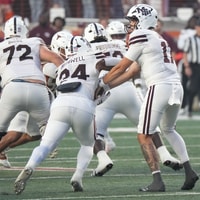
When Zach Arnett hired Kevin Barbay in 2023, Mississippi State moved from Leach’s unusually pass-heavy offense toward a system emphasizing rushing and play-action.
Barbay acknowledged the learning curve during spring practice. The changes included narrowing offensive line splits, introducing tight ends and teaching quarterbacks to operate under center. Mississippi State +1
The problem wasn’t necessarily that Mississippi State had bad players. It was that the returning players had spent years developing skills for a fundamentally different approach.
Will Rogers, for instance, was an extremely experienced Air Raid quarterback, but much of that experience didn’t directly prepare him for Barbay’s system.
That transition was made more difficult by the fact that SEC opponents offered little room for growing pains.
How long should a transition take?
These are reasonable planning estimates, not fixed rules.
| Time | What a program can realistically accomplish |
| First offseason | Install the new offense and identify personnel gaps |
| Year 1 | Operate a hybrid offense while teaching new techniques |
| Year 2 | Add portal players and recruits better suited to the system |
| Year 3 | Establish a roster substantially aligned with the new philosophy |
The transfer portal can compress this timeline, particularly at quarterback and tight end. Offensive line development is generally harder to accelerate.
What this means for Mississippi State going forward
There’s an important distinction between Mike Leach’s traditional Air Raid and Jeff Lebby’s version of the spread offense.
Lebby’s offense incorporates Air Raid passing concepts but places considerably more emphasis on tempo, the running game, RPOs and explosive downfield passing.
That creates two strategic considerations:
1. The roster is not as specialized as a traditional Leach roster. Players recruited for Lebby’s offense should generally be capable of transitioning to a variety of modern spread offenses without a complete rebuild.
2. Transitioning to a traditional, run-heavy offense would still be costly. The next coach might need different offensive linemen, additional tight ends and a quarterback with a different skill set.
My assessment
For a program like Mississippi State, which faces structural recruiting disadvantages against the SEC’s wealthiest programs, offensive continuity has real strategic value.
A successful distinctive offense can allow State to recruit players who are undervalued by programs running different systems. But that advantage comes with a cost: the more specialized your roster becomes, the fewer coaching candidates can take over without considerable disruption.
That doesn’t mean Mississippi State should be permanently committed to the Air Raid.
It means that when selecting a new coach, the cost of transitioning the existing roster should be an important part of the hiring decision, alongside the coach’s overall quality.
In fact, I’d argue that Mississippi State’s 2023 experience illustrates a broader problem: abruptly abandoning a specialized offense can erase years of accumulated player development before the replacement system has the personnel to succeed.