Its just something I find interesting because the consensus with very good teams that play in weak conferences is just that.........they are very good because they played in those conferences but you can see from the article just because you play in a weak conference doesn't mean you can't be good.......or well very good.
Anyways I just thought it was an interesting read and thought some others would also enjoy it.
Dec 23, 2025
Gonzaga concluded its non-conference slate with a fairly comfortable 91-82 win over Oregon at the Moda Center in Portland on Sunday. They racked up a sublime 1.34 points per possession, the tenth-most that Oregon has given up over the past 30 seasons. The Zags are now 12-1 with all but four of those games against power-conference opponents. Their only loss was against Michigan, who hasn’t lost yet and doesn’t look like it will any time soon.
It’s going to be another rough year for the Gonzaga-haters, who were giddy heading into the season as national media forecasted a down year for the program. Barring something unforeseen - and fair warning, haters, my ratings give them a 35% chance of going unbeaten through the WCC schedule with an expected record of 17-1 - Gonzaga will enter the NCAA tournament at worst a two-seed.
By March, the haters will again talk about how weak the WCC is and that the lack of competition inflates Gonzaga’s numbers. If they played in a power conference, the haters say, you’d see that Gonzaga crumble. The thing is, Gonzaga is in a power conference in November and December. And as we detailed in a 2022 investigation, their performance against power-conference teams was better than any other power conference team from 2017 to 2022. But we should update this now that we have an even ten seasons of data to work with.
So here are the teams with the best winning percentage against power-conference teams since the 2017 season:
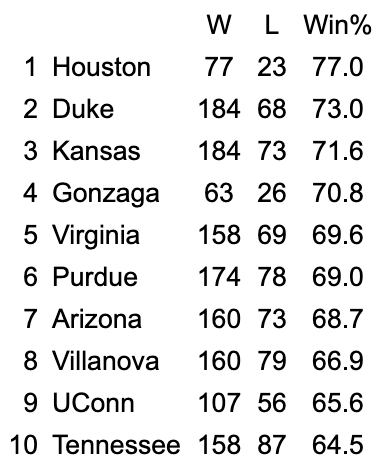
These are tough times for Gonzaga as they’ve slipped to fourth overall. But being ranked behind Houston, Duke, and Kansas is nothing to be ashamed of. And this list serves as a pretty good summary of the top teams in the game over the past decade. Gonzaga is there. They belong, and even the haters must know this.
When I wrote that piece in 2022, the main pushback was that Gonzaga’s record against power conference teams wouldn’t hold up if they actually played in a power league and had to battle these teams twice a week. I even had a power-conference head coach with Final Four experience tell me this.
But Houston has become an instructive counterexample to this line of thinking. With similar criticisms of “gaming the system” against weaker opponents, the Cougars joined the Big 12 two seasons ago. After starting their Big 12 tenure 1-2 and inviting skeptics to feel vindicated that it wasn’t so easy for an outsider to play in a power league, Houston has gone 38-3 in their last 41 games against Big 12 opponents (including conference tournament play).
I’ll leave it as an exercise for the reader to find a more dominant 41-game run in a power conference. And the Big 12 isn’t just an average power conference: It ranked as the top conference in 2024 and the third-best league last season. The only system Houston was gaming was being better than almost everyone else. It didn’t matter whether there was a Big 12 logo on their court or not.
Gonzaga-haters tend to be the stubborn type, so they’ll still assume that the Zags would collapse under the weight of having to play two games against power conference teams every week. But while they’re wondering about that, maybe they should also wonder what Kansas or Duke’s winning percentage would be if they had to play Gonzaga’s power-conference schedule. Because, as I pointed out in that 2022 piece, Gonzaga does not get the luxury of playing DePaul or Boston College or whoever the weakest team in a league happens to be in any given year like Kansas and Duke do.
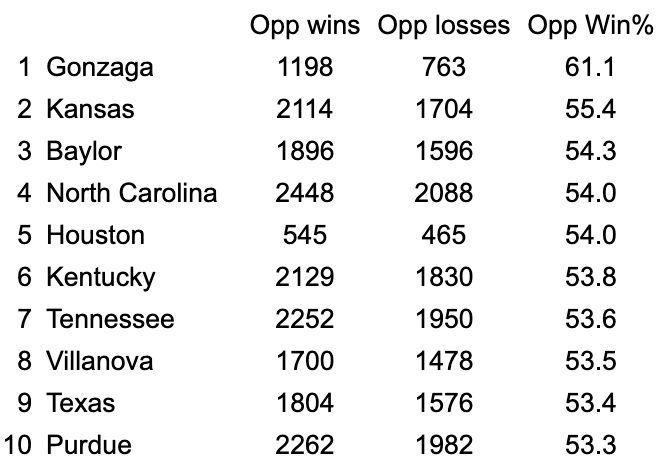
This season, the weakest power-conference team Gonzaga has played is probably Arizona State. But given that it was a true road game, there’s a chance it could still be a Quad 1 game at the end of the season. One fairly simple and transparent way to measure strength of schedule is to look at their power-conference opponents’ winning percentage against other power-conference teams (excluding games against the team itself). And this paints an interesting picture.
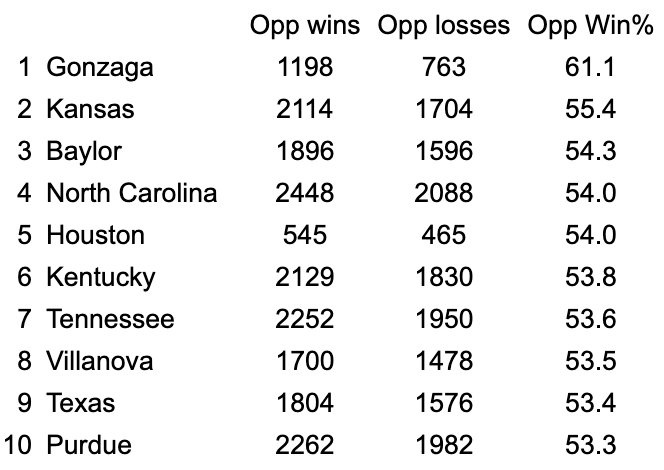
Ranking these teams from one to ten is a terrible way to present this information because Gonzaga dominates this category in a way that few statistical categories have been dominated. #2 Kansas is actually closer to #59 Rutgers in this measure than they are to Gonzaga. (There are only 82 teams in this dataset.)
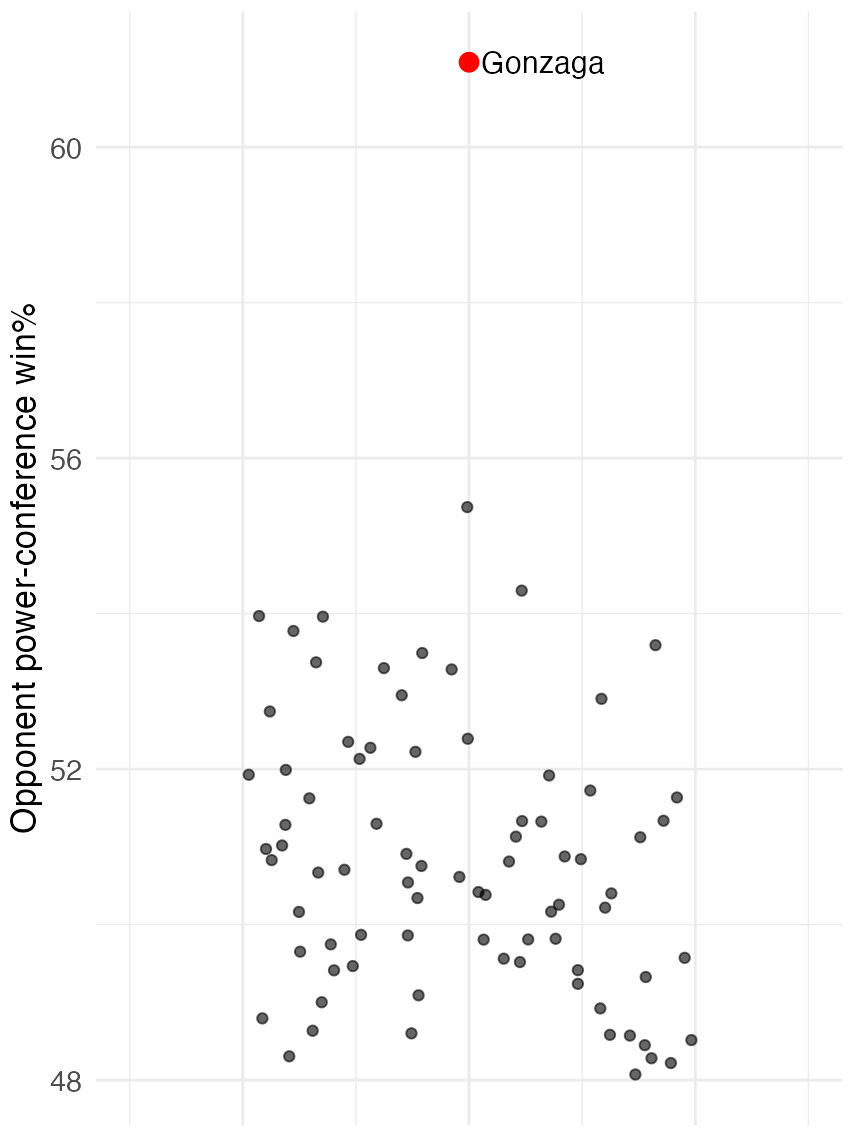
This is the kind of thing that looks better in graphical form. So let’s do it:
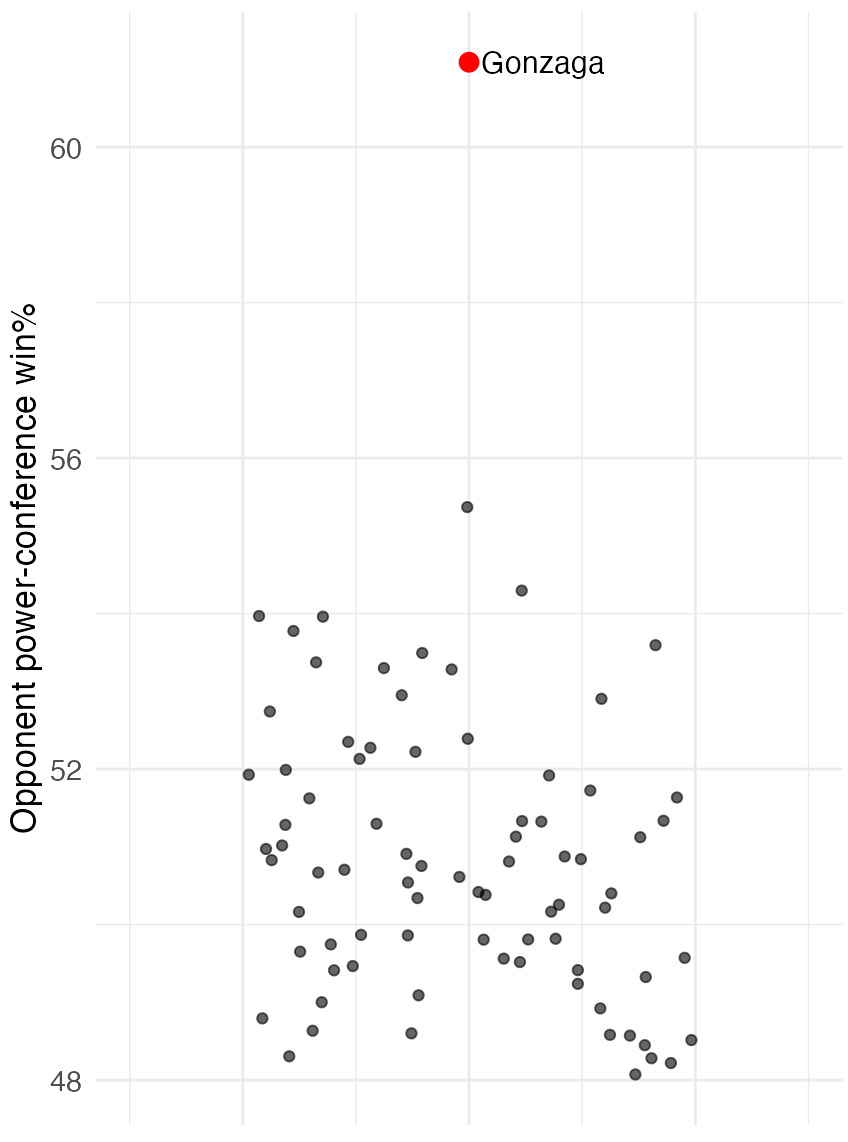
I’m kind of sticking it to Gonzaga-haters in this plot because not shown here is SMU. They easily have the worst strength of schedule, with their power-conference opponents over the past decade winning just 44.1% of their games against other power-conference teams. The Mustangs spent much of their pre-ACC tenure cherrypicking weaker power-conference teams. But that’s the only liberty I took. Every other P5/6 team is represented on the plot and Gonzaga’s strength of schedule has been in a different orbit.
Look, there was a time when hating on the Zags was a legitimate enterprise. I remember the aughts and there were some overrated Gonzaga teams in there. I was with you. But now, man, you need to grow up and face reality. Gonzaga is just legitimately very good, year in and year out.
It’s unfortunate that they won’t be joining a power conference any time soon to prove the haters wrong like Houston did. In moving to the reborn Pac-12 next season, Gonzaga goes to a league that is probably a bit better than the Mountain West. But with four of its future nine members currently outside the top 150, it’s nowhere near where the old Pac-12 was upon its death, and even that league was struggling to maintain relevance. Nonetheless, Gonzaga is on a ridiculous run. Hopefully, someday they’ll find a league worthy of them.
Anyways I just thought it was an interesting read and thought some others would also enjoy it.
It's another disastrous season for Gonzaga haters
Ken PomeroyDec 23, 2025
Gonzaga concluded its non-conference slate with a fairly comfortable 91-82 win over Oregon at the Moda Center in Portland on Sunday. They racked up a sublime 1.34 points per possession, the tenth-most that Oregon has given up over the past 30 seasons. The Zags are now 12-1 with all but four of those games against power-conference opponents. Their only loss was against Michigan, who hasn’t lost yet and doesn’t look like it will any time soon.
It’s going to be another rough year for the Gonzaga-haters, who were giddy heading into the season as national media forecasted a down year for the program. Barring something unforeseen - and fair warning, haters, my ratings give them a 35% chance of going unbeaten through the WCC schedule with an expected record of 17-1 - Gonzaga will enter the NCAA tournament at worst a two-seed.
By March, the haters will again talk about how weak the WCC is and that the lack of competition inflates Gonzaga’s numbers. If they played in a power conference, the haters say, you’d see that Gonzaga crumble. The thing is, Gonzaga is in a power conference in November and December. And as we detailed in a 2022 investigation, their performance against power-conference teams was better than any other power conference team from 2017 to 2022. But we should update this now that we have an even ten seasons of data to work with.
So here are the teams with the best winning percentage against power-conference teams since the 2017 season:
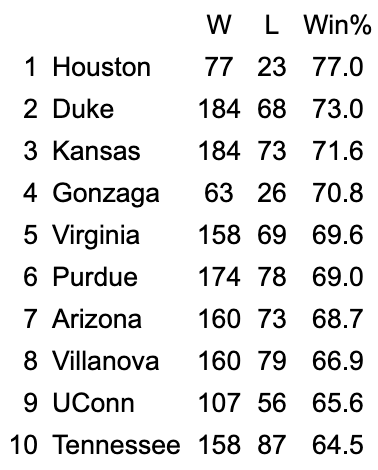
These are tough times for Gonzaga as they’ve slipped to fourth overall. But being ranked behind Houston, Duke, and Kansas is nothing to be ashamed of. And this list serves as a pretty good summary of the top teams in the game over the past decade. Gonzaga is there. They belong, and even the haters must know this.
When I wrote that piece in 2022, the main pushback was that Gonzaga’s record against power conference teams wouldn’t hold up if they actually played in a power league and had to battle these teams twice a week. I even had a power-conference head coach with Final Four experience tell me this.
But Houston has become an instructive counterexample to this line of thinking. With similar criticisms of “gaming the system” against weaker opponents, the Cougars joined the Big 12 two seasons ago. After starting their Big 12 tenure 1-2 and inviting skeptics to feel vindicated that it wasn’t so easy for an outsider to play in a power league, Houston has gone 38-3 in their last 41 games against Big 12 opponents (including conference tournament play).
I’ll leave it as an exercise for the reader to find a more dominant 41-game run in a power conference. And the Big 12 isn’t just an average power conference: It ranked as the top conference in 2024 and the third-best league last season. The only system Houston was gaming was being better than almost everyone else. It didn’t matter whether there was a Big 12 logo on their court or not.
Gonzaga-haters tend to be the stubborn type, so they’ll still assume that the Zags would collapse under the weight of having to play two games against power conference teams every week. But while they’re wondering about that, maybe they should also wonder what Kansas or Duke’s winning percentage would be if they had to play Gonzaga’s power-conference schedule. Because, as I pointed out in that 2022 piece, Gonzaga does not get the luxury of playing DePaul or Boston College or whoever the weakest team in a league happens to be in any given year like Kansas and Duke do.
This season, the weakest power-conference team Gonzaga has played is probably Arizona State. But given that it was a true road game, there’s a chance it could still be a Quad 1 game at the end of the season. One fairly simple and transparent way to measure strength of schedule is to look at their power-conference opponents’ winning percentage against other power-conference teams (excluding games against the team itself). And this paints an interesting picture.
Ranking these teams from one to ten is a terrible way to present this information because Gonzaga dominates this category in a way that few statistical categories have been dominated. #2 Kansas is actually closer to #59 Rutgers in this measure than they are to Gonzaga. (There are only 82 teams in this dataset.)
This is the kind of thing that looks better in graphical form. So let’s do it:
I’m kind of sticking it to Gonzaga-haters in this plot because not shown here is SMU. They easily have the worst strength of schedule, with their power-conference opponents over the past decade winning just 44.1% of their games against other power-conference teams. The Mustangs spent much of their pre-ACC tenure cherrypicking weaker power-conference teams. But that’s the only liberty I took. Every other P5/6 team is represented on the plot and Gonzaga’s strength of schedule has been in a different orbit.
Look, there was a time when hating on the Zags was a legitimate enterprise. I remember the aughts and there were some overrated Gonzaga teams in there. I was with you. But now, man, you need to grow up and face reality. Gonzaga is just legitimately very good, year in and year out.
It’s unfortunate that they won’t be joining a power conference any time soon to prove the haters wrong like Houston did. In moving to the reborn Pac-12 next season, Gonzaga goes to a league that is probably a bit better than the Mountain West. But with four of its future nine members currently outside the top 150, it’s nowhere near where the old Pac-12 was upon its death, and even that league was struggling to maintain relevance. Nonetheless, Gonzaga is on a ridiculous run. Hopefully, someday they’ll find a league worthy of them.


