The Army Debrief
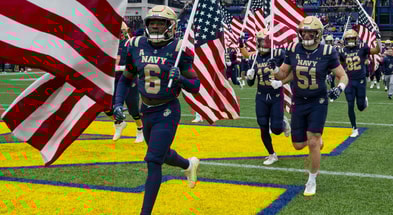
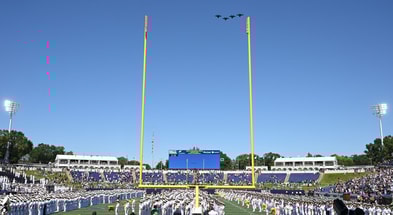
When you attend the Army-Navy Game, it doesn’t take long to figure out that you’re walking into something different. You show up to the game six hours early, but still have a line of cars waiting to get into the parking lot because the Secret Service is sweeping each one. Three hours before kickoff, the stadium is already half full because people don’t want to miss the march on of both schools. The sidelines are far more crowded than at most games, full of dignitaries and celebrities, but at some point, everyone has to clear out to make room for the parachute jumpers about to start raining from the sky. And that’s all before the game even starts.
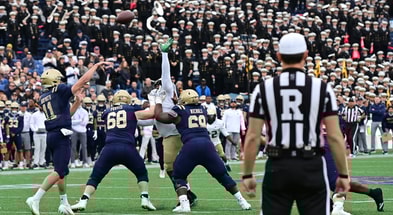
Once it does, the pomp and pageantry give way to the most intense, desperate, and hard-hitting football game of the season.
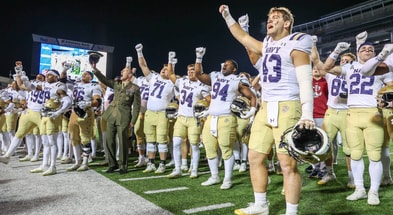
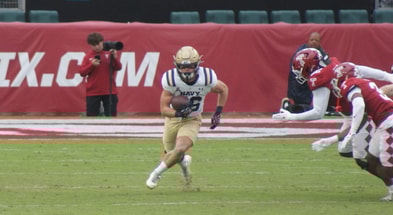
Nothing delivers the drama like the Army-Navy Game, and this year’s edition was a prime example. After falling behind 16-7 in the third quarter, the Mids rallied for the game’s last ten points to prevail, 17-16, over Army. The win moved the 22nd-ranked Midshipmen to 10-2, the first time in school history they’ve had back-to-back ten-win seasons. Navy also clinched the Commander-in-Chief’s trophy in consecutive seasons for the first time since 2012-2013.
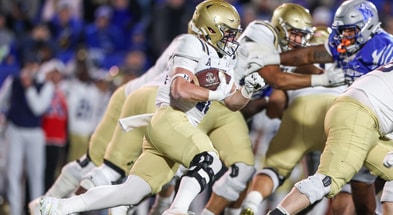
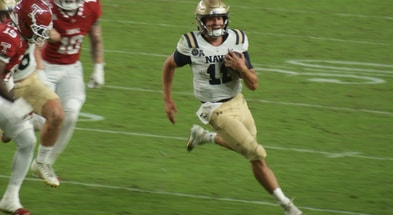
After getting the ball to start the game, Navy went on a 13-play, 75-yard drive to take a 7-0 lead when Blake Horvath punched it in from five yards out. But rather than fall into “here we go again,” Army answered with a nearly identical 13-play, 75-yard touchdown drive of their own, setting the tone for the back-and-forth game to come.
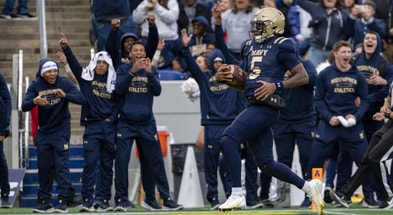
From then on, it was a nail-biter, which was exactly the kind of game Army wanted. That has been their winning formula this season: keep it close until the fourth quarter, then let their consistency and error-free play win it at the end. But the other side of that coin is that they can’t afford to make mistakes; they’re 1-5 this season in games where they’ve given up a turnover. Navy made more than its fair share of mistakes, but they also forced the same out of Army, most notably Phillip Hamilton‘s interception with 11:19 to play to give the Mids the ball at midfield. Then, after Eli Heidenreich miraculously recovered a Horvath fumble on a quarterback sneak, the two connected on a fourth-down touchdown pass with 6:32 remaining to put Navy ahead for good.
It took a lot of work to get there. The Black Knights took a 13-7 lead into halftime, along with a 155-117 advantage in total yards. That lead grew to 16-7 after an errant pass from Horvath resulted in an Army interception in Navy territory, leading to another field goal. But that would be the last thing Army could muster on the afternoon. In the second half, Navy outgained Army 155-47. After picking up a first down on the first play of the third quarter, Army didn’t have another for the rest of the game. They only ran 15 plays after halftime.
So let’s start with that defensive effort, which was absolutely suffocating in the second half. To be fair, it really wasn’t that bad in the first half, either. The difference was Army’s ability to generate a few big plays.
The Black Knights had two running plays that went for 38 yards; the other 22 first-half carries went for only 64 yards. But those two plays both came on drives that ended in points, with one coming on third-and-long.
That was this run, which came on Army’s first drive. Early on, Navy seemed to have trouble with their run fits after Army’s pre-snap shifting. On this play, the defense left a gap uncovered.
(That should have been a snap infraction, by the way. The center is holding the ball illegally. Not that it ever gets called.)
In the second quarter, Army lined up with trips to one side and an empty backfield. The striker didn’t read the play correctly and ran to the flat as if it were a pass play. You could also make a case that Coleman Cauley was held.
Army also made plays in the passing game, helped in part by more confusion from the Navy defense. On this play, Noah Short goes in motion inside the split end, and he settles underneath the safeties. That split end runs a route that more or less served to keep the cornerback from getting to Short. More importantly, though, is that two Navy defenders– both the raider and a safety– appear to be taking the H-back running to the flat.
I don’t think this was right; my guess is that there may have been miscommunication between the safeties. It’s only a guess, but I believe that being out of position contributed to the missed tackle. Either way, it turned an 8-yard gain into a 21-yard gain.
There was another missed tackle on the first play of the third quarter, when Short slipped past Justin Ross on a short out pattern that ended up going 29 yards. And while Ross should have made the tackle, Short was only open because he pushed off.
After that, though, Navy’s defense was lights-out. And it wasn’t because they did anything different schematically; they just played better.
For example, here are similar plays to the empty-backfield run we looked at earlier. On these plays, the striker read the play correctly, and Cauley cut around the block to make the stop.
The safeties also did a better job in run support on the perimeter. Army tried a two-for-one block here, but because Giovanni Sessi diagnosed the play so quickly, the blocker couldn’t get to him in time.
Perhaps in part because of better run fits, Navy’s defense also won more one-on-one matchups up front.
Winning those matchups also affected the passing game. Hamilton’s interception was caused in part by Landon Robinson getting into the backfield and forcing quarterback Cale Hellums to scramble. Robinson had stunted outside, giving him a mismatch against the tight end. Once Hamilton saw his assignment (the tight end) was blocking, he dropped into coverage. By forcing Hellums to hold onto the ball longer, Robinson gave Hamilton time to get into position to put a bracket on the intended receiver.
As I said, the Navy defense didn’t do anything noticeably different in the second half. They just played better.
It was a similar story for the Navy offense; they didn’t do anything schematically in the second half that they weren’t doing in the first half. Although in their case, I don’t know if I’d say they played better. Instead, it was more a case of persistence finally winning out, with a couple of clutch moments. But before we get into the offense’s performance, it’s necessary to talk about how Navy’s offense works.
I think people would be surprised to see how many defenders go unblocked on a lot of Navy’s plays. One of the keys to making Navy’s offense work is using motion to either get defenders moving the wrong way or to at least hold them in place while they figure out what’s going on. If players are moving the wrong way, you don’t need to block them. That’s one reason why Navy has been so good at generating explosive plays the last two seasons; defenders either get dirty eyes or they get outnumbered by blockers that aren’t being used elsewhere.
More often than not, the targets of the offense’s motion and misdirection are the inside linebackers. The challenge comes when you have inside linebackers as well-coached as Army’s. In the preview, we saw how they didn’t fall for Air Force‘s eye candy, and the same was mostly true against Navy.
It didn’t look that way on the Mids’ first drive, though. Navy used several variations of motion and line play to try to get the linebackers moving, and at times, it worked. And if the linebackers stayed planted in the middle of the field, Navy would either use the fullback as a lead blocker to run at them, or they outflanked them with a wide receiver screen and outside zone. Other times, the ILBs would get caught up in down blocks from the line and the tight end. Giving them something different to look at on every play seemed to work.
It seemed to work. Even as the Mids were having success on the opening drive, though, there were moments that hinted at the battle they’d face the rest of the way. On the first play here, you have a toss play designed to look like QB power, but the look didn’t hold the backside ILB, who makes a beeline to the ballcarrier. On the second play, the Mids used the outside zone to get the ILBs moving to set up a cutback lane behind them. But Army’s defensive line won at the line of scrimmage, preventing the cutback. Finally, we have a guard-tackle counter play with motion going the other way. It ends up being a decent gain, but that’s because Army missed tackles. They had guys in position to make a stop.
But for most of the game, they didn’t miss those tackles. The inside linebackers were the key to Army’s defense and the biggest thorn in Navy’s side.
Here are a few examples. With the ILBs not being influenced by motion, Navy tried to beat them to the edge with the outside zone. On the first play here, the playside tackle is supposed to get in front of the backside ILB, but the linebacker reacts to the play too quickly. On the second play, the Mids tried to get the linebackers to move outside with a fake swing pass before running up the middle. But the ILBs stayed home. Finally, we had an ILB coming on a run blitz with the OLB. The OLB charged the mesh and took the quarterback, while the ILB took the running back.
Another element of Army’s Air Force game plan that we saw against Navy was that the edge rushers always charged the mesh. In the run game, this helped the inside linebackers by speeding up the quarterback’s read. If the quarterback can’t slow-play the mesh, he can’t hold the ILBs in place on outside runs. The ILBs could get outside more quickly.
But where the mesh charge most affected the game was against the pass. Because the DE or OLB were heading straight for the quarterback no matter what, play action didn’t matter to them. Navy has several pass plays designed to look like power reads, with a pulling guard coming around to pick up the edge rusher on the other side. Normally, that rusher would hesitate while reading the play. But because he only had one job in this game, he was in the backfield faster than the pulling guard assigned to block him.
So Army came in with a good game plan and, more importantly, disciplined players. But discipline is not the same as perfection. For Navy, the game boiled down to taking advantage of whatever opportunities they could find, and when they arose, making sure those drives turned into points. And it happened just enough.
The first explosive play from the Navy offense came in the third quarter on a Horvath run. While Navy had difficulty getting the ILBs to move using motion, they found a roundabout way to do it using a different formation. When Navy lined up with trips receivers, the linebackers adjusted toward the receiver side. Navy ran inside zone, using Alex Tecza as a lead blocker. The ILB being lined up more to the outside made him easier for Tecza to pick up. Army’s nose guard playing the opposite A-gap meant the guard didn’t need to pitch in on a double team. Instead, he headed straight for the other ILB.
When the Mids couldn’t lure the ILBs away from the middle of the field, their best play was using Braxton Woodson to get around them.
One of the best plays of the afternoon came on the Mids’ game-winning drive. Navy ran a guard-tackle counter. Sometimes they run an option off this, with the quarterback reading the edge rusher and running out the back door if the rusher follows the running back. This time, it was a designed handoff. The inside linebackers followed the pulling linemen, since they knew the mesh charge meant the quarterback wouldn’t keep the ball. But instead of following the pulling guard and tackle, Tecza cut back the other way. With the DE taking the quarterback, it was wide open.
It took a while, but that was the play that finally got the ILBs moving in the wrong direction.
The drive finished with Horvath’s touchdown pass to Heidenreich. Navy just ran four verticals, and Army played straight man coverage. The safety covering Heidenreich lined up with outside leverage, making him beaten before the ball was even snapped. It would have made sense if one of the inside linebackers had dropped into coverage, but one ILB was covering Tecza while the other was a spy on Horvath. When Heidenreich cut inside, it was as simple as pitch and catch.
Horvath did not have a good passing game, but he connected on the one that counted the most.
One of the things we talked about after the Memphis game was how that performance would pay dividends against Army. And I think it did. The offense didn’t play its best in either game, having to overcome solid game plans from its opponents. Navy’s defense had missteps in both first halves while playing lights out in the second. And it was a physical contest throughout. The Memphis win meant that Navy didn’t have to believe they could prevail in a game like that; they knew they could.
After last year’s Army-Navy game, we talked about how it would shake up the series. After relying on more or less the same defensive game plan for a decade, Army had to come up with something new. In a sense, that gave them an advantage for this year’s matchup, since they had an element of surprise. But Navy won anyway, and now they have the opportunity to study the game and develop a better plan for next year. It bodes well for the future.
In a series full of classics, this one was an all-timer. For Navy, it wasn’t about execution as much as it was about perseverance. It captured everything this Navy team has been about all season, both good and bad. There is something to be said for playing perfectly, but there is also something to be said for making mistakes, overcoming them, and still finding a way to win. That has been the character of the 2025 Mids, and there is nothing sweeter than coming through in the game every Navy player and fan remembers for the rest of their lives.