

Catching Up with... David Jacobs

Likely, most UGA football fans familiar with David Jacobs know of him as the Bulldogs player who suffered a near-fatal stroke a quarter-century ago during the 2001 season. The stroke impacted the left side of Jacob’s brain, paralyzing his entire right side, temporarily confining him to a wheelchair, while ending his football-playing career altogether.
But, more so, Jacobs was a highly recruited defensive end coming out of Westlake High School in Atlanta, who was part of one of the most touted signing classes (1998) in UGA football history at the time. After playing somewhat of an obscure role his first two seasons as a Bulldog, the end-turned-tackle was one of the team’s top tacklers, while leading the team in tackles for loss (10) and quarterback pressures (21) through the first eight games of 2001 from his nose tackle position. Jacobs was heading for perhaps an all-conference campaign as a junior, a senior year in which Georgia would win an SEC championship, and likely an opportunity to play in the NFL before suffering the stroke.
For his Georgia career, Jacobs appeared in 30 games, starting 15 (8 at nose tackle, 6 at defensive end, 1 at defensive tackle), totaling 101 tackles, including 13 for loss.
Although his football career was over, Jacobs became an inspiration to many as he battled back from paralysis to join his teammates on the sidelines as an observer during the 2002 SEC championship season. Given to the player(s) who most portrays courage, spirit, character, and determination, the David Jacobs Award was established in his honor, and given out annually from 2001 to 2019. On the current team, defensive lineman Joseph Jonah-Ajonye was a recipient of the David Jacobs Football Scholarship.
We recently caught up with Jacobs from his home in Canton, Georgia.
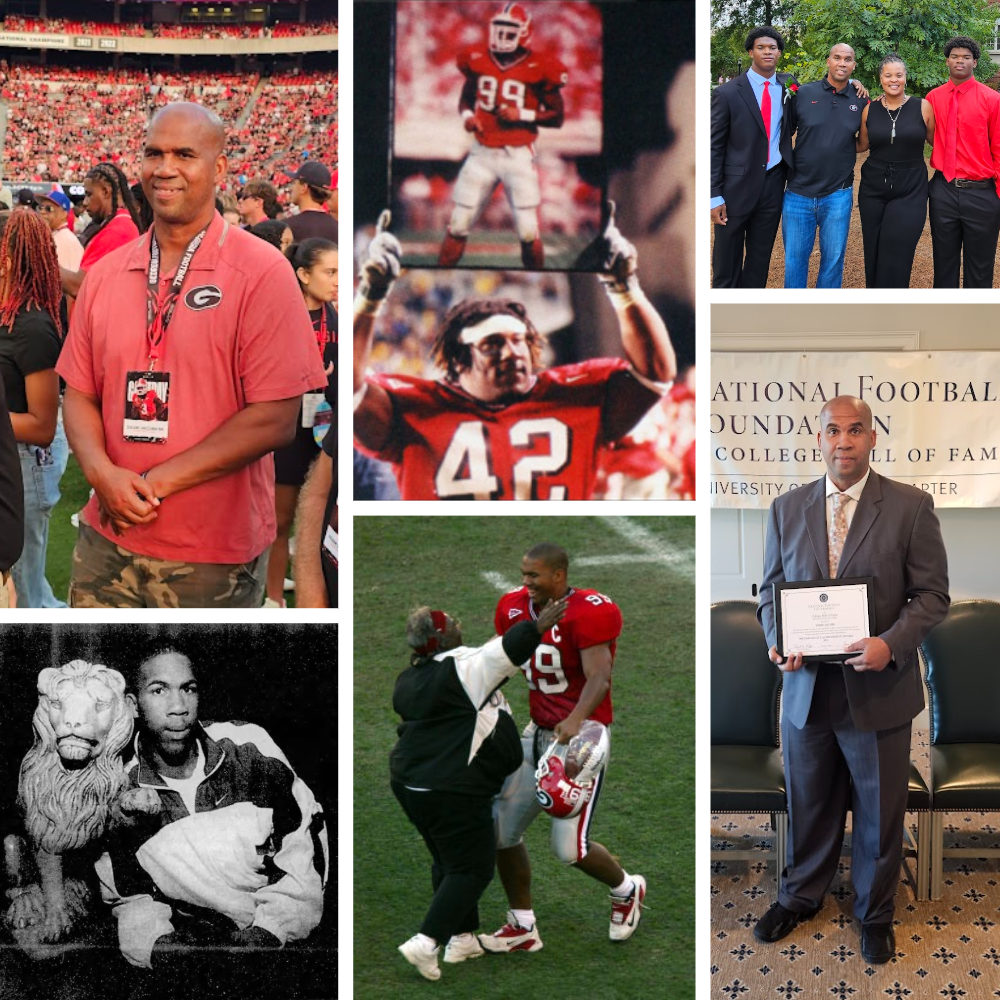
UGASports: Why did you decide to attend and play football at Georgia?
Jacobs: “When I was getting recruited, I developed a close relationship with Coach Rodney Garner, who was an assistant coach and handled a lot of the recruiting at Tennessee. I originally committed to Tennessee. But when Coach Garner was hired by Coach [Jim] Donnan at Georgia [in January of 1998], I began considering Georgia. With Coach Garner in Athens, and the fact that I’d be attending school and playing football close to my family, going to UGA eventually became a no-brainer for me.”
UGASports: After starting the first half of your redshirt season at defensive end, you were demoted to the second team in favor of fellow freshman Charles Grant, an eventual first-round pick. The next season, you were a reserve defensive tackle behind Richard Seymour, an eventual Pro Football Hall of Famer. Although Georgia’s entire defensive line at the time featured future NFL players, was it disheartening to go from starting as a freshman to being a reserve player?
Jacobs: “When I first started playing for Georgia, I made my fair share of mistakes. And it’s natural for good players to learn from those mistakes—learn from what I was doing. And once those teammates got their starting opportunity, they were able to seize the moment and secure the position. I remember when I lost my starting position, right after the [1999] Vanderbilt game, I said to myself that if I ever got the opportunity to be a starter again, I would never be satisfied. I would always feel like somebody was on my back, trying to get my starting position. But I decided no one would take my starting position, so it was then my turn to seize the moment and secure it.”
UGASports: That you did, beginning your junior season of 2001 as the Bulldogs’ starting nose tackle. You held onto that role until suffering your stroke. From a personal standpoint, and team-wise, what game stands out from that season?
Jacobs: “Definitely when we beat Tennessee [26-24] up in Knoxville. That game really sticks out to me because we trailed and had to rally back against Tennessee a couple of times before finally winning. For me, I started making plays and wound up having a good number of tackles (Jacobs’ nine tackles in the game, including six solo, were more than any other defensive lineman for either team). In the end, Verron Haynes caught the game-winning touchdown from David Greene for the win in a game we were supposed to lose. I’m fortunate to have experienced and played a part in one of the great upset wins in UGA football history.”
UGASports: Simply, how did you respond—both mentally and physically—shortly after suffering your stroke in mid-November of 2001? And when did you realize that your football-playing career was over?
Jacobs: “At the time, all I was really aware of was that the entire right side of my body was completely paralyzed. And, if I was going to recover from it, I would have to fight—fight for the game of life. So, I put everything into my rehab, fought hard, while recovering from the stroke. After a couple of months of rehab, I came to a conclusion myself, although I think everybody already knew, that I wouldn’t be able to play football anymore. It took me six months before I was even able to walk again, just take baby steps, so I knew playing was probably over. The way I felt at the time, not being able to fully feel on my right side, I knew that there was no way in the world I was going to be able compete again with 300-pound linemen.”
UGASports: After being part of Georgia’s 2002 SEC championship team, you eventually got into coaching. Tell us about that.
Jacobs: “Yes, I wanted to get as close to the sport of football as I possibly could, so I started coaching at nearby Clarke Central High School in Athens for a couple of years. I then coached at Parkview High School in Gwinnett County under head coach Cecil Flowe for two or three years before coaching at Tucker High School. I really enjoyed coaching, applying what I learned from playing football, and giving back to the kids.”
UGASports: How did you get into the mortgage business? Where do you work now?
Jacobs: “I made a couple of loans while working under one of my good friends, really liked it, and decided to do that as a career. I reached out to Eric Zeier (former Georgia quarterback), who was then working in the mortgage business for HomeBanc. Eric helped me get on there, and I’ve been working in the mortgage business ever since, for over 20 years. I worked for Southeast Mortgage for several years. I’m currently a Branch Manager with loanDepot.”
UGASports: Tell us briefly about your family.
Jacobs: “I met my wife, Desiree, while we were both attending UGA. We live in Canton and have two sons. David, or DJ, is our oldest, and Dawson is our youngest. They both attend Blessed Trinity High School.”
UGASports: Many readers of this Q&A will be well aware of your sons. As one of the top prospects in the 2027 class, David is an Ohio State commit. Dawson, a 2028 prospect, is also being recruited by most schools—just like you were coming out of Westlake. Considering all three of you were/are heavily recruited, and besides the obvious (NIL and the like), what’s a major difference in what you’ve seen in your sons’ recruitment compared to yours back in the late ‘90s?
Jacobs: “There are so many things that are different in today’s recruiting compared to my day. But something that has stood out to me is that the coaches visiting my sons are generally the ones who would be their position coaches—and no one else. When I was getting recruited, a coach assigned to my area—and not necessarily my position coach—would be the coach recruiting me. So, I think my boys have it better off, in a way, since the coach recruiting them will be the same person who’ll coach them at practice.”
UGASports: How do you balance being “pro-Georgia” (i.e., wife and him both attended UGA, he played football there, still is close to the program, often visits UGA, etc.) yet allowing your boys to make the best possible choice of where to attend school and play football?
Jacobs: “As their parent, I feel like it’s my job to put everything in front of them—to expose them, let them experience everything about each program. Like I tell them, when we visit these nice football facilities all over the country, you’re going to have both good days and bad days in college—and you’re going to have to walk into your school’s football facility when things are going good for you, but also when things are not so good. Which football facility would they rather walk into on both the good and bad days? It’s then up to them to make the final decision. Georgia was my final decision, and it wound up being a great place for me—and my wife too. But Georgia might not be the right place for them—but maybe Georgia is the right place. At the end of the day, it’s a decision that they need to feel good about.”
UGASports: Finally, we wanted to hear from you about Mark Richt, who became Georgia’s new head coach in your breakout season of 2001, and a man you’ve been extremely close to ever since. Several years ago, Coach Richt reminded us of your emotional Senior Day in 2002, superbly describing the emotional moment (see tweet below).
Jacobs: “Coach Richt is amazing—an amazing man and amazing role model. He has always maintained a great relationship with my entire family. He’s David’s Godfather. Over the years, Coach Richt has always been there anytime I needed to talk. We encourage one another. I’ll never forget Senior Day in 2002 either, when Coach Richt allowed me to run out onto the field to my family, suited up, like the other seniors. To go out on the field by running out there—and not being pushed in a wheelchair—was a feeling like no other.”