

The Best Team That Never Happened: Inside UNC’s 2010 Season
by Mike Ingersoll
North Carolina’s tumultuous 2010 football season unfolded in the national spotlight. But the people most affected – the players – were not allowed a voice during its most trying and confusing times. For the 10-year anniversary, Mike Ingersoll spoke with fellow members of that team to provide the previously untold players’ account of a season unlike any other in Tar Heel Football history.
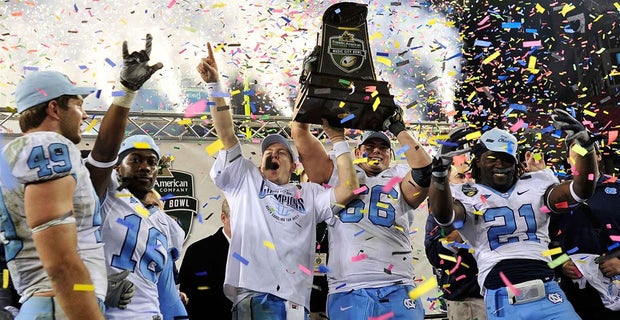
As confetti fell, swaths of administrators, media, family members, friends and Bowl Committee representatives descended toward a makeshift stage that had been quickly assembled on the far end of the field. The pre-fab steel landing slowly filled with coaches and players who made their way for the trophy presentation. Following quick speeches of appreciation, gratitude, hard work, and obstacles overcome, the Bowl Committee presented the game’s MVP and championship trophies.
About a quarter of all Division I Football Bowl Subdivision teams end their season with a win. Catapulted by an early victory over Clemson, a turbulent year—full of expectations and intense media scrutiny—had finally culminated in the championship everyone projected back in August. Destiny fulfilled. On January 10, 2011, Auburn University had become national champions.
More than 2,000 miles away, the official first day of classes for UNC’s spring semester was underway. The day was unremarkable except for the bundled-up students who were insulating themselves against the lingering January cold and unexpected ice. Like every other new year in Chapel Hill since the inaugural 1888 Carolina football season, the beginning of the spring academic semester held no expectations for the Tar Heels. Seven tumultuous months before, however, players inside UNC’s Kenan Football Center had marked January 10 for a much different reason.
PRIORITIES
In June 2010, 100 Carolina football players gathered for an impromptu, players-only meeting. From the front of the room, senior captain and quarterback T.J. Yates probed, “What are our goals? What are we really trying to do?” The players needed this afternoon to reset. Months earlier, the coaching staff met with the team and discussed goals for 2010. This was a talented group – the most talented Carolina team since the end of Mack Brown’s first tenure in Chapel Hill. Nearly a third of the roster would ultimately touch NFL grass. But when left to their own devices, the team’s accountability had waned. There were stakes for 2010—everyone felt it—so the seniors called a come-to-Jesus meeting. When everyone came, it was clear the priorities were still there—everyone just needed to be refocused.
“What are we trying to do here?” Yates asked again, standing by the whiteboard, ready to list out the team’s goals. A voice from the back of the room shouted, “Conference championship.” The quarterback added the goal to the board. Another voice: “Orange Bowl.” And Yates added it. “Shoot, I’m tryin’ to win a natty,” another voice shouted, without hesitation. The room fell silent, heads nodded. Everyone was locked in, sitting straight, tall, and attentive. In huge letters, the whiteboard now showed “NATIONAL CHAMPIONSHIP.”
The players talked about the steps to get there, understanding that all hands must be on deck and that this was a once-in-a-lifetime opportunity for this group. The players believed that if there was a roster that could pull it off, it was this one—preseason ranked and loaded with all-conference, all-American, and NFL talent. To that group, in that moment, it wasn’t just plausible, it was probable. Everyone was on board. From that moment forward, none of the underclassmen expected to be in class on January 10. They all expected to be in Tempe.
That was in June.
ALL THE PIECES
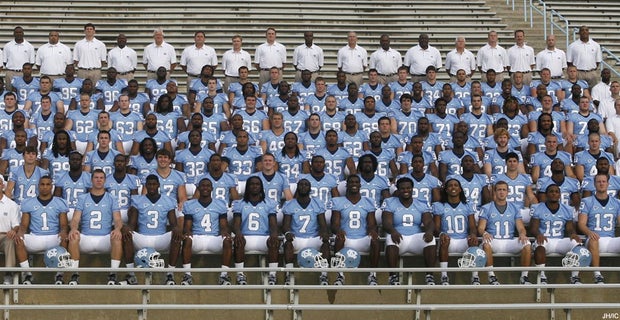
The 2009 season ended as disappointingly as the one before, almost in identical fashion. But there was a difference between them: the players’ outlook heading into the offseason. Crucial senior leadership and key pieces were lost after the 2008 season—including one of the nation’s best receiving corps and special teams duos (Brandon Tate as a returner, pre-injury, and Connor Barth at kicker). The team left remaining had some experience but hadn’t yet made the developmental or confidence jumps necessary to realize its potential. That potential was apparent to outside observers such as the late Bill Stewart, former UNC offensive line and 2008 West Virginia head coach, who characterized UNC football as a “sleeping giant” in his post-bowl game comments in Charlotte, a moniker that had been attached to the program for decades. That 2008 team was too green to take the next step, though it came close several times. While the loss to West Virginia and college football legends Pat White and Steve Slaton stung, eight wins felt like the team was ahead of schedule (especially following a 4-8 season in Butch Davis’s first year in Chapel Hill), and ending the bowl drought felt like an accomplishment. They were just happy to be there. Critically, it was a team still figuring out its identity.
The transition to the 2009-10 offseason was different. Unlike the loss to West Virginia, losing to Pittsburgh in 2009’s bowl game infuriated the team. In a year when the internal expectation was to win nine games at a minimum and vie for a division title, to still somehow lose three of the previous four games to teams that were, from the players’ perspective, inferior in all aspects—scheme, coaching, talent, and ceiling—replaced 2008’s optimism with something different. That offseason became about business.
Many of the same cast of players from the year before returned to winter workouts. But the experience and approach changed. Physical development and psychology in a 19-, 20-, or 21-year-old athlete can take an exponential leap over the course of a single year (or even over a few months). Maturity and professionalism permeated throughout the returning roster. Weight room records, some of which stood for nearly a decade or longer, fell. Post-workout position work took on a new, more competitive feel. In the past, it was rare to see position players studying film in meeting rooms in January and February. In 2010, it was rare not to. Regardless of the reasons for the shift—whether it was because LSU loomed on the schedule or was due to the halls teeming with NFL scouts—the progress was evident. Early morning winter workouts, traditionally dubbed “mat drills,” felt less like punishment and more like welcomed development.
The players were tacitly aware of how well positioned they were to take the next step. “The team was pretty much loaded,” said senior safety Da’Norris Searcy. And he was right. Throughout March’s spring practices, the blend of former head coach John Bunting’s 2006 class—all but a small handful of whom redshirted and were still rostered—and current head coach Butch Davis’s subsequent 2007 and 2008 classes created a depth chart that pushed itself, refining the skills of upperclassmen while accelerating the development of the younger players. Less time was necessary to spend on conditioning, which allowed the coaches to spend more of the allotted hours on skills and scheme work. Thanks to the commitment in the weight room, players were in better shape and fewer were injured. Thanks to the extra film study, coordinators John Shoop and Everett Withers could install and experiment with more nuanced offensive and defensive concepts, with the bulk of their projected depth chart intact. “By our senior year, we had over 50 guys who had either started, played, or played on special teams,” Searcy recalled. That experience was invaluable, allowing coaches to simply coach and preparing a senior class to accomplish what it set out to do three and four years prior—win a championship.
Seniors like running back Shaun Draughn noticed it, too. “Our eyes were on a national championship from the day [Butch] came in,” Draughn said. He wasn’t alone.
“We had all the pieces. We had a first-class coach, we had talent, we had first-round NFL draft picks. You name it, we had it,” said Zack Pianalto, senior tight end and one of the team’s offensive staples. “I think our eyes were on a national championship, or at least a BCS bowl.”
SEPTEMBER IN APRIL
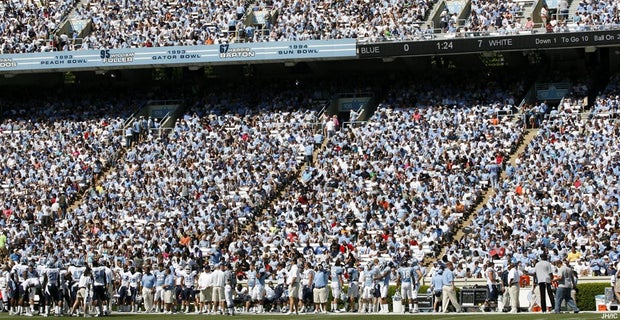
On April 10, 2010, Carolina held its spring game. In anticipation of the Chick-Fil-A Kickoff Game in Atlanta that year, both UNC’s and LSU’s scrimmages were nationally televised on ESPN. The players were met by nearly 30,000 fans, who enjoyed a mini-game day outside Kenan Stadium and fan-centric events in the stadium in the hours leading up to the first snap. While all this excitement was commonplace for a school like LSU, it was a first for UNC. The fanfare, coverage, and scrutiny of the impending spring game added an extra layer of motivation for the players and, for the first time, the spring game felt more like an event to them than a chore. The smell of concessions, the presence of PA announcers, and the low hum of fans helped mark the day as the unofficial beginning of the 2010 season rather than the welcomed end of the drudgery of spring practice—something that typically felt more like a forced commitment, devoid of any natural enthusiasm.
The locker room, too, felt like game day. All spring games involved squeezing into old game uniforms and preparing for a mock pregame warm-up. But unlike those past years, which were more pageantry and chore, the locker room energy and excitement before the 2010 spring game was palpable. Television coverage and dense fan attendance had raised the stakes. Adrenaline-filled jitters typically reserved for opening day ran through many players. It felt like September in April. The team taped, spatted, braced, and dressed like it was a conference game. Coming down through the tunnel felt more like a fall Saturday than any spring game the group had experienced. For the first time, Carolina football players were genuinely eager for the spring game.
Uniquely, the 2010 spring game broke up the depth chart and supplanted it with teams. Players competed with and against guys they didn’t normally line up against in the weeks of practice preceding the game. The team loved it. Consequently, the game served as a proving ground for many young players and an opportunity to showcase the development of the older ones, all on national television.
Most spring games or scrimmages involve dumbed-down play calls and schemes because the purpose of spring practice is development, not installation, and the bread-and-butter schemes and concepts allow players to play more freely and naturally without overthinking, thus giving the coaching staff its best opportunity to gauge each player’s offseason development. This was increasingly true of the 2010 spring game, which featured dramatically simplified offensive and defensive schemes so as not to reveal anything early to LSU in all the media coverage. As expected, LSU employed a similar approach in their game two weeks earlier. Ultimately, the mix of natural and enthusiastic competition, heightened stakes, and simplified concepts resulted in one of the most successful spring games in recent memory, both from the standpoint of the fan experience and the on-field product. The team’s commitment to the physical and cerebral parts of the game crescendoed at seemingly the right time.
For the players, the entire experience was substantially more fulfilling than in years past, and like Saturday evenings in the fall, they celebrated accordingly that night. The optimism and excitement were building in the locker room, and that optimism carried the players through the early part of the summer. By mid-summer, however, the first wolf arrived at the door.
SUMMER AND A TWEET
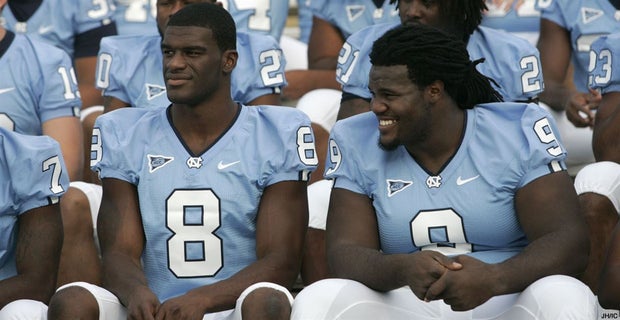
Before Mark Zuckerberg moved to an ad-based model; before a generation of average people realized the monetization and celebrity-creating potential of Instagram; before Jack Dorsey was first brought before Congress to defend his algorithm’s impact on the world’s collective psyche; and before football administrators across America fully understood the impact of social media and could stop him, Marvin Austin tweeted. It’s often said that a butterfly flapping its wings on one side of the world can cause a tsunami on the other. That is, the ripple effects of small decisions can reach far and wide, sometimes causing catastrophic damage far, far away from where the decision was made. For UNC, it wasn’t a butterfly flapping its wings, but rather a defensive tackle typing his tweets.
On May 29, 2010, Austin lit the fuse that would ultimately cost him his senior season, as well as the senior seasons, draft positions, or degrees of nearly 20 of his teammates. For at least a year, UNC’s football administration and player personnel monitored players’ social media accounts (which, in 2009 and 2010, consisted of only Facebook, which everyone had, and Twitter, which some people had).
It’s understandable how it was missed. Song lyrics for a 21-year-old on his social media account are anything but suspicious. Anyone who grew up with AOL Instant Messenger knows that. So, “I live in club LIV so I get the tenant rate … bottles comin like its a giveaway” seems relatively innocuous on the surface, and for many administrators or anyone over age 30 at the time, made no sense at all. But for NCAA officials, a tweet like this, coming from a projected first-round draft pick on a “new money,” up-and-coming UNC football team positively loaded with stars, during a time when he should be in Chapel Hill at class and workouts, not clubbing in Miami, was a red flag.
Looking back, some of the issues were predictable. A number of players were surprise returners for their senior season. Of that group, an even smaller number (countable on one hand) either elected or were permitted (it’s unclear which) to forego a summer school session, instead training in destinations like Florida and Arizona (NCAA rules mandate that in order to participate in summertime team activities, players must be enrolled in class). Personalized offseason training for high-profile college players is relatively commonplace now. In 2010, it was unheard of, and especially within the Carolina locker room. To some of the players it seemed selfish, contrary to the culture they—and those players—worked to build. It was also clear to the majority of the roster that the opportunity to train elsewhere for a month or two wasn’t available to everyone. Some players were indifferent, but most questioned it. For those who knew why certain players were not in Chapel Hill for the entire summer, there was a noticeable tension. On the one hand, there was disappointment in them among some (and on some level also envy) for what was perceived as certain players placing themselves above the team, particularly given that the program already had all the necessary resources, including access to a world-class strength staff, to develop physically both for individual seasons and for NFL scouts. On the other hand, those who remained in Chapel Hill were grateful to have those pieces back. Without them, the team was good, but with them, the team was scary.
Unfortunately, the return of those players wasn’t exactly smooth. Individualism ran rampant. NCAA rules prohibit coach-run practices during the summer. However, the players are free to hold their own developmental sessions, which the team did, twice per week in the evenings following workouts—typically one-hour workouts consisting of individual drills and seven-on-seven (the linemen would run through scheme cards and one-on-ones). While the turnout for these “voluntary” mini-practices was substantially better than in years past, the same group of players consistently skipped them, which included some seniors. This ultimately led to the rest of the seniors, led by Yates, calling the players-only meeting in June.
Regardless of the team or the program or the culture, players-only meetings are often viewed as mostly ceremonial, and, quite often, kind of hokey. It’s rare for them to be effective. At first, the meeting was no different, met with eyerolls and disinterest, mostly from those who had been missing workouts. That changed when the conversation shifted to the players’ goals for 2010. At the moment “national championship” was shouted in the room, backs straightened and eyes widened. As the whiteboard squeaked and Yates scribbled “NATIONAL CHAMPIONSHIP” at the front of the room, a low murmur started to grow. Smiles opened and heads began to nod. Some teams can talk about lofty goals, including the loftiest, but few have any legitimate shot at them. But, there are teams that can have that discussion in earnest because it is actually plausible. This was one of them. For the next 30 minutes, the team—without its coaches—outlined its goals for 2010 and the steps it would need to take to be in Tempe on January 10. It felt like the first major breakthrough in accountability, and at the end of the meeting, everyone was on board. Leaving that meeting, the season could not come soon enough.
At the same time, unbeknownst to the team, as it lifted, conditioned, and prepared that summer, the NCAA was making preparations of its own, mobilizing a task force to begin its occupation of Chapel Hill. For years, the NCAA had been admonished as a paper tiger, selectively enforcing its bylaws and unevenly handing down sanctions to its member institutions. To save face, it needed to make a splash. In June 2010, the NCAA sanctioned the University of Southern California, handing down a multiyear bowl ban and massive scholarship reduction in response to a renewed investigation into improper benefits received by former USC phenom Reggie Bush. Despite the infractions occurring a half-decade earlier, the NCAA raised the first signal that the summer of 2010 would be bloody. Players watched the severity of the punishment with disbelief as Southern Cal pleaded for leniency. It was all a show—that 2005 season was long over, the trophies already won, and nothing was ever going to change that. Moreover, the players had all heard the rumors of USC’s antics during Pete Carroll’s run, without recourse, and had friends in other programs actively receiving similar benefits at the exact same time Bush was being stripped of his Heisman. Paper tiger.
Little did the Carolina locker room know that the retroactive hit to Southern Cal’s long-gone 2005 season would be nothing compared to the proactive destruction of the Tar Heels’ 2010 campaign. Players were oblivious to the separate team of investigators taking aim at Chapel Hill at the same time they were running roughshod through Southern California. In retrospect, Austin’s tweet couldn’t have come at a more inopportune time. Not only was the NCAA clamoring for the opportunity to defend its legitimacy with a newsworthy investigation, it was already in investigation mode, putting the finishing touches on its Southern Californian dog-and-pony show at the exact same time Austin tweeted.
TRAINING CAMP
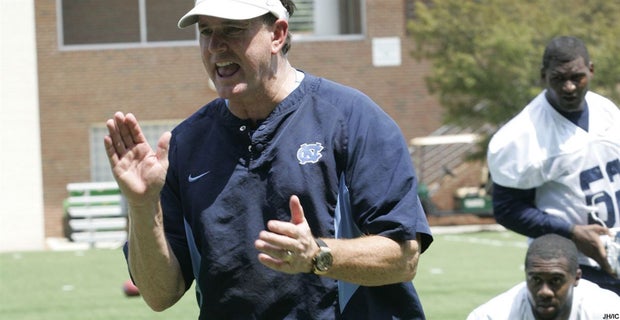
By August, training camp was in full swing. Everyone was back and healthy, and the minor drama of missed workouts and destination training was all but forgotten. Of the original training camp starters on offense and defense (including those at positions which shared responsibilities, like running back and fullback, where the “starter” was irrelevant), over two-thirds were seniors who would be in an NFL locker room by the end of the following season (and several more at least would make a training camp roster in 2011). The rest of the depth chart was littered with future NFL talent, too. As in the spring, there was an emphasis from the coaching staff on physical recovery and keeping the team engaged. With that much talent, and players who are well-versed in the systems, schemes, and game plans (i.e., play responsibilities being second nature at that point), it’s obviously a challenge for coaches to maintain their focus and interest, particularly when they are 21-to-22-year-old college students. In reality, this was a good problem to have.
The first week of camp was held mostly in shorts and helmets, limiting the chances for inopportune collisions or soft tissue injuries. Cold tubs after practice were mandatory, as they were over summer workouts. Nutritionists worked in high gear, forcing cherry juice, protein, and chocolate milk as much as possible to accelerate recovery and limit muscle fatigue (cherry juice, a common recovery supplement for chemotherapy patients, had actually become a staple of the team’s post-workout and practice recovery in spring 2008 after Davis’s own battle with cancer). The atmosphere was lively and exciting. Practices were efficient, effective, and productive. The team spent less time on foundational play concepts due to the seniority of the core players and their familiarity with those concepts, which allowed for deeper dives into the playbook, sooner. This was a huge advantage, as the earlier the offense could experiment with the personnel and playbook, the earlier it could make refinements and spend time game planning in advance of week one.
Then, trouble. “Like a week into camp, man, things are going good, guys are having mic’d-up segments out there, everything was going good,” said Searcy. “And all of a sudden, everything just stopped.”
In the locker room, confusion reigned. The NCAA had conducted interviews in mid-July with a focus on potential improper benefits received by a select few players. The details were limited to media reports and speculation, as the NCAA had a gag order in effect to keep UNC quiet. Butch Davis spoke optimistically at preseason media events about playing the waiting game and how the program was eager to move past the investigation and be better for it. Whether it was because of a lack of information or a general naivete, the potential severity was downplayed by players in the locker room and the focus was on the start of training camp. Now, however, came a second round of interviews which served as a clear expansion of the investigation.
In a private meeting with certain players, Davis delivered the news that the NCAA had come back to Carolina. These were players whom, as best anyone could tell, were identified by either the NCAA or the school as having information relevant to the broadening investigation.
The team suspected that the coaches and administration had known this for a while. And in fact it had—though that information was not provided to the majority of the team. Searcy remembered that the first meeting “was the starting defense … and Greg [Little]. That’s it.” At this point, the NCAA was only interested in what they suspected were improper benefits received by some of the players, and, given the talent load that existed on the defensive side of the ball, it made sense that the coaches would need to speak with the whole defense to get details. To the players’ knowledge, the coaches were as in the dark just as they were, at least initially.
Matt Merletti, junior safety: “I remember that [first meeting] spreading like wildfire on the team, and people were questioning like ‘what’s going on?’ and nobody really knew other than ‘hey, NCAA’s coming.’ And nobody at that point, obviously, had any idea about any academic scandal or improper benefits that occurred, or whatever you want to call it. We really didn’t know what all was at stake. Nobody had any idea.”
It would later become clear that the all-powerful, all-seeing NCAA became focused on Carolina not because of some insider tip, or because some agent spilled the beans, but really by sheer, dumb luck. The NCAA’s entire crusade was sparked less by Austin’s tweet itself, but by a photo of some money he included with it. Yet, even the investigators were unsure what they were looking for. Adding insult to injury, the money, as the players understood it, did not belong to Austin at all; instead, it belonged to someone else who was in the hotel room where the photo was taken. The NCAA was in a similar information-gathering mode as the coaches and the players—no one really knew anything, they just had a hunch. The problem is, NCAA investigators are better trained at eliciting information than teenagers are at protecting themselves. Making matters worse, not a single player was advised by the coaches, university, or NCAA that it would be in their interests to have an attorney present during questioning.
“Then, like a week later, I guess that was when Greg [Little] told them about the tutor,” recalled Searcy. “So then we got called back in there for another meeting, and that’s when there was 25 of us.” At this point, the “investigation” took a turn and ventured into squishy territory. It was truly a matter of first impression whether the NCAA, by its mission, an athletics membership conference governing interscholastic athletic competition, had any authority whatsoever over issues on the academic side of one of its member institutions. This is particularly true given that UNC eliminated all athletic oversight of academics, compartmentalizing tutoring and academic support under the control of the College of Arts and Sciences, a decision made in the 1990s. There was no precedent to support the notion that the NCAA could assert dominion over academic issues (assuming that, even if it did exist, the NCAA was bound by “precedent” in the legal sense at all, which it is not).
The NCAA proceeded as if it had this authority. Perhaps sheltered too long by “the Carolina Way” and believing it was somehow different than every other major college athletics department, the school not only actively cooperated, but participated in the investigation. This was a grave mistake. The players could not believe what they were seeing. It very quickly became clear that there were separate factions vying for their own self-interests: the athletics department, the university, and the football program. None of the three were aligned in interest, which became painfully clear to the team the first time they were told not to speak to the media about the matter. Even the coaches were given a gag order by the school. No one was telling the players’ story. Soon, the investigation, which began as a small, directionless information-gathering session regarding a picture attached to a tweet, exploded into a full-blown inquisition, inexplicably aided by the school, itself. The public was not too far behind.
By now, Carolina had the best defensive scout team in America. The majority of the two-deep found itself running cards for the first-team offense, which drew obvious flags and questions. The decision to ultimately relegate at least nine defensive players, all projected to be drafted in the first half of the 2011 draft, to the scout team was news to everyone, including them. Searcy, for example, found out he was on the scout team when Everett Withers released that day’s depth chart in pre-practice meetings. Quan Sturdivant, senior linebacker—who, admittedly, was never one to look at a depth chart (the nation’s top-rated inside linebacker shouldn’t have to)—found out when he walked on to the field with the starting defense, only to be directed to the offensive field to take over as the scout version of LSU’s standout linebacker. Practically, the staff had no way of knowing who would be available for LSU, or for any of that season, due in large part to the vague information provided to them by the NCAA investigators, themselves. Their only choice was to prepare as if none of them would be available and to make last-minute adjustments for those who were. Lineups changed daily, sometimes even period to period at practice, which only raised more questions in the locker room. Of course, the reasons for this would not be explained until much later.
Predictably, scout period at practice became substantially more difficult if you were a starting offensive player. This was not only because of the exponential increase in talent, but also because that talent was extremely aggravated. The benefit of this was obvious—the team spent its time preparing for LSU against players who ran LSU’s schemes better than it did. The detriment was also obvious—it’s hard to run through your passing game when All-American pass rusher Robert Quinn is disrupting every dropback.
To make matters worse, the majority of the team—with the exception of those in the preliminary meetings with Davis—still had little idea what was happening or what issues were at play. Even most of the players in those meetings were kept in the dark. The powers that be clearly felt that players were all on a need-to-know basis, and the rest of team simply did not need to know. To that point, it had all amounted to rumors anyway, and players tried not to let it concern them (they were in the midst of a sweltering, exhausting training camp, after all). That was, until the helicopters showed up.
“All of us were on a knee, and [Coach Davis] is standing there, and there’s helicopters circling around Navy Field. And I remember looking up, and Butch was trying to talk to us and, you know, I guess prep us for the game—I have no idea what he said, I don’t remember,” recalled Merletti. “[T]hat’s when it really set in that this was serious.”
The media flocked to Stadium Drive. Sturdivant recalled the frenzy—players couldn’t walk the short path from the practice fields tucked behind Parker and Teague dorms to the stadium directly across the street without being approached by reporters. “I remember the news people were standing outside the stadium,” he said. There was one major problem, though—the players had nothing to tell them. On the whole, they knew nothing. They didn’t understand the issues, if anyone was in trouble, or what they were in trouble for. In fact, the reporters and other strangers who would reach out to the players all seemed to know more about the situation than the players did. It was an eerie loneliness. It was also insulting.
Once the compliance interviews started, however, that loneliness would soon turn to distrust—not of each other, but of the university.
AN AMBUSH
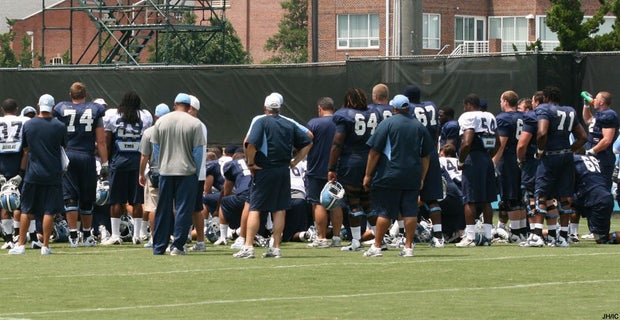
On the fourth floor of the Kenan Football Center, a room was set up with a long conference table positioned parallel to a series of wide, gaping windows. Several tape recorders rested in the middle. Four to five NCAA investigators were split up, some sitting at one end of the table, others at the other end, all facing the wall. Interviewees were placed on the other side, facing the open windows. For some of these interviews (depending on the issue to be interrogated), university personnel—typically compliance staff—or other athletics department representatives were present. Football couldn’t provide the players with any information, on account of the confidentiality mandate, and neither the NCAA nor university offered, encouraged, or even advised any player (with one lone exception) to retain legal counsel or other representation.
The atmosphere of the interviews players underwent with NCAA investigators is rarely if ever discussed. For those involved, the experience was relatively universal. The only real difference was whether the NCAA viewed you as an affirmative violator of its bylaws or simply someone who could provide dirt on someone else. To investigators, the value of the latter group also included their potential to unwittingly incriminate themselves in the process, usually through, what the interviewees considered to be, fairly innocuous, innocent information.
It was an ambush. Set up by NCAA investigators—who, frequently, are themselves licensed attorneys—these interviews were, in essence, depositions. This is also true of the tactics employed. For example, witnesses faced a window to distract them and fatigue them quicker during the first hour or so. Investigators asked questions examination style—rapid fire, leading questions that assumed their own answer. For a teenager or someone in their early twenties, this is a terrifying experience, made more daunting by the vagueness and spuriousness of it all. In a normal legal examination, a witness is represented and often prepared by counsel in the days leading up to questioning. None of the players walked in to their “interview” represented, at least not at first, and certainly were not prepped ahead of time on what to expect in terms of topics, documents, or subject matter. This was by design. No one told the players what they were being interviewed for and, for many, NCAA investigators intentionally kept this information hidden from them even during the interview. An ambush.
Draughn’s experience was like many of his teammates’—“You bring people in, all suited and booted, you know, we’re kind of intimidated. Like, ‘who are these folks?’ We don’t know the extent of what’s going on, we just know we can’t play. We didn’t know why. We knew it was something about a class, and somebody was receiving money and all this stuff, but they didn’t even tell us the reason why we couldn’t play during the time they did the interview … [T]hey came in and it was like … a deposition. My parents ended up getting me a lawyer.” Draughn saw the game being played. “[A]fter I got my lawyer, I was released that next week. And I’m like, ‘shoot, I should have done this earlier,’ but of course … we’re 18, 19 years old not knowing any better. I’ve never been to court, I don’t know anything about that.”
In fairness to the university, coaches, and compliance staff, it’s also true that the investigators were withholding some information (though not all) from them, as well. What was disclosed was often accompanied by the insinuation that it was in the university’s best interests to keep the information confidential. This certainly was not in the players’ interests, however. Regardless, Draughn understood the tension that existed for UNC. “The school should’ve been a little more involved and a little more transparent through it all,” he said, “but of course, there’s no telling what was going on behind the scenes that we didn’t know about.”
What the players did know was that the university and the compliance office were conducting their own academic investigation concurrently with the NCAA’s, though it was often difficult to discern which investigation was which. Neither investigation was intended to protect the players, who were provided no support—and instead, in some egregious cases, received blatantly incorrect, inarguably naïve, guidance from school officials.
Devon Ramsay, the draft’s top-rated fullback entering the 2010 season, was notified at practice after week three that he needed to meet a member of UNC’s football administration and the Faculty Athletics representative on the fourth floor of the Kenan Football Center after he showered. To date, he was the only player known to have been asked whether he wanted a lawyer, though he received no elaboration or explanation as to why he might. Ramsay was then made to believe that he was simply providing information for his interviewees’ purposes, people he trusted, though he became wary when a tape recorder was placed on the table. Its significance was downplayed, though, and they reassured Ramsay that he was only there to clarify some things. They showed him an email with tutor Jen Wiley regarding a paper. Wiley would later find herself at the center of the “scandal.”
For players whose grades and academic performance were above a certain threshold, study hall wasn’t mandatory. Ramsay— who attended the Lawrenceville School in New Jersey, a premier academic prep institution— was one of those players. He knew that Wiley had taken this particular class with this professor before, so he sought her advice regarding whether a paper he wrote for the professor met that professor’s expectations for the assignment—an objectively appropriate thing to do. Wiley sent back suggestions to his draft.
Ramsay was accused of plagiarism because of Wiley’s suggestion. Importantly, the suggestions Wiley provided were simply to a rough draft of the paper, not the final, submitted version. Neither the NCAA nor the school ever located the submitted final paper. Where did the NCAA’s allegations come from? Nobody knew. In fact, UNC’s Honor Court—notoriously hostile towards athletes—completely disregarded the case and threw it out for this very reason. Shockingly, however, UNC’s Compliance department encouraged Ramsay to sign a document admitting academic fraud. Despite Ramsay’s insistence that the accusations were baseless, Compliance convinced him that this was his quickest way back to the field. On the university’s advice, he signed the paper. He was unrepresented.
In response, the NCAA ruled Ramsay permanently ineligible. Soon after, he obtained representation by former North Carolina Supreme Court Justice Robert Orr. After months of meetings with the university, athletics department, and NCAA compliance, Ramsay appealed. The NCAA, realizing its error, reinstated him, but the season was over. In his first game back in 2011, Ramsay tore his ACL. He would recover to play two plays in his final college game. He later accepted an invite to rookie minicamp in Tampa Bay in spite of all the setbacks.
In total, UNC held at least 17 players out, prospectively, through camp. These players were relegated to the scout team. By week one, the official number dropped to 13 total players withheld from competition for at least some portion of the 2010 season. Many of these players were held out because the NCAA indicated that it merely suspected that they might have, maybe, committed an infraction, and if they played and were later found to have done so, the team would be forced to retroactively forfeit any game in which they played. Many of these players were ultimately cleared, some as late as week six, forcing some true seniors to take a redshirt. The prevailing sentiment from the locker room was that the school should just let them play, and let the consequences be what they may—“they can’t take away our rings.”
The consequences of the NCAA’s stalling cost some players hundreds of thousands, if not millions, of dollars. At least one of these players had a mid-round draft grade in 2010 when he was cleared mid-season. As a result, he took his redshirt so he could play a full season, then went undrafted a year later and never even made it to an NFL training camp. Other players, like Ramsay, were victims of circumstance created by, at best, naivety, or at worst, administrative malpractice.

LSU
Training camp was as uniquely taxing emotionally as it was physically. For Searcy, he was left wondering whether he would actually get to play in front of his home fans, friends, and family. “All week, we’re sitting there on pins and needles—are we going, or are they going to hold us out?” Searcy said. “I didn’t even know until Friday morning. We had another meeting Friday morning, with our bags and everything.” A native of Decatur, Georgia, the 2010 Chick-Fil-A Kickoff Classic was a homecoming of sorts for Searcy, a senior who a month earlier was finalizing ticket counts for the game. Now, he was waiting to find out if he needed to buy one for himself.
“[Corey] Holliday, and Butch was in the room, they gathered us together, but they didn’t say nothing. It was somebody else who told us [we couldn’t play]. Someone from the academic side who was working with the NCAA.” Searcy wasn’t alone. A dozen other players were notified moments before the team boarded the buses that they, too, would not be traveling to Atlanta. Not with the team, anyway. Even those who were traveling had no idea who would board the bus with them and who would stay back. For that matter, the coaches didn’t either. In a process that resembled middle school final cuts, much less organized travel for a major Power 5 program, players waited next to the statue of Choo Choo Justice in front of Kenan Stadium for a decision on their playing fate. “My very first memory of this game is literally sitting right in front of Kenan, and the whole team is getting on the buses, and there’s multiple players on the phone with the NCAA just to find out whether or not they can get on the bus,” Yates explained. “And these aren’t just, like, guys. This is obviously our starting defense, starting running backs, starting wide receiver.” The players all took attendance, as every man who stepped on the bus was inventoried by those already seated.
It was a gloomy day. Overcast and sticky. A late-summer storm rolled through just as the team was leaving town. Through the windows, players stared in disbelief at those left standing in front of the Football Center’s Hall of Honor as the buses pulled away. Floored, Pianalto took stock of the situation. “So literally at that moment, you’re stepping on the bus and as the bus pulls out of the lot you’re thinking, ‘Wow, well, this is it. We’ve got to be ready with who we have because that’s all we have.” For Pianalto, that was the defining moment of the game, and the team was just leaving the parking lot in Chapel Hill.
Pulling up the hill toward the Bell Tower, players on each bus checked on the other, feverishly texting and calling back and forth. Gasps, ticks, and expletives carried through the cabin as news of who was and was not on board the other bus spread. Players who had never played were now starters. Freshmen who most likely would have redshirted would now play significant minutes. The offensive bus fell silent.
Two players not on the bus, but in limbo, were star linebackers Sturdivant and Bruce Carter. Sturdivant described the experience as “a whirlwind.” After being told they would not be allowed to travel with the team, the pair went back to the apartment they shared and tried to process what had happened. Four hours later, Sturdivant’s phone rang. The NCAA wanted to speak with both of them again, and they needed to return to the Kenan Football Center to be re-interviewed. The investigators asked Sturdivant and Carter virtually the exact same questions as before, with the two of them providing the same answers. At the end of the second interview, investigators indicated they could find no infractions committed by them and they were cleared to play. At least in this instance, players were prematurely deemed ineligible, either by the school or the NCAA. They would not be the last players to find themselves in this situation.
The two were given minutes to go home and pack a bag. They were then rushed to RDU International Airport, boarded on a private jet, and flown to Atlanta. Rumors circulated amongst the team that the pair had been cleared, but no one could confirm it. As players exited Friday evening meetings, Carter and Sturdivant emerged up the staircase toward the lobby of the hotel’s conference center, exhausted. No one had any idea they were coming. That night and the next day, the players tried to focus on the game, but all anyone could discuss was whether more key players would be cleared and magically returned to the team before kickoff. “At that point, it was all such a whirlwind,” recalled Yates. “I remember in the hotel the day of the game, the night before the game, we’re still in that same situation where we don’t know who’s going to take the field. …We had no idea who our starting 11 were going to be going into the game, even the day of.”
The story of the game has been told ad nauseum over the past decade. The walk to the locker room was filled with “Tiger Bait” chants from droves of fans lining the walkway into the Georgia Dome locker rooms. From start to finish, the stadium was deafening. Neither team could hear its own cadence. Squishy, over-rubberized, and incredibly short, almost like commercial carpet, the old Georgia Dome field turf was among the worst playing surfaces in the country. Footing was uneasy and turf burns followed every fall, but it was fast. The sidelines were filled with stars from both schools. Even Julius Peppers had made the trip. In just a form-fitting hoodie and jeans, he was the most intimidating player on the field, and he wasn’t even playing. The teammates who had been sidelined by the NCAA sat behind the UNC bench, including Austin, Draughn, Charles Brown, and others. After opening possessions, the mystique of national power LSU, loaded with NFL talent of their own and a gem of the top-dog SEC, wore off. Sideline adjustments after the first series were minimal, and the offensive and defensive units quickly settled into their assignments (special teams would take a little longer). Across the board, Carolina’s players matched up man for man. Jhay Boyd erupted for over 220 yards receiving. Tony Elzy emerged from the shadows following Johnny White’s injury and willed the offense to first downs, while also laying out LSU defenders in pass protection. It was the kind of game, and opponent, you wish you had 11 more of every year. “[T]hat,” said Draughn, “was probably as close to the national championship atmosphere that we could’ve gotten that year, because … from the fans’ perspective—I was a fan that day—and man, the stadium was rocking.”
Sturdivant was an unsung hero. Per team policy, he didn’t start the game because he hadn’t practiced the week prior, but he made his presence felt immediately when he came in. “They ran a little ISO into the B-gap,” Sturdivant said. “The fullback came, I hit the fullback, and made a tackle for a loss. I remember all that, like, vividly. I can see it right now, because I was mad … Bruce, he went in before I did, so I was hot, I was mad.” A few plays later, receiver Russell Shephard caught a slant route in front of Sturdivant, and he nearly folded Shephard in half on contact. Then, with 1:08 left in the fourth quarter, he recovered the fumble that would give the team that fateful last drive.
Often overlooked are the roles so many other unsuspecting players played. “We exhausted our entire roster, basically, to complete that game,” remembered Yates. NFL veteran Tre Boston, along with former Vikings corner Jabari Price, were freshmen in 2010, and based on the roster, likely to redshirt. Instead, they started and played virtually the entire game. Mywan Jackson saw his most significant time of the season, and even Pete Mangum—a walk-on—played spot duty at corner. Other players like Linwan Euwell, Dion Guy, Herman Davidson, and Gene Robinson, amongst others, either started or contributed invaluable minutes. That defense of backups, led by Carter and Sturdivant, held LSU scoreless in the second half and caused multiple turnovers.
Earlier that year, the coaching staff recast Greg Elleby from defensive lineman to offensive guard. He flourished, and was a favorite in the offensive line meeting room. At LSU, he emerged as a natural and was invaluable to the line rotation (later that season, Elleby would be reallocated back to the defense and would contribute on both sides of the ball, ultimately suffering a knee injury while at defensive tackle that would end a very impressive individual season—the offensive line was heartbroken for him). Even Jon Cooper—yes, future Jacobs Blocking Trophy winner and No. 7 overall NFL draft pick Jon Cooper—falls into this group, having been thrust into a role at center for the first time in his life. Cooper made some costly mistakes, including an errant snap for a safety early in the game, and was benched. He was beside himself and in tears on the sideline, but not out of self-pity—he didn’t want to let his teammates down and thought he had (he hadn’t, nor could he ever). That type of attitude and accountability underscored the entire season. In the end, Carolina almost won that game because of people like Cooper.
Yates took ownership of the last two plays. But there may not be a more holistic glimpse into the leadership, accountability, and approach of that 2010 team than Pianalto’s response to Yates’s attempt to shoulder the blame entirely himself: “I remember the postgame interview like it was yesterday,” Pianalto said. “I completely stated, ‘Look, I dropped both passes.’ And I did—if you clearly watch the film, both passes hit my hands. They were catchable balls. The second-to-last one into the back-corner of the endzone—sure, I would’ve loved it for T.J. to put a little air under it and thrown it two feet in front of me, you know, instead of back shoulder, and I know he would’ve, too. And on the last play you could argue, ‘Oh, he grabbed my arm, P.I.,’ but … I’m happy the refs didn’t call it, because I hate when refs take over a game like that. So, all that to say, there were two catchable balls, and I just didn’t catch them. So, that’s kind of how it is, and you always wish you had those back, but that’s why you play the games.”
As time expired, the team was spent. Pianalto crouched over in the endzone in disbelief. Yates broke down into tears in the tunnel from the rollercoaster of the previous few weeks. But then something unexpected happened. “The LSU fans were applauding us as we walked off.” Yates wasn’t the only one who noticed. The whole team did, and it became one of the most bittersweet endings to any game most of the players would ever play.
The next day, defensive line coach John Blake resigned.

6-1
Following an inexplicable loss to Georgia Tech by the same score as the week prior, UNC won six of the next seven games, the lone loss coming after a blown 10-3 lead at Miami. The wins included four straight, one of which was a 21-16 win against Clemson, which featured that year’s eventual ACC Defensive Player of the Year and Bronko Nagurski Award winner Da’Quan Bowers, and an up-and-coming coach few had ever heard of named Dabo. The stretch also included a 44-10 blowout of Virginia in Charlottesville, the first win for Carolina at Virginia since 1981. Given the year to that point, the Virginia win was a milestone that the team, and the program, needed. It was a glimpse into what could have been: 339 yards passing, 140 rushing, and 5 forced turnovers. The locker room erupted afterwards.
On the heels of the Miami loss, the team headed south to Florida, again, to play at Florida State, which was ranked No. 24 in the nation. The hotel accommodations were … unusual. On what seemed like the set of Deliverance stood a two-story, independent hotel on the edge of a low-rate, municipal golf course. Apparently, this was the same hotel visiting teams had stayed in for years. Meals were cooked by the family that owned the hotel, who served them—and this bears emphasis—in the golf cart repair building next door, which could only be reached on foot through the grass and Spanish moss-laden trees roughly 30 yards from the hotel. The experience was certainly a first, but would not be the only first of the weekend.
Top 10
- 1Hot
Mingo Update
Latest on top target
- 2Breaking
House Leaving
Linebacker to enter portal
- 3Trending
Signing Day Revelation
Greg column
- 4
Signing Day Tracker
Meet the new Heels
- 5
Changing of Guard
Dixon takes reins at Rupp
Get the Daily On3 Newsletter in your inbox every morning
By clicking "Subscribe to Newsletter", I agree to On3's Privacy Notice, Terms, and use of my personal information described therein.
Like Scott Stadium at Virginia, Doak Campbell was home to a substantial dry spell for Carolina, except Tallahassee’s was permanent as Carolina had never won there at all. By the end of the game, the taste of the Miami loss was all but gone. Like LSU, Yates’s performance at Florida State included another 439 yards passing—a school record at the time. Also like Virginia, it was another phenomenal game for Dwight Jones. If the 2010 UNC season were a person, it would have been Jones—an incredible natural talent with his own story of tumult, triumph, and untapped raw potential.
The game kicked off at 3:30 p.m. in the heat, and it ended under the lights in the cold—the temperature’s drop into the 40s was unexpected, even for the panhandle in November. During a TV timeout late in the fourth quarter, one of Florida State’s defensive linemen looked at the UNC players, shook his head, and said, “I didn’t come to Florida for this s***.” Everyone on both sides laughed. That drive started and ended with smiles, as Casey Barth hit the go-ahead field goal. The rest is another chapter in FSU Wide Right history.
It was a season of firsts for Carolina football, in almost every way. First win in Charlottesville since 1981. First win in Tallahassee ever. In spite of the week two stumble against Georgia Tech and the dismantling at the hands of the NCAA, UNC still had an outside chance at winning the program’s first ACC Coastal Division title. At 6-3, and the closest to full strength the team would be that year, Carolina welcomed No. 20 Virginia Tech, undefeated in conference. A Virginia Tech loss to UNC and then again the following week against Miami would have placed Carolina in first place in the division going into its late-season match-up with N.C. State.
On film, the Hokies were extremely beatable, in spite of their record. Their strength was at running back, but they otherwise were not extraordinary anywhere else. They were consistent, and smart, but not physically overpowering. On the whole, the Carolina players felt they were better, schematically and in terms of personnel. This proved true in the first half, as the defense held VT to only field goals and contained a dangerous Tyrod Taylor much as they did the year before. However, despite leading until mid-way into the third quarter, turnovers and three-and-outs ultimately doomed the offense, which was held scoreless in the second half. Carolina fell to 6-4 on the season. But another milestone was still in reach—the first nine-win season in Davis’s tenure. The prospect of increasing the win total from the year before still felt like an accomplishment considering the circumstances the team had endured.
Unfortunately, the win in Tallahassee was the apex of the regular season, though players didn’t know it yet. The Virginia Tech loss felt different. Going into the game, there was confidence, obviously. The offense and the defense were hitting their strides. After several years of build up, Carolina had finally defeated Virginia Tech the year before in thrilling and historic fashion (to that point, the only other time the Hokies ever lost at home on Thursday night was to Matt Ryan and Boston College in the pouring rain several years before). It was a rivalry that had been developing since 2007. Every game was close, and in 2009, it hatched. The win in Blacksburg felt like a turning point, and Carolina seemed poised to dethrone VT in the division and to exchange blows for years to come. Carolina went into Virginia Tech with confidence—a record of 6-3, snatching defeat from the jaws of victory in two of those losses. In retrospect, the team also went into it exhausted, at least emotionally. The incessant media coverage, the shuffling of lineups, resignation of coaches, and excommunication of teammates had taken a toll no one had realized at the time. Even with backups at most positions, Carolina was more talented than nearly every team on its schedule. This included Virginia Tech, which made the loss all the more deflating.
* * *

N.C. State was a blur. It was senior day, but not for everyone. A few were obviously missing, which made it all the more surreal. The previous year, Carolina lost to State in yet another heartbreaker, despite being more talented, better coached, and better prepared. The 2010 roster was better than the team it fielded a year earlier, but on film, the Wolfpack were still inferior to a shorthanded UNC team. But, State had something special. The Carolina defense referred to him as “Houdini,” and he was a magician. Some, like Jon Cooper, may even say he was a conjurer: “Russell Wilson sold his soul to the devil.”
Regardless, records, film, personnel, and expectations seem to be irrelevant when playing N.C. State. It’s a creature all its own. It’s not just “another” game. “When we play NC State, we all see red,” said Draughn. “You could play Duke, you know, we hate them, too, right? But we play N.C. State, it’s like, personal—it’s a street fight.”
And a magic show. Take Russell Wilson’s Hail Mary on 4th and goal during the fourth quarter, trailing 19-10. In what would prove to be the turning point in the game, Wilson was flushed from the pocket (as he was most of the game) by Quinton Coples, and was forced to scramble 17 yards back to the 20-yard line. From between the numbers and the hash, Wilson threw the ball into triple coverage in the back of the endzone. The intended target was Jarvis Williams, by the back pylon. As Wilson heaved the ball, Darrell Davis, covered by Searcy, sprinted toward Williams, taking two steps out of bounds. As the ball came down, Davis batted the ball back into play as Searcy shoved him into the bushes, while Merletti and Jabari Price covered Williams, who fell. Left uncovered, Owen Spencer dived and caught the ball off the top of the grass. The illegal touching by Davis was missed by the referee, who was standing on the back line of the endzone mere feet from Davis, watching his approach. Even after review, the top ACC officiating crew still missed it.
Touchdown. “They had one guy!” said Sturdivant. “And he was Houdini.”
After the play, one of the N.C. State receivers spit in Kevin Reddick’s face, drawing a punch. State, which had otherwise been dominated the entire game, was alive and well, it seemed.
The game ended with State coming from behind in the fourth quarter, after trailing all game, to win 29-25.
The players were dejected. “I have a very sour taste in my mouth about N.C. State because we never managed to beat them,” recalled Elzy. “Although I feel like we were always better—talent-wise, coaching-wise … but somehow, some way, they always came out on top. I think that was the frustrating part for us.”
For Yates, walking out of Kenan for the last time after N.C. State was one of only two games in his entire playing career where he cried afterwards. The other was LSU.
The following week at Duke, Carolina righted the ship. But that, too, was a game won on fumes, with Elzy once again proving to be the clutch player he’d been all season, securing the final first down needed to run out the clock and escape with a win. In the end, it was fundamentals and coaching that got UNC through the end of that season. Finishing at 7-5 was a letdown even when trying to find moral victories, in large part because three of those losses were by a touchdown or less and UNC held leads in all of them.
RESILIENCE
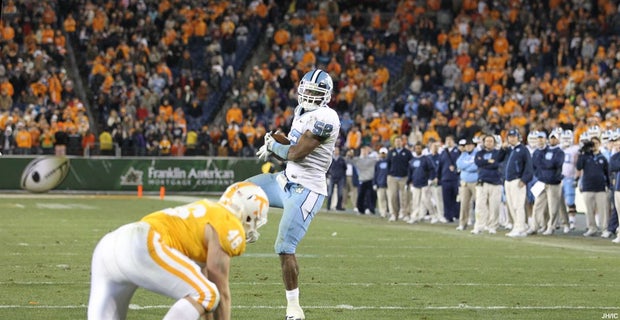
For most fans, the resonant memory of the 2010 Music City Bowl was Casey Barth’s kick. For others, the trophy celebration, or even Tyler Bray prematurely slashing his neck at Davis and UNC’s bench. The players remember it differently. “I think of bottles,” said Merletti, succinctly, as he recalled the slew of beer bottles that rained down on the fans and the field when overtime was announced. For Searcy, it was losing teammates—again. “I think of Deunta [Williams] getting hurt.” And, in his typical loose, playful fashion, Sturdivant remembers the fun. “The City of Nashville,” he said, smiling. “We had a good time out there during that bowl week!”
The summer before the 2010 season, Tennessee athletic director Mike Hamilton canceled the home-and-home series scheduled between the two schools, set to begin in 2011. Hamilton’s rationale: he wanted to “lighten the load” of the Vols’ upcoming schedule, and he had lost the stomach to play UNC out of conference. “The reality is, we’re not back to where we want to be back yet,” Hamilton said. Head coach Derek Dooley co-signed the decision. When the news about the cancellation broke, Carolina was between practices in the middle of training camp. During a mid-day flush-out lift, laughter erupted from several players when they were told. For a brief moment, the team’s ego got a much-needed boost. The program was finally getting some respect even in spite of the impending decimation by the NCAA. Apparently, others believed the Tar Heels were still formidable—maybe the team should, too.
Three months later, it was announced that Tennessee was Carolina’s bowl opponent. The players shook their heads, but after the irony wore off, it became a mission to prove Tennessee right. A win would do that, and it would also be the first (and unfortunately only, though no one knew that at the time) bowl victory for Davis in Chapel Hill. Bowl preparation began right between the end of exams and graduation. After some rest, the team was excited to get back to playing. The spell they’d fallen under in the final four weeks of the season passed, and everyone felt fresh.
The hotel was magnificent, and the bowl committee put on an exciting week of events. Nashville was a fun town. Most days were overcast, but the weather was crisp, as were on-site bowl practices. At the hotel, a makeshift weight room had been set up in one of the ballrooms. At night, players ventured out to Broadway. On the first night there, a group of players ran into country music star Chris Young at The Stage. He was there with his sister, Dot, and a longtime friend. Soon after, a small group of linemen, tight ends, and quarterbacks bar-hopped with Young and sang “Little Black Dress” in a dive karaoke bar that he insisted the guys visit. It was closing when everyone arrived, but the doors stayed open for him. He sang the chorus.
The game was more competitive than the players expected. Tennessee was better than its 6-6 record, or at least seemed to be after having a month to prepare for the game. The Vols were also one of the dirtiest teams Carolina played all season, bordering on State or Virginia levels. 2010 was a season of waiting, and the end of that game was no different. All year the team waited to find out who would ride the bus to LSU, who would be cleared and who would be lost, who would get hurt and who would step up. At the end of regulation, Carolina had to wait for the referees to tell them whether they could kick the ball, and prolong that season of waiting. Even overtime was an exercise in delay. It was as if the football gods were not interested in seeing the season end.
From June workouts, to a players-only meeting where the dream was hatched, to August when the dream was snatched from the team, to buses before LSU, and wide right at Florida State, the players were carried through that season by one thing.
Faith.
Sturdivant remembers his interception in overtime. “I might’ve, could’ve, ran that back but I knew I wasn’t full speed, so somebody was going to catch me. So I thought ‘why am I gonna run this back and they tackle me?’ And I knew we got Casey Barth. We need five yards and we’re still going to win. I had a lot of confidence in him … Let Barth go and kick that field goal, and we’re going to win the game.
“I had too much faith in Casey, because I dropped my helmet. I was like, ‘we ain’t going back, game over.’”
Baby Barth wanted the ball on the left hash, so the offense positioned it accordingly. There was never any intent to score a touchdown. Carolina had the most reliable kicker in the nation (and you couldn’t tell the team differently). Draughn brought the ball down inside the 10-yard line, one defender away from scoring in spite of Barth’s destiny. On second and goal, from 23 yards away, Barth knocked it stiff. Game, and season, over.
At the end of a tumultuous 2010 season, the Tar Heels stood on a stage. It wasn’t the trophy they’d planned on hoisting, but it was maybe more meaningful. After all the tumult, after all the drama, and after all the pain, disappointment, and criticism, the 2010 team matched the win total of the previous two years, and finally won a bowl game after losing the previous two on last-second field goals just like this one. In a season of setbacks, UNC caught a break. It was a triumph of coaching, and of accepting that coaching. It was a success internally, in the face of so much outward-facing failure. It was a season that the players could be proud of, even when their own professors, classmates, and school paper told them they should be ashamed. As Elzy put it, “It was resiliency.”
And confetti fell.
***
PERSONAL REFLECTIONS, 10 YEARS LATER
In April 2011, the NFL Draft confirmed what fans knew all season—Carolina was loaded. Amidst a (then) record nine players drafted, one ESPN announcer referred to the 2010 Tar Heels as “maybe the best team that never happened.” Most senior classes are lucky to have one, maybe two, players go pro. For UNC, all 17 seniors who participated in the team’s pro day earlier that month signed NFL contracts, either as draftees or free agents, and found themselves in NFL camps that July. At the time, this was the most of any one single class in history. Of those 17, 13 would still be on teams at the end of their rookie seasons, another record. It was affirmation of the work and fortitude of the players in that locker room over the previous four years, many of whom never dreamed of touching NFL grass.
The 2010 football season is remembered by most outside observers as the case study for “what ifs” in a lifetime of what ifs and almost maybes for a fan base clamoring and yearning to break through the label of “sleeping giant” in Chapel Hill that never seems to wake up. “We had our goals and our standards set high that year,” Draughn said. “To have it clipped right there at the beginning was heartbreaking.”
But for those of us who lived that season, 2010 was a success. It was a testament to the skill and professionalism of the coaching staff, which included a host of NFL experience and an assistant who would later be considered the top offensive line coach in America, Sam Pittman—now living his dream as a college head coach at Arkansas. College football fans would be hard pressed to find a staff faced with a more difficult situation than UNC’s in 2010, absent SMU after the Death Penalty, though that is really an apples-to-oranges comparison.
The season spoke to the staff’s ability to evaluate and develop players. Moving Draughn from safety to running back. Transforming Bruce Carter from quarterback/safety to a top-rated linebacker. The following years were no different. Giovani Bernard, Tre Boston, Bryn Renner, Jabari Price, Quinton Coples, Jonathan Cooper, James Hurst, Russell Bodine, Travis Bond, Brennan Williams, Kevin Reddick, Kareem Martin, Tim Jackson, Dwight Jones, Cam Holland, Jhay Boyd, Zach Brown, and others from that 2010 team would go on and sign NFL contracts.
It is also a testament, most importantly, to the players. Cooper captured the sentiment perfectly: “The most memorable thing for me was when we did go into LSU, and I’m scared to death playing center, which wasn’t my natural position yet, and making a bunch of mistakes that could have cost us the game and we still had a great shot to win the game. I think that speaks to … our resiliency—we had people plugged in to positions where it wasn’t their natural position, but we still showed that we were definitely national contenders, and had we not had that [NCAA] trouble, that we definitely could have, possibly, went to the national championships. You hate ‘what ifs,’ but, what if?”
A week before the 2011 team began training camp, Carolina fired Butch Davis. The decision came against then-athletic director Dick Baddour’s recommendation. Baddour, whose tenure lasted 14 years, announced he would step down one day later. For the 2010 seniors, many of us received the news as we checked in to our hotels for NFL camp that July. Many of us were in shock. Davis later joined the Buccaneers staff in Tampa Bay, and in spring 2012, was reunited with as many as seven players he coached at Carolina—Connor Barth, Zack Pianalto, E.J. Wilson, Hilee Taylor, Jonathan Smith, Jordan Nix, and me, some of whom were already there, while others he personally saw to it were signed. He was our biggest cheerleader, and just as in Chapel Hill, his door was always open. One night, he took a number of players out to dinner at OceanPrime. Most of the meal centered on one prevailing question:
What if?
In November 2012, Shepherd Cooper, then the NCAA’s Director of the Committee on Infractions issued a statement saying, “Former University of North Carolina head football coach Paul ‘Butch’ Davis was not alleged to have been involved in any violations of NCAA legislation in the University of North Carolina Case (Case No. M357 / Infractions Report No. 360, March 12, 2012).” Chancellor Emeritus James Moeser, who hired him, publicly defended Davis. “I would not have fired him,” Moeser insisted.
Davis was a proven winner. But in the end, he was a scapegoat. Nevertheless, the impact of Davis’s tenure was felt for years after his firing. Even core players on the 2015 division championship team—Jeff Schoettmer, Sam Smiley, Romar Morris, record-setting Marquise Williams, and All-American Landon Turner—were Butch Davis recruits. Some, like Williams, were actually coached by Davis, enrolling early in January 2011. In personal moments, Davis will tell you that he and his wife, Tammy, loved Chapel Hill. When the opportunity to take the head coaching job at his alma mater, Arkansas, opened in 2007, Davis stayed in Chapel Hill. He’ll tell you that he planned to end his career at Carolina. Instead, he is back home in Miami, coaching FIU, the school down the street from where he built his reputation. To no one’s surprise, he took a 4-8 team to bowl games each of the past three seasons and placed players in the NFL. His staffs included Tar Heels Allen Mogridge, Bryn Renner, and his son, Drew. No longer a scapegoat, he appears to be having fun again. If you ever visit FIU, be on the lookout for people from the 2010 team in his office or at practice. He still keeps his door open.

At winter commencement, the graduating seniors walked. Carter showed up in a wheelchair, fresh off ACL surgery, and was wheeled in by Sturdivant. Like everything else, this was a blend of Bunting’s last class and Davis’s first. Both should have been proud.
But not everyone who walked would graduate. At least two players were notified after walking at the commencement ceremony, and mere days before the team left for Nashville, that they would not travel to the bowl game. For each of them, the issue stemmed from a paper, one of which was submitted two years earlier, in 2008. While these players will not be named, it can be said that both were students that took their education seriously. They were also two players whose example, especially on the field, coaches hoped more players would follow. One was already out for the year with an injury. The timing of it made no sense.
For one of them, the experience was more of a railroading than a search for truth. He was notified on the field, at practice, that he was to be brought before the Honor Court and would not travel to the bowl game. Other than that it was concerning a paper, he was given no other details, nor was he provided any guidance or resources—a recurring theme. Soon after, as the team made the journey to Nashville, he made the journey to UNC’s Honor Court, held in the basement of the registrar’s building on Manning Drive. Four students sat on the committee. When he arrived, the professor who brought the charges was present and declared him a liar in front of the council. This was not the first class the player took with this professor, and their relationship was never combative or disrespectful. By the professor’s tone, though, no one in the room would have known that. The allegations were that he failed to place quotes around a statement purported to have been made by the subject of his five-page final paper, and that he copied the text straight from a website. It was astounding. This portion of the paper was, in fact, not a quote at all. It was merely a paraphrased concept from his research on the paper’s subject individual. Even more remarkable, the professor failed to bring a copy of the website showing the text he claimed was copied. It was also clear that there was no need to cheat, either. In fact, he had written multiple 20-page papers for this same professor in other classes with absolutely no issues whatsoever. None of this mattered.
Despite his attempts to explain and defend himself, the professor consistently berated and interrupted him. It became clear that this man, a young associate professor, was attempting to prove his worth to his colleagues. It seemed more like a vendetta than an actionable issue. At the conclusion of the “hearing,” at which no concrete evidence was presented (other than a young, ambitious professor’s shouting), the four-student panel ruled that he had, in fact, plagiarized the paper. Consequently, he fell three credits short of graduating. Unable to afford the cost of the class or to commit the time away from his family necessary to take it, he is, to this day, without a college degree.
Several players are still in similar positions. This is the true tragedy of 2010.
* * *
There were times when the incessant character assassinations, personal assaults, and vitriol levied against the team from external critics was not nearly as bad as what was whispered—sometimes not so subtly—from their own classmates, professors, and peers. Like most of the players, Cooper, a future first-round pick in his own right but then only a sophomore, still felt those sideways glances and heard the whispers as he walked through campus despite no personal involvement in the investigation at all.
“It was tough,” he said, “because before we even got handed down the ramifications that would be on the field, it’s just the talk around school of everybody [asking], ‘Do you do your own school work? Is everything done for you?’ And, you know, you were the butt of everyone’s joke. Then you go into the season with all these top prospects and then you just get a bomb dropped on you that says they can’t play with you.”
It was overwhelming at times—a constant weight on everyone’s shoulders. At some level, everyone was under investigation, with the most callous, cold, and uncompromising judgment coming from their own Carolina community. We were celebrities on campus in May. By September, the players were pariahs.
For Marvin Austin, Greg Little, and Robert Quinn, the university made sure those whispers would unfairly follow them forever. This does not change the fact that, at the time, the team held some resentments against them, too. “To be quite honest, I did a little bit [feel resentment toward the players who got in trouble],” admitted Pianalto. “If I remember everything correctly, the improper benefits opened the Pandora’s Box of the academic thing, and everybody who got caught in the academic thing, I think it was just blown way out of proportion, but was I upset at Marvin and Greg and Rob for taking improper benefits? Sure. Am I today? No. Time moves on, and we moved past it. But I’m not going to lie and say I wasn’t upset that we had this dream season in our eyes and we had it right there for the taking, and it got kind of taken away from us. But equally, when you’re a 19- to 21-year-old kid and somebody hands you an opportunity to better yourself, your family, etc., to turn that down is—it’s hard to say, right? I see both sides … But sure, I was upset.”
Unlike most college students, Marvin Austin never drank or smoked while in college. He was there for one purpose—to go to the League. In retrospect, we all were. Youthful arrogance and public persona aside, he had a good heart. Coming from Ballou High School, he grew up in a rough part of D.C. It was not long after he got his own on-campus apartment that he brought his younger sister to come live with him and enrolled her in the Chapel Hill public school system. On his own time, he volunteered at the local YMCA. He did not advertise this or want recognition for it. He’s a good person.
Greg Little is fun. He is magnanimous, personable, and can be infectiously positive. There were times his cockiness (well deserved) bordered on arrogance, but in the end he was part of the team. From cold tub pranks to hugs and huge smiles at the bar after games, he was always welcoming and inclusive, no matter who you were or what position you played.
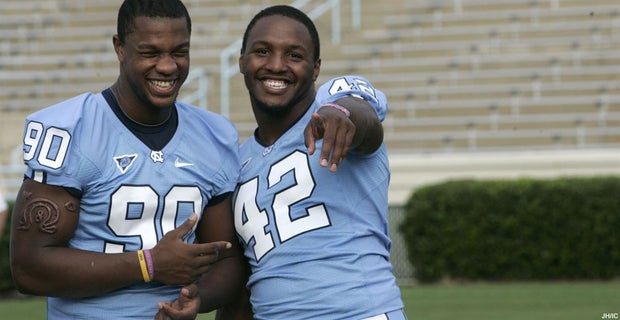
Robert Quinn was an exceptional kid. In 2008 and 2009, there was not a more gracious person on that team. He oozed humility, almost to a fault. He was grounded, down to earth, and a ridiculous dancer. He was also quiet, but extremely easy to befriend. It may have had something to do with his personal trials, losing part of his high school career to a brain tumor. “El Roy,” as we all called him, was—and as those still close to him will attest, is—a wonderful person. He was the most athletic, explosive, and gifted pass rusher in the 2011 draft. There were rumors he could go as high as the top pick had he played in 2010. Given all the trappings that naturally come with that status and stature, he can hardly be faulted for a wristwatch.
These three are teammates, and the school’s treatment of them—banning them from the program for life—is shameful, and egregiously disproportionate to the offenses committed. A decade later, and a decade wiser, it is clear—they were 20- and 21-year-old college athletes, each good people in their own way, and the school failed them. The same school that sacrificed them, providing no resources or guidance by which they could protect themselves despite having the means and knowledge by which to do so, failed these boys who put their trust in that school to have their best interests in mind. That same university had no issue with selling 8, 9, and 42 jerseys at $65 a piece in its own Student Stores.
Many of us former players view North Carolina’s handling of that 2010 team as cowardly. As a personal aside, when transferring into UNC Law in 2015, the registrar could not locate my academic records. It was explained to me that they were found locked away in some dark corner of campus along with my teammates’ files. The school all but erased our time from its memory. There were also concerns regarding self-proclaimed whistleblower Mary Willingham’s research for her forthcoming book, “Cheated,” whereby Willingham cherry-picked the academic records of certain players by name, as opposed to anonymously as it should have been done. The school’s avoidance of our class led to it never even notifying those of us who were included on her list, raising FERPA concerns that still go unresolved to this day.
Ultimately, UNC’s decision to distance itself reflects more poorly on the school than it does on the players. Yet, the punishment imposed on Marvin, Greg, and Rob is far, far worse than the backhanded, pearl-clutching, passive-aggressive treatment many of the rest of us received. An athlete’s college is a cornerstone of their identity. The rash decision to impose lifetime bans against these three young men stripped them of that. They committed no crimes, and they deserved better. It is inexcusable, and it is long past the time for the university to correct its mistake.