Republicans, list your favorite things about Darlene Graham

bdgan

All-American
Oct 12, 2021
5,483
5,318
113
Ok, I've had about enough of this so I'm going to need some reciepts.

That's nearly a 10% reduction in taxes at that top tax bracket, that's not insignificant.

You guys love talking about how the standard exemption was roughly doubled but that was paired with the elimination of the personal exemption, which came close to washing that entire benefit out while also making it less likely to be able to itemize deductions.

Corporate income taxes were reduced by 40%.

Allow more deductions on pass through income.

The estate tax exemption was doubled.

They got rid of the solar tax credit.

Everything I'm reading is that middle class people got a 1.5-2% bump in take home pay while the top 10% saw a 3-4%.
The BBB didn't provide any tax rate reduction for billionaires. You're just upset that the billionaires didn't get a tax increase.

The BBB didn't reduce the corporate income tax rate either. You're upset that we didn't revert to the 35% rate that was in effect a decade ago. That's an interesting position considering how you despise tariffs because they're passed onto consumers. Yet somehow you don't believe that higher taxes on income would be passed onto consumers.

FWIW the current 21.5% corporate rate puts us in the middle of all OECD countries.

Ireland 12.5%
Norway 22%
Poland 19%
Spain 25%
Switzerland 19.6%
UK 25%
France 25.8%
 

bdgan

All-American
Oct 12, 2021
5,483
5,318
113
Ignoring the lowering of top tax rate, here are the other changes the BBB made to high earners.
1. Increased estate tax exemption to $15m. (I agree with this.)
2. Expanded the Qualified Small Business Stock (QSBS) exemption by 50%—allowing up to $15 million or 10 times an investor's basis to be excluded from capital gains—and maintains preferential treatments for private equity and investment funds. (I agree with this.)
3. Cut and locked in lower corporate and international business tax rates, providing tens of billions in annual savings to top 0.1% shareholders and corporate giants. (I agree with this.)
4. 199A pass through deduction allowing business owners to deduct 20% of their "qualified business income." Taxpayers making less than $200,000—while representing 60 percent of small-business filers—received only 11 percent of the benefits from the pass-through deduction. (Somewhat agree with this - I think it should have been cut off once your small business makes more than $1m/year.)

While I mostly agree with all of the BBB tax adjustments, there was much more in there than just reducing the top tax bracket.
$15m estate tax exemption and QSB are hardly a concession to billionaires.
 

FLaw47

All-American
Dec 23, 2010
3,941
5,555
113
The BBB didn't provide any tax rate reduction for billionaires. You're just upset that the billionaires didn't get a tax increase.

The BBB didn't reduce the corporate income tax rate either. You're upset that we didn't revert to the 35% rate that was in effect a decade ago. That's an interesting position considering how you despise tariffs because they're passed onto consumers. Yet somehow you don't believe that higher taxes on income would be passed onto consumers.

FWIW the current 21.5% corporate rate puts us in the middle of all OECD countries.

Ireland 12.5%
Norway 22%
Poland 19%
Spain 25%
Switzerland 19.6%
UK 25%
France 25.8%

BBB made permanent a bunch of stuff that would have increased so yeah, a benefit for the very wealthy. Are you able to explain how, under Trump's administrations, that the little guy actually got the most benefit from the tax policies? If your response is "well they don't pay any taxes so of course the rich people got bigger cuts" I would point out:
  1. That's moving the goalposts
  2. That's a great reason for not doing a tax cut
For the record I actually think corporate taxes are stupid but reducing them should be paired with tax increases elsewhere instead of just further blowing up the deficit.
 

scotchtiger

Heisman
Dec 15, 2005
135,411
23,694
113
For the record I actually think corporate taxes are stupid but reducing them should be paired with tax increases elsewhere instead of just further blowing up the deficit.

I don't have time to jump into much of this today, but on corp taxes, I'll say that a major miss was lowering corp tax rates without putting in protections against things like stock buy-backs. I believe Biden/Harris proposed increasing the tax there and that could make sense. But the 2017 bill pretty much screwed that up by not having the protection in place to begin with when the corp rate was lowered.
 

dbjork6317

Heisman
Dec 3, 2009
18,735
73,669
113
I'll push back a little bit on your statement "this is what conservatives want - less rights for certain people" I don't think that's right. I know I don't want less rights, I want the same rights for everyone and we have courts set to make sure that happens. Are there times when someone's issue falls through the cracks..sure. But that the same in everything we do. But when a court determines someone's right have been violated there is remediation.

EDIT: on your statement about trump adding 12 trillion to the debt....couple of things to remember...1. Congress sets the budgets. So let's put some of the blame on them for $40trillion in debt. 2. If Trump added $12 trillion to the debt that means others added $28trillion ...so burden is not solely on Trump. Presidents and Controlled Congress' by either party have distinguished themselves on the fiscal front
I didn’t make the $12 trillion comment. But while we’re on the topic of congress controlling the purse strings, this President has decided that doesn’t apply to him and has brought back impoundment, which could not be more blatantly illegal.
 

scotchtiger

Heisman
Dec 15, 2005
135,411
23,694
113
Ok, I've had about enough of this so I'm going to need some reciepts.

That's nearly a 10% reduction in taxes at that top tax bracket, that's not insignificant.

You guys love talking about how the standard exemption was roughly doubled but that was paired with the elimination of the personal exemption, which came close to washing that entire benefit out while also making it less likely to be able to itemize deductions.

Corporate income taxes were reduced by 40%.

Allow more deductions on pass through income.

The estate tax exemption was doubled.

They got rid of the solar tax credit.

Everything I'm reading is that middle class people got a 1.5-2% bump in take home pay while the top 10% saw a 3-4%.

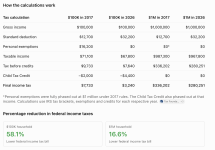
$100K family and a $1M family. $100K received a 58.1% reduction and the $1M family received a 16.6% reduction.

1791999450101.png
 
  • Like
Reactions: bdgan

FLaw47

All-American
Dec 23, 2010
3,941
5,555
113
$100K family and a $1M family. $100K received a 58.1% reduction and the $1M family received a 16.6% reduction.

View attachment 1484731

Sauce


Annual TCJA Tax Cut Breakdown (Full Implementation, ~2018–2025 Baseline)​

In total, the TCJA reduced federal revenues by roughly $275 billion to $285 billion annually during its initial primary window.

Income GroupExpanded Cash Income LevelShare of Total Tax Cut (%)Raw Average Tax Change Per Filer ($)Estimated Annual Aggregate Total ($ Billions)
Lowest Quintile (0–20%)Less than $25,0000.8%-$60~$2.2B
Second Quintile (20–40%)$25,000 – $48,6004.5%-$380~$12.5B
Middle Quintile (40–60%)$48,600 – $86,10011.1%-$930~$31.0B
Fourth Quintile (60–80%)$86,100 – $149,40021.2%-$1,810~$59.0B
Top Quintile (80–100%)Greater than $149,40062.4%-$7,640~$174.0B
— 80th to 90th Percentile$149,400 – $216,80014.1%-$2,850~$39.5B
— 90th to 95th Percentile$216,800 – $307,9009.8%-$4,030~$27.4B
— 95th to 99th Percentile$307,900 – $732,80018.0%-$13,480~$50.2B
— Top 1% (99th–100%)Greater than $732,80020.5%-$51,140~$56.9B
— Top 0.1% (99.9th–100%)Greater than $3,439,9007.9%-$193,380~$21.9B

So we spent more money giving tax cuts to the top 1% than we did on more than the bottom 60%. We spent more money giving tax cuts to the top 20% than the bottom 80%.

Do you contest any of that?
 

bdgan

All-American
Oct 12, 2021
5,483
5,318
113
BBB made permanent a bunch of stuff that would have increased so yeah, a benefit for the very wealthy. Are you able to explain how, under Trump's administrations, that the little guy actually got the most benefit from the tax policies? If your response is "well they don't pay any taxes so of course the rich people got bigger cuts" I would point out:
  1. That's moving the goalposts
  2. That's a great reason for not doing a tax cut
For the record I actually think corporate taxes are stupid but reducing them should be paired with tax increases elsewhere instead of just further blowing up the deficit.
Like I said you wanted the top tax rates to go up and they didn't. That's what you're calling tax cuts for billionaires.

It's interesting that allowing the covid era ENHANCED ACA subsidies to expire was viewed completely different by democrats.
 

bdgan

All-American
Oct 12, 2021
5,483
5,318
113
BBB made permanent a bunch of stuff that would have increased so yeah, a benefit for the very wealthy. Are you able to explain how, under Trump's administrations, that the little guy actually got the most benefit from the tax policies? If your response is "well they don't pay any taxes so of course the rich people got bigger cuts" I would point out:
  1. That's moving the goalposts
  2. That's a great reason for not doing a tax cut
For the record I actually think corporate taxes are stupid but reducing them should be paired with tax increases elsewhere instead of just further blowing up the deficit.
Please explain what you want to change in the tax code and why. For example are you OK with half the country who currently pay no income taxes to pay more? What would you do with the extra taxes on the wealthy?
 

bdgan

All-American
Oct 12, 2021
5,483
5,318
113
Sauce


Annual TCJA Tax Cut Breakdown (Full Implementation, ~2018–2025 Baseline)​

In total, the TCJA reduced federal revenues by roughly $275 billion to $285 billion annually during its initial primary window.

Income GroupExpanded Cash Income LevelShare of Total Tax Cut (%)Raw Average Tax Change Per Filer ($)Estimated Annual Aggregate Total ($ Billions)
Lowest Quintile (0–20%)Less than $25,0000.8%-$60~$2.2B
Second Quintile (20–40%)$25,000 – $48,6004.5%-$380~$12.5B
Middle Quintile (40–60%)$48,600 – $86,10011.1%-$930~$31.0B
Fourth Quintile (60–80%)$86,100 – $149,40021.2%-$1,810~$59.0B
Top Quintile (80–100%)Greater than $149,40062.4%-$7,640~$174.0B
— 80th to 90th Percentile$149,400 – $216,80014.1%-$2,850~$39.5B
— 90th to 95th Percentile$216,800 – $307,9009.8%-$4,030~$27.4B
— 95th to 99th Percentile$307,900 – $732,80018.0%-$13,480~$50.2B
— Top 1% (99th–100%)Greater than $732,80020.5%-$51,140~$56.9B
— Top 0.1% (99.9th–100%)Greater than $3,439,9007.9%-$193,380~$21.9B

So we spent more money giving tax cuts to the top 1% than we did on more than the bottom 60%. We spent more money giving tax cuts to the top 20% than the bottom 80%.

Do you contest any of that?
It looks like you're most upset about tax breaks for people earning > $86k
 

baltimorened

All-American
May 29, 2001
8,913
6,534
113
I've heard the cost would be $3.5 trillion but I don't think that's completely honest. The private sector spends $1.6 trillion on health insurance. Medicare is another $1.2 trillion and Medicaid is $0.7 trillion (not including state contributions). So we're already spending about $3.5 trillion per year. The devil is obviously in the details and the Medicare for all people aren't talking because their details would be widely criticized. It's safer for a politician to say it would be better and less expensive without providing details.

Some things to consider:
- Employers would pay a tax in lieu of paying premiums so it might increase their costs but not by that much.
- Dems want to cover everybody including illegal immigrants and people with TPS. That alone could be $100 billion/yr.
- People wouldn't have a choice of plans. No high deductible plans to save cost.
- Would Medicaid and Medicare be replaced?
- How would the tax be imposed? In Europe everybody pays for the most part. In Canada wealthy people pay ~ $60k per year.

One argument for Medicare of all is that it would be less expensive if run by the government. I don't think that's true. I understand that providers only have to deal with the government, not an array of different insurers. I agree that's bound to save some money but competition and the motivation to reduce costs are eliminated.

One thing for sure is that Medicare for all wouldn't reduce cost by 40% to get us where western European countries are. There's no way we can pay our providers more than twice as much and have similar costs.
a lot of us just complain about the increasing cost of healthcare without asking why. Well, I don't have the full answer, but just a few things...inflation, everything costs more: GLP1, a lot of programs cover this and it costs money: new tests, and equipment costs money: Our structure, Medicare and Medicaid, in a lot of instances, don't cover the cost of the services provided. So private insurers pay higher reimburseable rates to cover the differences. I saw some study where everyone was on Medicare and reimbursement rates stayed the same many hospitals wouldn't be able to pay the bills. There are already hospitals with large clientele of Medicaid/Medicare patients which have closed

just a couple of thoughts
 
  • Like
Reactions: bdgan

FLaw47

All-American
Dec 23, 2010
3,941
5,555
113
Like I said you wanted the top tax rates to go up and they didn't. That's what you're calling tax cuts for billionaires.

It's interesting that allowing the covid era ENHANCED ACA subsidies to expire was viewed completely different by democrats.

Republicans intervened to ensure that a scheduled return to the pre TCAJA rates didn't happen so yeah. Potato potato.
 

baltimorened

All-American
May 29, 2001
8,913
6,534
113
Ignoring the lowering of top tax rate, here are the other changes the BBB made to high earners.
1. Increased estate tax exemption to $15m. (I agree with this.)
2. Expanded the Qualified Small Business Stock (QSBS) exemption by 50%—allowing up to $15 million or 10 times an investor's basis to be excluded from capital gains—and maintains preferential treatments for private equity and investment funds. (I agree with this.)
3. Cut and locked in lower corporate and international business tax rates, providing tens of billions in annual savings to top 0.1% shareholders and corporate giants. (I agree with this.)
4. 199A pass through deduction allowing business owners to deduct 20% of their "qualified business income." Taxpayers making less than $200,000—while representing 60 percent of small-business filers—received only 11 percent of the benefits from the pass-through deduction. (Somewhat agree with this - I think it should have been cut off once your small business makes more than $1m/year.)

While I mostly agree with all of the BBB tax adjustments, there was much more in there than just reducing the top tax bracket.
the BBB didn't reduce the top tax brackets. The bracket is the same as that passed in 2017
 

baltimorened

All-American
May 29, 2001
8,913
6,534
113
But the rate has been 37% since 2017. Their argument is that they got a tax cut by not getting a tax increase.

Two additional points:

- I support increasing taxes on the ultra wealthy. >50% (37% + state + local) seems more than adequate but we're running $2 trillion deficits. We've got to find a way to get the deficit down. The problem is democrats who want to tax the rich think that money will lower their grocery, housing, and health insurance costs. Redistribution doesn't lower cost, it just forces more people to pay for other people.

- The USA already has the MOST PROGRESSIVE tax system in the industrialized world. That's not because super wealthy Americans pay the most, it's because those in lower income brackets pay the least.

U.S. already has most ‘progressive’ tax system in industrialized world | Fraser Institute
how about a surcharge on earnings over a certain level....pick one...$1million, $750,000...

we've done this before
 

FLaw47

All-American
Dec 23, 2010
3,941
5,555
113
It looks like you're most upset about tax breaks for people earning > $86k

Maybe if you can't read.

Please explain what you want to change in the tax code and why. For example are you OK with half the country who currently pay no income taxes to pay more? What would you do with the extra taxes on the wealthy?

There's a lot of things I'd do and I'll list them out in the vain hopes you actually read them with an open mind (I'm not going to give precise numbers here because I don't have the CBO stashed away in my house). This is not an exhaustive list of things, just what I could come up with while sitting here.
  • Get rid of stepped up basis on death
  • Reduce the estate tax exemption
  • Add more brackets at the top end of the range and increase the rates for the current top end
  • Increase taxes on capital gains to be something close to income taxes
  • Gget rid of corporate taxes
  • Replace corporate taxes with a VAT
  • Move away from property taxes for real estate and move to a land value tax
  • Get rid of the mortgage interest deduction
  • Eliminate the income cap on social security taxes (sorry Scotch)
Things that I'd do that cost money:
  • State provided parental leave for 12 weeks for up to two parents. Leave cannot be shared, it's 12 weeks per parent use it or lose it.
  • Create more public pre-schools
  • Subsidize clean energy in whatever the most beneficial way is (I'd think here supply side demands would be ideal)
  • Reduce the deficit
  • Make Social Security solvent again
  • Infrastructure
Things that don't necessarily cost money but might:
  • Public Option for health insurance
 

fskillet

All-Conference
Mar 26, 2026
932
2,502
93
the BBB didn't reduce the top tax brackets. The bracket is the same as that passed in 2017
Sorry, the BBB cancelled a scheduled return to their pre-2017 levels. I also said to ignore that one bullet point and coincidentally it’s the only one you didn’t ignore.
 

scotchtiger

Heisman
Dec 15, 2005
135,411
23,694
113
Sauce


Annual TCJA Tax Cut Breakdown (Full Implementation, ~2018–2025 Baseline)​

In total, the TCJA reduced federal revenues by roughly $275 billion to $285 billion annually during its initial primary window.

Income GroupExpanded Cash Income LevelShare of Total Tax Cut (%)Raw Average Tax Change Per Filer ($)Estimated Annual Aggregate Total ($ Billions)
Lowest Quintile (0–20%)Less than $25,0000.8%-$60~$2.2B
Second Quintile (20–40%)$25,000 – $48,6004.5%-$380~$12.5B
Middle Quintile (40–60%)$48,600 – $86,10011.1%-$930~$31.0B
Fourth Quintile (60–80%)$86,100 – $149,40021.2%-$1,810~$59.0B
Top Quintile (80–100%)Greater than $149,40062.4%-$7,640~$174.0B
— 80th to 90th Percentile$149,400 – $216,80014.1%-$2,850~$39.5B
— 90th to 95th Percentile$216,800 – $307,9009.8%-$4,030~$27.4B
— 95th to 99th Percentile$307,900 – $732,80018.0%-$13,480~$50.2B
— Top 1% (99th–100%)Greater than $732,80020.5%-$51,140~$56.9B
— Top 0.1% (99.9th–100%)Greater than $3,439,9007.9%-$193,380~$21.9B

So we spent more money giving tax cuts to the top 1% than we did on more than the bottom 60%. We spent more money giving tax cuts to the top 20% than the bottom 80%.

Do you contest any of that?

I've been clear in my wording. On a % basis, a middle income earner received a greater tax reduction. That's my example above.

Using your numbers, the same logic applies:

The top 1% pays 38.4% of federal income taxes, but only received 20.5% of the tax cut.

The top 20% pays 83% of federal income taxes, but only received 62.4% of the tax cut.

Conversely, the 60th-80th percentile pays 12% of federal income taxes, but received 21.2% of the tax cut.

The bottom 60% pays a mere 5% of federal income taxes, but received 16.4% of the tax cut.

Again, the tax cuts were clearly directed toward low and middle earners on a % basis. Higher earners received a lower share of tax savings relative to what they contribute. Lower and middle earners received a greater share of tax savings relative to what they contribute.
 
Last edited:
  • Like
Reactions: bdgan

FLaw47

All-American
Dec 23, 2010
3,941
5,555
113
I've been clear in my wording. On a % basis, a middle income earner received a greater tax reduction. That's my example above.

Using your numbers, the same logic applies:

The top 1% pays 38.4% of federal income taxes, but only received 20.5% of the tax cut.

The top 20% pays 83% of federal income taxes, but only received 62.4% of the tax cut.

Conversely, the 60th-80th percentile pays 12% of federal income taxes, but received 21.2% of the tax cut.

The bottom 60% pays a mere 5% of federal income taxes, but received 16.4% of the tax cut.

Again, the tax cuts were clearly directed toward low and middle earners on a % basis. Higher earners received a lower share of tax savings relative to what they contribute. Lower and middle earners received a greater share of tax savings relative to what they contribute.

And the fact of the matter is that if they wanted to make sure that more of the tax cuts went to people who made less income the could have. Instead they spent way more money giving tax breaks to the top 20% instead of the bottom 80%. But that's not what they wanted so they did something different. I don't think it's clear at all that the intent of the tax cuts were to primarily benefit lower income individuals but I think it's perfectly plausible that it was done the way it was so that they could claim it was.
 

bdgan

All-American
Oct 12, 2021
5,483
5,318
113
a lot of us just complain about the increasing cost of healthcare without asking why. Well, I don't have the full answer, but just a few things...inflation, everything costs more: GLP1, a lot of programs cover this and it costs money: new tests, and equipment costs money: Our structure, Medicare and Medicaid, in a lot of instances, don't cover the cost of the services provided. So private insurers pay higher reimburseable rates to cover the differences. I saw some study where everyone was on Medicare and reimbursement rates stayed the same many hospitals wouldn't be able to pay the bills. There are already hospitals with large clientele of Medicaid/Medicare patients which have closed

just a couple of thoughts
It's not just inflation, it's expansion of services. Back in the 70s our family doctor worked from his house. If he couldn't help you he sent you to the hospital because there weren't so many specialists. If we drove 10 miles we passed several factories. Today you'll pass a dozen healthcare facilities. There certainly weren't as many drugs. Mental health professionals were a fraction of what they are today. All of that is good but it's not free. A lot of people expect 1970s pricing with 2020s technology.

Same with things like Cars or homes. Cars used to have an AM radio, no rear window defroster, no airbags, no fuel injection, no ABS brakes, etc. Homes didn't have a/c, a microwave, smoke detectors, or wiring for internet. Of course the prices keep going up. The difference with healthcare is that nobody wants to put a price on it. Same with education.
 

scotchtiger

Heisman
Dec 15, 2005
135,411
23,694
113
And the fact of the matter is that if they wanted to make sure that more of the tax cuts went to people who made less income the could have. Instead they spent way more money giving tax breaks to the top 20% instead of the bottom 80%. But that's not what they wanted so they did something different. I don't think it's clear at all that the intent of the tax cuts were to primarily benefit lower income individuals but I think it's perfectly plausible that it was done the way it was so that they could claim it was.

Top 20%: 83% of taxes, 62% of cut. Negative 21%.

Bottom 80%: 17% of taxes, 38% of cut. Positive 21%.

I'm not sure how much more clear it can be. Any logical person would look at in within the context of the amount paid by each cohort.
 
  • Like
Reactions: bdgan

FLaw47

All-American
Dec 23, 2010
3,941
5,555
113
Top 20%: 83% of taxes, 62% of cut. Negative 21%.

Bottom 80%: 17% of taxes, 38% of cut. Positive 21%.

I'm not sure how much more clear it can be. Any logical person would look at in within the context of the amount paid by each cohort.

No, I don't think that's how any logical person would look at it. You're operating from a position that the people who pay the most in taxes "deserve" the most relief and a lot of people disagree with you.

With the all of Trump's tax policies, we've spent more money helping out wealthy people than we have poor people. That is an inescapable truth. You may think that's virtuous or something but it's what happened.

EDIT: Why is it so difficult for you to say that, at this moment of time, if the government has $100 to give out that you deserve more of it than someone making $50,000 per year?
 

bdgan

All-American
Oct 12, 2021
5,483
5,318
113
Maybe if you can't read.


There's a lot of things I'd do and I'll list them out in the vain hopes you actually read them with an open mind (I'm not going to give precise numbers here because I don't have the CBO stashed away in my house). This is not an exhaustive list of things, just what I could come up with while sitting here.
  • Get rid of stepped up basis on death
  • Reduce the estate tax exemption
  • Add more brackets at the top end of the range and increase the rates for the current top end
  • Increase taxes on capital gains to be something close to income taxes
  • Gget rid of corporate taxes
  • Replace corporate taxes with a VAT
  • Move away from property taxes for real estate and move to a land value tax
  • Get rid of the mortgage interest deduction
  • Eliminate the income cap on social security taxes (sorry Scotch)
Things that I'd do that cost money:
  • State provided parental leave for 12 weeks for up to two parents. Leave cannot be shared, it's 12 weeks per parent use it or lose it.
  • Create more public pre-schools
  • Subsidize clean energy in whatever the most beneficial way is (I'd think here supply side demands would be ideal)
  • Reduce the deficit
  • Make Social Security solvent again
  • Infrastructure
Things that don't necessarily cost money but might:
  • Public Option for health insurance
The stepped up basis is intended to minimize double taxation. The estate tax went away in 2010 and so did the stepped up basis. I remember people being upset that George Steinbrenner didn't pay estate taxes but he also didn't get a stepped up basis.

I don't know any VAT countries that don't also have corporate income tax.

Eliminating the cap on SS tax would change the program from a form of forced retirement savings to a redistribution program. I think we'll have to do some of that but I don't like it. Regardless it hardly impact billionaires (unless you define a billionaire as somebody who earns more than ~ $200k).

Many states already have parental leave programs.

I'm past retirement age so I have a different perspective. My first year of school was 1st grade. No kindergarten and no pre-K. You might be surprised to learn that I was proficient in math, science, readings, etc when I graduated. IMO the only reason for more public preschools is to provide taxpayer assisted daycare which might be helpful for 2 income families. FWIW the USA already spends more than all other countries except Luxembourg & Norway.

We disagree on subsidies for green energy. We've done a lot of that already. I'm an all of the above kind of person who thinks each technology should stand on it's own 2 feet.

The USA (Fed, State, Local) already spends ~ $1 trillion on infrastructure each year.

How do you propose to reduce the deficit except by raising taxes?


Somehow you seem to think that we could have all those things and balance the budget at the same time by taxing the rich? Trust me that's not nearly enough money.
 

FLaw47

All-American
Dec 23, 2010
3,941
5,555
113
The stepped up basis is intended to minimize double taxation. The estate tax went away in 2010 and so did the stepped up basis. I remember people being upset that George Steinbrenner didn't pay estate taxes but he also didn't get a stepped up basis.

In what way does stepped up basis avoid double taxation? It escapes paying capital gains tax. I don't think you know what this is and it definitely still exists.

I don't know any VAT countries that don't also have corporate income tax.

So what?

Eliminating the cap on SS tax would change the program from a form of forced retirement savings to a redistribution program. I think we'll have to do some of that but I don't like it. Regardless it hardly impact billionaires (unless you define a billionaire as somebody who earns more than ~ $200k).

So what?

Many states already have parental leave programs.

So what?

I'm past retirement age so I have a different perspective. My first year of school was 1st grade. No kindergarten and no pre-K. You might be surprised to learn that I was proficient in math, science, readings, etc when I graduated. IMO the only reason for more public preschools is to provide taxpayer assisted daycare which might be helpful for 2 income families. FWIW the USA already spends more than all other countries except Luxembourg & Norway.

So what?

We disagree on subsidies for green energy. We've done a lot of that already. I'm an all of the above kind of person who thinks each technology should stand on it's own 2 feet.

You can disagree, that's fine. I think it makes sense to sometimes subsidize things that are for the public good.

The USA (Fed, State, Local) already spends ~ $1 trillion on infrastructure each year.

Ok? We need to spend more.

How do you propose to reduce the deficit except by raising taxes?

Are you asking me what we should do to reduce the deficit other than raising taxes? Because I definitely suggested raising taxes. It was in the post you quoted.

Somehow you seem to think that we could have all those things and balance the budget at the same time by taxing the rich? Trust me that's not nearly enough money.

The stuff I mentioned isn't particularly expensive. I also didn't say "balance the budget". I said "reduce the deficit".
 
  • Love
Reactions: tigres88

scotchtiger

Heisman
Dec 15, 2005
135,411
23,694
113
No, I don't think that's how any logical person would look at it. You're operating from a position that the people who pay the most in taxes "deserve" the most relief and a lot of people disagree with you.

With the all of Trump's tax policies, we've spent more money helping out wealthy people than we have poor people. That is an inescapable truth. You may think that's virtuous or something but it's what happened.

EDIT: Why is it so difficult for you to say that, at this moment of time, if the government has $100 to give out that you deserve more of it than someone making $50,000 per year?

I don't want the government to give me anything. The only reason the government has that $100 is because they took it from someone who earned it. And relative to that $50K person, to get $100 from the two of us, the government took $98.82 from me and $1.18 from them (math per chatGPT).

I don't feel badly at all saying they should "only" take $83 dollars from me and $0.50 from them. Referencing back to ballpark reduction %s above. I'm still very, very clearly paying my fair share.
 

baltimorened

All-American
May 29, 2001
8,913
6,534
113
It's not just inflation, it's expansion of services. Back in the 70s our family doctor worked from his house. If he couldn't help you he sent you to the hospital because there weren't so many specialists. If we drove 10 miles we passed several factories. Today you'll pass a dozen healthcare facilities. There certainly weren't as many drugs. Mental health professionals were a fraction of what they are today. All of that is good but it's not free. A lot of people expect 1970s pricing with 2020s technology.

Same with things like Cars or homes. Cars used to have an AM radio, no rear window defroster, no airbags, no fuel injection, no ABS brakes, etc. Homes didn't have a/c, a microwave, smoke detectors, or wiring for internet. Of course the prices keep going up. The difference with healthcare is that nobody wants to put a price on it. Same with education.
I agree with you. The entire cost structure has shifted
 

baltimorened

All-American
May 29, 2001
8,913
6,534
113
The stepped up basis is intended to minimize double taxation. The estate tax went away in 2010 and so did the stepped up basis. I remember people being upset that George Steinbrenner didn't pay estate taxes but he also didn't get a stepped up basis.

I don't know any VAT countries that don't also have corporate income tax.

Eliminating the cap on SS tax would change the program from a form of forced retirement savings to a redistribution program. I think we'll have to do some of that but I don't like it. Regardless it hardly impact billionaires (unless you define a billionaire as somebody who earns more than ~ $200k).

Many states already have parental leave programs.

I'm past retirement age so I have a different perspective. My first year of school was 1st grade. No kindergarten and no pre-K. You might be surprised to learn that I was proficient in math, science, readings, etc when I graduated. IMO the only reason for more public preschools is to provide taxpayer assisted daycare which might be helpful for 2 income families. FWIW the USA already spends more than all other countries except Luxembourg & Norway.

We disagree on subsidies for green energy. We've done a lot of that already. I'm an all of the above kind of person who thinks each technology should stand on it's own 2 feet.

The USA (Fed, State, Local) already spends ~ $1 trillion on infrastructure each year.

How do you propose to reduce the deficit except by raising taxes?


Somehow you seem to think that we could have all those things and balance the budget at the same time by taxing the rich? Trust me that's not nearly enough money.
doing away with step up Hurst everybody, not just billionaires.

when I was on school board the pre k was a big thing. We did studies on benefits or pre k vs non pre k...granted anecdotal study. I'm positive there has to be more. what we found was that kid in pre k did better in early grades than those not in pre k (makes sense). But by grade 3 (or it might have been 5, I can't remember) any benefit was gone.

Now if we're looking at Pre k as a "baby sitting" effort to free more mothers into the work force, since we need workers, that might be worth looking into.

Until we get control of the fraud and financial mismanagement in our federal spending, I'm against any tax increases for anybody.

I've lived in a VAT country..there's a reason those people come to the US and do a lot of shopping and buying when here...our prices are significantly lower. VAT is a hidden tax on anybody who buys, Since we are a economy driven by consumption, VAT might not be a good idea.

higher taxes on capital gains really sounds good but could have detrimental impacts on retirement accounts which are dependent on the capital markets for returns. Lower return means less money in retirement. I's a tradeoff.

wouldn't eliminating the mortgage deduction hurt the low middle earners? People with money can put down large down payments or simply pay cash.

Florida is trying to do away with the property tax we'll see how that goes in november vote.

public option..I don't care as long as it does not require money from the federal budget as was promised during ACA debates. But somehow those commitments lose there fervor over time. NOTE government shutdown over allowing lapse of expanded subsidies in 2025
 

FLaw47

All-American
Dec 23, 2010
3,941
5,555
113
@baltimorened and @bdgan, I'm putting a lot more into this than you are. I'm delegating some of these explanations to Gemini until you can provide higher quality thoughts or rebuttals.

Get Rid of Stepped-Up Basis on Death​

  • Why it’s a good idea: Stepped-up basis allows the accrued capital gains of an asset to simply vanish for income tax purposes when the owner dies, resetting the cost basis to fair market value for the heir. This underpins the "Buy, Borrow, Die" strategy, where wealth is borrowed against tax-free for a lifetime and passes to heirs without capital gains ever being realized. Ending it removes the "lock-in" effect where capital stays trapped in unproductive assets just to dodge taxes, and levels the playing field between wage labor and inherited wealth.
  • Flaw47: If the person sold all of their stuff one second before they died, they'd owe capital gains on everything. Granting step up basis just because they died first doesn't make any sense.
  • Citation: The CRFB Analysis on Closing the Stepped-Up Basis Loophole and the CBO Deficit Reduction Options: Revoke the Step-Up of Basis for Capital Gains at Death find that roughly two-thirds of the benefit flows to the top quintile (and over 20% to the top 1%), and eliminating it raises hundreds of billions while removing significant economic deadweight loss.

Reduce the Estate Tax Exemption​

  • Why it’s a good idea: The federal estate tax exemption shields roughly $13.6M+ per individual ($27M+ per married couple), exempting over 99.8% of estates from paying a dime. Lowering the threshold directly targets dynastic wealth concentration, which stifles intergenerational economic mobility without harming small businesses or family farms (which can easily be protected through targeted statutory carve-outs).
  • Citation: The Tax Policy Center Briefing Book on the Estate Tax and the Bipartisan Policy Center Report on the 2025 Tax Debate demonstrate that lowering the basic exclusion threshold acts as one of the most progressive revenue-generating instruments available, impacting almost exclusively the top 0.2% of wealth holders while generating $200B+ in decadal revenue.

Add More Brackets at the Top End and Increase Top-End Rates​

  • Why it’s a good idea: The top federal bracket tops out around $600k–$700k for married filers. A household earning $750k pays the exact same marginal rate as an executive making $30M. Adding brackets (e.g., at $2M, $5M, and $10M+) captures pure economic rents and raises significant revenue from taxpayers who have near-zero marginal utility of consumption, without disincentivizing labor effort among high-earning professionals.
  • Citation: Nobel Laureate Peter Diamond and Emmanuel Saez published The Case for a Progressive Tax: From Basic Research to Policy Recommendations (JEP), finding that the revenue-maximizing top marginal tax rate for ultra-high earners is between 60% and 70% before meaningful labor-substitution effects occur.

Increase Taxes on Capital Gains to Match Ordinary Income​

  • Why it’s a good idea: The preferential discount on long-term capital gains (top federal rate of 20% vs. 37% ordinary income) is the single biggest engine of tax inequality. It drives massive accounting trickery (converting ordinary wage/carried interest income into capital returns) and results in the ultra-wealthy paying lower effective tax rates than mid-tier professionals. Equalizing rates restores horizontal equity: a dollar of income should be taxed the same whether earned by labor or an investment portfolio.
  • Citation: The Congressional Research Service Report on Taxes and the Economy: An Economic Analysis of the Top Tax Rates Since 1945 found that lower capital gains rates do not correlate with faster economic growth or higher private investment, but they are directly associated with widening income inequality.

Get Rid of Corporate Income Taxes​

  • Why it’s a good idea: Corporate taxes are opaque, economically distortionary, and heavily gameable. Because a corporation is legally an entity and not a human being, it cannot actually bear a tax burden; the tax is passed through unpredictably to shareholders (capital), employees (lower wages), and consumers (higher prices). Abolishing it eliminates offshore profit-shifting schemes, inversion maneuvers, and compliance waste, while making domestic capital investment wildly attractive.
  • Citation: Alan Auerbach’s NBER paper, Who Bears the Corporate Tax? A Review of What We Know, documents the severe deadweight loss and distortions in business formation and financing (debt vs. equity bias) caused by standard corporate entity-level taxes.

Replace Corporate Taxes with a VAT​

  • Why it’s a good idea: A destination-based Value-Added Tax (VAT) is the most stable, efficient, and leak-proof revenue-generating tool in modern economics (used by 170+ nations and every OECD peer). Because it taxes broad domestic consumption rather than business profit, it does not punish domestic manufacturing, export production, or investment. Paired with progressive rebates (a universal basic credit or UBI-style demogrant), a VAT raises massive, steady revenue with virtually zero economic deadweight loss.
  • Citation: The Institute for Fiscal Studies landmark review, The Mirrlees Review: Tax by Design, established that broad-based consumption taxes combined with targeted direct transfers provide the most economically neutral, distortion-free tax foundation possible.

Shift Away from Property Taxes to a Land Value Tax (LVT)​

  • Why it’s a good idea: Traditional property taxes tax both the raw land and the structure built on top of it. This actively penalizes property improvements, renovations, and housing density (build a triplex or renovate a run-down lot, and your taxes spike). An LVT taxes only the unimproved value of the location. Because the supply of land is completely fixed (inelastic), LVT cannot be passed onto tenants, stops real estate land speculation/hoarding, encourages dense housing development, and carries zero economic deadweight loss.
  • Citation: Joseph Stiglitz’s foundational work on The Theory of Local Public Goods and the Henry George Theorem and empirical research from the CEPR on Land Value Taxation and Urban Dynamics confirm that land taxes are fully capitalized into land values and bear no excess burden because land cannot be hidden or relocated.

Get Rid of the Mortgage Interest Deduction (MID)​

  • Why it’s a good idea: The MID does virtually nothing to increase homeownership rates; instead, it subsidizes the purchase of larger, more expensive homes for upper-middle-class and wealthy filers, artificially inflating home prices and incentivizing high household debt leverage. Peer nations like the UK and Canada have higher homeownership rates without any federal mortgage interest deduction.
  • Citation: Jonathan Gruber, Amalie Jensen, and Henrik Kleven’s NBER study, Do People Respond to the Mortgage Interest Deduction?, and Gervais & Tonetti’s study in the American Economic Journal on The Housing Tax Shelter, demonstrate that eliminating the MID reduces housing price distortions without lowering overall homeownership rates.

Eliminate the Income Cap on Social Security Taxes​

  • Why it’s a good idea: The Social Security payroll tax (6.2% employee / 6.2% employer) only applies to wages up to the taxable maximum (~$170k+), meaning high earners pay zero payroll tax on earnings above that line. Eliminating the cap makes the tax proportional across all wage earners, closes the vast majority of the program's long-term funding shortfall, and protects promised benefits without slashing them for lower earners.
  • Citation: Actuarial scoring from the SSA Office of the Chief Actuary Solvency Provisions and the CBO Options for Reducing the Deficit: Increase the Maximum Taxable Earnings for Social Security show that applying the payroll tax above the cap covers roughly 60% to 75% of Social Security's entire 75-year actuarial deficit.

Continued​


FLaw47

All-American
Dec 23, 2010
3,941
5,555
113

Things That Cost Money​

State-Provided 12-Week Non-Transferable Parental Leave​

  • Why it’s a good idea: The US is an extreme outlier as the only developed country without statutory paid parental leave. Reserving 12 non-transferable weeks specifically for each parent (the “daddy quota” in the Nordic model) dramatically improves female workforce retention and closes the maternal wage penalty, as fathers are structurally incentivized to take leave rather than letting all career disruption fall on the mother.
  • Citation: Dahl, Løken, and Mogstad’s AER study, Peer Effects in Program Participation, and cross-country research from the OECD Family Database on Parental Leave Systems, show that dedicated, non-transferable father quotas directly compress the long-term gender pay gap and bolster child developmental outcomes.

Create More Public Pre-Schools​

  • Why it’s a good idea: High-quality early childhood education yields massive economic returns. Subsidized universal or expanded public pre-K frees working parents (especially mothers) to stay in the labor force, generating immediate tax revenue and labor supply, while providing long-term cognitive and behavioral dividends that pay for themselves over decades through lower incarceration, higher college graduation, and higher lifetime earnings.
  • Citation: Nobel Laureate James Heckman’s empirical research, summarized in The Lifecycle Benefits of an Influential Early Childhood Program, demonstrates a 7% to 13% annualized ROI per dollar invested in comprehensive early childhood education programs.

Subsidize Clean Energy via Supply-Side Incentives​

  • Why it’s a good idea: Subsidizing the supply side (Production Tax Credits, Capex matching for grid buildout, and modular clean tech deployment) directly drives down the long-run marginal cost curve of energy through technology learning curves and scale. Unlike demand subsidies, which can simply bid up prices if supply is constrained, supply-side buildouts force deflationary energy abundance across the whole economy.
  • Citation: Rupert Way, Matthew Ives, Penny Mealy, and J. Doyne Farmer’s paper in Joule, Empirically Grounded Technology Forecasts and the Energy Transition, proves that technology learning rates for solar, wind, and batteries drive structural cost decreases far faster than fossil-fuel generation when deployment volume is accelerated via capital support.

Reduce the Deficit​

  • Why it’s a good idea: Sustained high primary deficits during peacetime expansions squeeze out private investment, spike debt servicing costs, and increase macroeconomic vulnerability to inflation or sudden sovereign bond yield spikes. Restoring long-term fiscal balance via structural tax reform (VAT, LVT, loophole elimination) stabilizes the debt-to-GDP ratio and frees up public funds currently wasted on bond interest.
  • Citation: The CBO Long-Term Budget Outlook consistently models that stabilizing and reducing the debt-to-GDP trajectory increases long-term real GDP per capita by lowering market borrowing costs and crowding-in private capital formation.

Make Social Security Solvent Again​

  • Why it’s a good idea: The Social Security Old-Age and Survivors Insurance (OASI) Trust Fund reserves are projected to exhaust in the 2030s. If Congress ignores it, statutory law forces an automatic, across-the-board ~20% to 23% benefit cut overnight, devastating millions of vulnerable retirees. Restoring actuarial balance now eliminates economic uncertainty for near-retirees and prevents a sudden retirement poverty shock.
  • Citation: The 2024 Annual Report of the Board of Trustees of the Federal OASDI Trust Funds shows that resolving the solvency gap proactively through revenue restructuring prevents drastic, sudden benefit cliffs.

Infrastructure Investment​

  • Why it’s a good idea: Modern, well-maintained civil infrastructure (high-voltage transmission lines, freight networks, ports, water systems, clean transit) generates positive economic externalities and lowers shipping and transaction friction across the private supply chain. Deferred maintenance compounds exponentially in cost, making proactive public capital spending highly accretive.
  • Citation: Josh Bivens’s research for the Economic Policy Institute, The Potential Macroeconomic Benefits from Increasing Infrastructure Investments, indicates that every $1 spent on productive physical infrastructure yields between $1.50 and $2.20 in overall economic output over its lifecycle.

Things That Don't Necessarily Cost Money (Cost-Neutral or Net-Savings)​

Public Option for Health Insurance​

  • Why it’s a good idea: A government-backed public option introduced onto health exchanges doesn't require a state takeover; it simply injects a non-profit competitor with nationwide leverage into regional insurance markets that are currently heavily consolidated and monopolistic. It forces private insurers to lower overhead and curb excessive markups, reducing average plan premiums for consumers and lowering federal ACA subsidy expenditures.
  • Citation: The CBO Report on A Public Option for Health Insurance in the Nongroup Marketplaces scored public option proposals as generating net federal budgetary savings ($100B+ over ten years) because lower exchange benchmark premiums directly reduce federal premium tax credit outlays.
 

bdgan

All-American
Oct 12, 2021
5,483
5,318
113
In what way does stepped up basis avoid double taxation? It escapes paying capital gains tax. I don't think you know what this is and it definitely still exists.
Paying income tax on an increase in value then also paying estate tax on the higher value = double taxation. That seems pretty simple to me.
I think it makes sense to sometimes subsidize things that are for the public good.
Ok? We need to spend more.
We spend $7 trillion while collecting $5 trillion. I don't think the problem is we're not subsidizing enough.
 

FLaw47

All-American
Dec 23, 2010
3,941
5,555
113
Paying income tax on an increase in value then also paying estate tax on the higher value = double taxation. That seems pretty simple to me.

You don't pay income taxes on it, you pay capital gains. You're making an argument against estate taxes, not step up basis. I mean "double taxation" is and always has been a dumb argument but here we are. Plus stepped up basis is what allows borrow-buy-die to work and there are lots of ways to skirt estate tax. Getting rid of stepped up basis solves A LOT.

We spend $7 trillion while collecting $5 trillion. I don't think the problem is we're not subsidizing enough.

I don't accept "we spend too much" as a rebuttal to me answering your question of "what would you spend on if we raised taxes?".
 

bdgan

All-American
Oct 12, 2021
5,483
5,318
113
when I was on school board the pre k was a big thing. We did studies on benefits or pre k vs non pre k...granted anecdotal study. I'm positive there has to be more. what we found was that kid in pre k did better in early grades than those not in pre k (makes sense). But by grade 3 (or it might have been 5, I can't remember) any benefit was gone.
A study was done on Bush's No Child Left Behind Act that had the same conclusion you referenced. Kids in the program did better at first but by 3rd grade there was no differences.

Like I said I never even had K but I learned to read and do math just fine. The USA spends more on education than almost all OECD countries but our outcomes don't math our spending. Sometimes it's not about the spending.
 

bdgan

All-American
Oct 12, 2021
5,483
5,318
113
@baltimorened and @bdgan, I'm putting a lot more into this than you are. I'm delegating some of these explanations to Gemini until you can provide higher quality thoughts or rebuttals.

Get Rid of Stepped-Up Basis on Death​

  • Why it’s a good idea: Stepped-up basis allows the accrued capital gains of an asset to simply vanish for income tax purposes when the owner dies, resetting the cost basis to fair market value for the heir. This underpins the "Buy, Borrow, Die" strategy, where wealth is borrowed against tax-free for a lifetime and passes to heirs without capital gains ever being realized. Ending it removes the "lock-in" effect where capital stays trapped in unproductive assets just to dodge taxes, and levels the playing field between wage labor and inherited wealth.
  • Flaw47: If the person sold all of their stuff one second before they died, they'd owe capital gains on everything. Granting step up basis just because they died first doesn't make any sense.
  • Citation: The CRFB Analysis on Closing the Stepped-Up Basis Loophole and the CBO Deficit Reduction Options: Revoke the Step-Up of Basis for Capital Gains at Death find that roughly two-thirds of the benefit flows to the top quintile (and over 20% to the top 1%), and eliminating it raises hundreds of billions while removing significant economic deadweight loss.

Reduce the Estate Tax Exemption​

  • Why it’s a good idea: The federal estate tax exemption shields roughly $13.6M+ per individual ($27M+ per married couple), exempting over 99.8% of estates from paying a dime. Lowering the threshold directly targets dynastic wealth concentration, which stifles intergenerational economic mobility without harming small businesses or family farms (which can easily be protected through targeted statutory carve-outs).
  • Citation: The Tax Policy Center Briefing Book on the Estate Tax and the Bipartisan Policy Center Report on the 2025 Tax Debate demonstrate that lowering the basic exclusion threshold acts as one of the most progressive revenue-generating instruments available, impacting almost exclusively the top 0.2% of wealth holders while generating $200B+ in decadal revenue.
AI will give different responses depending on how you phrase the question. Putting that aside:

Taxing somebody on how much their assets appreciated then taxing them again based on the total value when you die is DOUBLE TAXATION. It's also a tax on inflation.

I told you about the 2001 Economic Growth and Tax Relief Reconciliation Act (EGTRRA) which temporarily repealed federal estate taxes for 2010, but also got rid of the step-up in basis for inherited assets. We might be able to reach a meeting of the minds if you favor one over the other but you want both.
 

bdgan

All-American
Oct 12, 2021
5,483
5,318
113
I don't accept "we spend too much" as a rebuttal to me answering your question of "what would you spend on if we raised taxes?".
You prove my point about democrats who want to raise taxes. You want to use the added revenue for more social welfare /redistribution instead of reducing the deficit.
 

FLaw47

All-American
Dec 23, 2010
3,941
5,555
113
AI will give different responses depending on how you phrase the question. Putting that aside:

Taxing somebody on how much their assets appreciated then taxing them again based on the total value when you die is DOUBLE TAXATION. It's also a tax on inflation.

I told you about the 2001 Economic Growth and Tax Relief Reconciliation Act (EGTRRA) which temporarily repealed federal estate taxes for 2010, but also got rid of the step-up in basis for inherited assets. We might be able to reach a meeting of the minds if you favor one over the other but you want both.
And I will reiterate that I could not care less about the concept of double taxation. Literally everything we spend has been taxed multiple times. Whenever you buy something you pay sales tax on it. Whenever you get income, it's with money that the employer has paid taxes on at some point. It is a dumb argument.

Separately, what you are arguing against is capital gains tax. And again, if the person had sold the assets four seconds before they died, it wouldn't have mattered. They would have paid full capital gains taxes on the asset and then would have had the full estate tax taken out of that reduced amount afterwards. If you want to argue that capital gains tax should be inflation-adjusted, you will have a sympathetic ear, but that is not what you have argued.

And obviously AI is subject to errors. I decided to outsource some of my labor when I'm responding to people who aren't putting in an equivalent amount of effort or reason into their arguments. I did at least check to make sure that the output was stuff that I agreed with.
 
  • Like
Reactions: tigres88

FLaw47

All-American
Dec 23, 2010
3,941
5,555
113
You prove my point about democrats who want to raise taxes. You want to use the added revenue for more social welfare /redistribution instead of reducing the deficit.

Edit: Hopefully you didn't see the original version of this because it wasn't nice. As I pointed out in the message you were responding to, I both suggested that we have more social spending AND pay down the deficit. I did not say that the deficit meant nothing to me, and I have also never suggested that the only reason to raise taxes was to pay down the deficit.
 
Last edited:

baltimorened

All-American
May 29, 2001
8,913
6,534
113
You don't pay income taxes on it, you pay capital gains. You're making an argument against estate taxes, not step up basis. I mean "double taxation" is and always has been a dumb argument but here we are. Plus stepped up basis is what allows borrow-buy-die to work and there are lots of ways to skirt estate tax. Getting rid of stepped up basis solves A LOT.


I don't accept "we spend too much" as a rebuttal to me answering your question of "what would you spend on if we raised taxes?".
flaw, all good ideas with reasons why...I applaud your efforts. But I just don't like the idea of some of them. I'm a "for every action there is an equal and opposite reaction" believer......works in physics, works in economics...so for all the good things on one side there are sure to be some negatives which none of the folks in your post seem to acknowledge.

It appears to me that your focus is in how to raise additional revenues. And, we need to do that and I don't think anyone disagrees. And your proposition is to tax the wealthy, and I imagine many people, especially the not wealthy would line up to support that. But, I'd submit that taking money from the rich and thinking the government could spend it more wisely is un proveable theory and, if history is a good example of the future it would be difficult debate. If anything, some could make a good case right now that fraud and mismanagement costs taxpayers a lot of money. Granted though, not enough to close the revenue/spending gap.

Of course, all those not impacted by any or all of the propositions would likely be all for them, since people "vote" in their best interests.

For sure we have a fiscal problem that needs to be resolved. If we are to resolve it, there will likely be some compromise between taxes and spending. But right now, our government does not appear to be serious about reducing the deficits and until they are, everything is just talk and or speculation. If we're not careful the dereliction is going to come back to bite us and severely limit options when we might need them most.
 

baltimorened

All-American
May 29, 2001
8,913
6,534
113
AI will give different responses depending on how you phrase the question. Putting that aside:

Taxing somebody on how much their assets appreciated then taxing them again based on the total value when you die is DOUBLE TAXATION. It's also a tax on inflation.

I told you about the 2001 Economic Growth and Tax Relief Reconciliation Act (EGTRRA) which temporarily repealed federal estate taxes for 2010, but also got rid of the step-up in basis for inherited assets. We might be able to reach a meeting of the minds if you favor one over the other but you want both.
bdgan, I have to admit I don't understand your argument..although for sure I agree with your end result..no elimination of step up.

But I think Flaw is right unless you two are talking around each other. As I understand it, when a stock asset owner dies, the cost basis steps up to the date he does and then passes to his heirs. If the heir sells that stock the same day there is to capital gains tax as the new cost basis is the step up amount.

I just went through this with my estate planner in updating my trusts. One of my main interests was insuring that the step up was accounted for...
 
  • Like
Reactions: FLaw47
Tiger Illustrated

Latest

  1. 01 Tiger Illustrated Football Drilling down on Clemson Football's roster spend
  2. 02 Rivals Football Recruiting Dabo Swinney, Clemson's culture win over 2028 TE Wright Martin: 'It was home for me'
  3. 03 On3 Football College Football Playoff nearing deal to expand to 24 teams
  4. 04 Tiger Illustrated Football Recruiting Clemson Football Roster & Recruiting Big Board: Safety
  5. 05 Tiger Illustrated Football Recruiting Clemson Football Roster & Recruiting Big Board: Wide Receiver