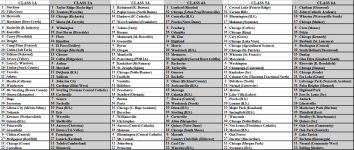
It seems like the calls to switch Classes 1A-6A to 1-32 seeding instead of 1-16 with a North/South split have been ramping up lately, so I have taken the liberty of comparing how this year's postseason brackets would compare if 1-32 seeding was actually used in all classes. The 1-32 seeding mockup brackets used for this analysis will be added in a subsequent post.
The first question is how would changing to 1-32 change the brackets from a competitive standpoint?
One of the common complaints with 1-16 seeding is it leads to regular season rematches. Let’s look at how those would fluctuate:
Another complaint against 1-16 is it dampens the likelihood of the “true” state championship game, where the best two teams in the class would face off in the finals. To compare how well the two systems compare at achieving this goal, I determined the top two teams in each class based on Massey Ratings and then saw which round they would meet in under 1-16 vs 1-32.
In Class 1A, Stockton and Lena-Winslow are the top-two rated teams.
By this metric, 1-16 slightly outperforms 1-32
The second question is how much would travel increase?
Important Notes for travel figures:
-All travel estimates are done based on traveling between the two high schools. Not all teams play games exactly by their school but the school address is a good estimate in most cases and doing this avoids speculating where CPL schools might play hypothetical matchups
-All travel was routed between the hours of 12:00 am and 1:00 am to minimize irregular traffic impacting figures. As a result, there is some fluctuation from what would in reality be the optimal route at regular game times
-Round trip figures are used for miles
Let's look at how many miles 1-32 seeding would add overall and for each individual class
Across all 6 classes:
In Class 1A:
Let's also look at the Top 10 longest trips created under each format:
1-16 Seeding 10 Longest Trips
1-32 Seeding 10 Longest Trips
The first question is how would changing to 1-32 change the brackets from a competitive standpoint?
One of the common complaints with 1-16 seeding is it leads to regular season rematches. Let’s look at how those would fluctuate:
- With 1-16 seeding, there are 11 rematches in this first round (3 in 1A, 1 in 2A, 2 in 3A, 4, in 4A, 0 in 5A and 1 in 6A)
- With 1-32 seeding, there are 5 rematches in the first round (1 in 1A, 0 in 2A, 2 in 3A, 2 in 4A, 0 in 5A and 0 in 6A)
Another complaint against 1-16 is it dampens the likelihood of the “true” state championship game, where the best two teams in the class would face off in the finals. To compare how well the two systems compare at achieving this goal, I determined the top two teams in each class based on Massey Ratings and then saw which round they would meet in under 1-16 vs 1-32.
In Class 1A, Stockton and Lena-Winslow are the top-two rated teams.
- In 1-16, they could play in the semifinal round
- In 1-32, they could play in the semifinal round
- In 1-16, they could play in the quarterfinal round
- In 1-32, they could play in the quarterfinal round
- In 1-16, they could play in the quarterfinal round
- In 1-32, they could play in the semifinal
- In 1-16, they could play in the semifinal round
- In 1-32, they could play in the semifinal round
- In 1-16, they could play in the state championship
- In 1-32, they could play in the state championship
- In 1-16, they could play in the state championship
- In 1-32, they could play in the second round
By this metric, 1-16 slightly outperforms 1-32
- In four classes (1A, 2A, 4A and 5A), the top-two teams would meet in each other in the same round
- In one class (6A), the top-two teams would meet three rounds later under 1-16 than 1-32
- In one class (3A), the top-two teams would meet one round later under 1-32 than 1-16
The second question is how much would travel increase?
Important Notes for travel figures:
-All travel estimates are done based on traveling between the two high schools. Not all teams play games exactly by their school but the school address is a good estimate in most cases and doing this avoids speculating where CPL schools might play hypothetical matchups
-All travel was routed between the hours of 12:00 am and 1:00 am to minimize irregular traffic impacting figures. As a result, there is some fluctuation from what would in reality be the optimal route at regular game times
-Round trip figures are used for miles
Let's look at how many miles 1-32 seeding would add overall and for each individual class
Across all 6 classes:
- 1-16 seeding resulted in a total of 18,180 miles traveled (average of 189 per game)
- 1-32 seeding resulted in a total of 26,300 miles traveled (average of 274 per game)
- Difference: 1-32 seeding increases mileage by 45% and a total of 8,120 miles (average of 85 more miles per game)
In Class 1A:
- 1-16 seeding resulted in a total of 3,290 miles traveled (average of 206 per game)
- 1-32 seeding resulted in a total of 4,908 miles traveled (average of 307 per game)
- Difference: 1-32 seeding increases mileage by 49% and a total of 1,618 miles (average increase of 101 miles per game)
- 1-16 seeding resulted in a total of 3,664 miles traveled (average of 229 per game)
- 1-32 seeding resulted in a total of 5,420 miles traveled (average of 339 per game)
- Difference: 1-32 seeding increases mileage by 48% and a total of 1,756 miles (average increase of 110 miles per game)
- 1-16 seeding resulted in a total of 2,848 miles traveled (average of 178 per game)
- 1-32 seeding resulted in a total of 4,248 miles traveled (average of 266 per game)
- Difference: 1-32 seeding increases mileage by 49% and a total of 1,400 miles (average increase of 88 miles per game)
- 1-16 seeding resulted in a total of 3,196 miles traveled (average of 200 per game)
- 1-32 seeding resulted in a total of 4,600 miles traveled (average of 288 per game)
- Difference: 1-32 seeding increases mileage by 44% and a total of 1,404 miles (average increase of 88 miles per game)
- 1-16 seeding resulted in a total of 2,552 miles traveled (average of 160 per game)
- 1-32 seeding resulted in a total of 3,920 miles traveled (average of 245 per game)
- Difference: 1-32 seeding increases mileage by 54% and a total of 1,368 miles (average increase of 86 miles per game)
- 1-16 seeding resulted in a total of 2,630 miles traveled (average of 164 per game)
- 1-32 seeding resulted in a total of 3,204 miles traveled (average of 200 per game)
- Difference: 1-32 seeding increases mileage by 22% and a total of 574 miles (average increase of 36 miles per game)
Let's also look at the Top 10 longest trips created under each format:
1-16 Seeding 10 Longest Trips
- Quincy at Crete Monee (600 miles)
- Plainfield East at East St. Louis (528 miles)
- Hillcrest at Macomb (462 miles)
- Hamilton at Wilmington (446 miles)
- Salt Fork at Dupo (406 miles)
- Marion at Mahomet-Seymour (392 miles)
- Maroa-Forsyth at Chester (382 miles)
- St. Joseph (Ogden) at Benton (360 miles)
- Fairfield at PORTA (356 miles)
- Villa Grove at Calhoun (354 miles)
1-32 Seeding 10 Longest Trips
- Woodstock (North) at Breese (Central) (652 miles)
- West Frankfort at IC Catholic (628 miles)
- Chicago (South Shore) at Quincy Notre Dame (620 miles)
- East St. Louis at Highland Park (620 miles)
- Forreston at Dupo (620 miles)
- Cahokia at Marengo (618 miles)
- Marion at Providence Catholic (592 miles)
- Carthage (Illini West) at Johnston City (576 miles)
- Mascoutah at St. Francis (572 miles)
- Quincy at Bradley-Bourbonnais (550 miles)
Last edited: