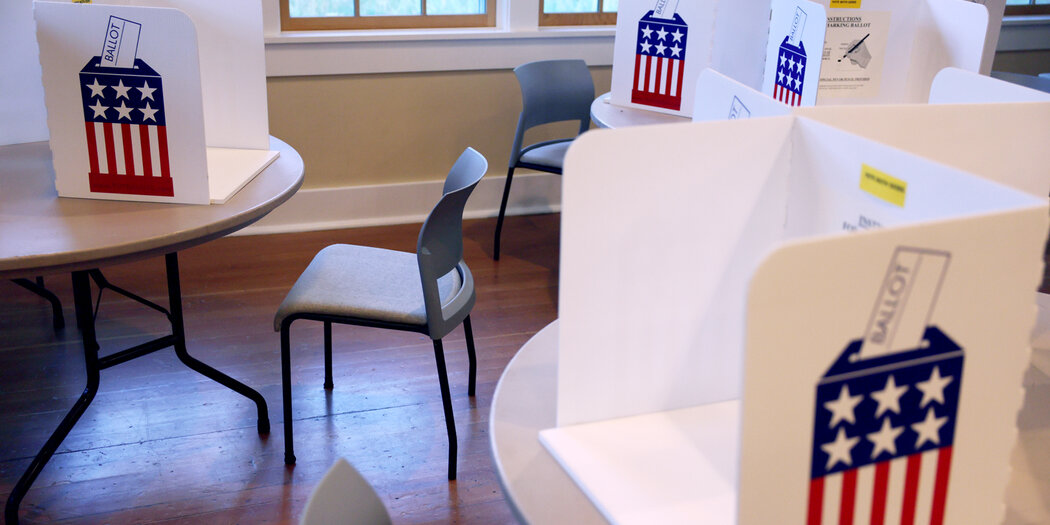
First let's admit that we never had this huge concern about voter fraud until Trump came along. For 250 years we've trusted our election officials and the voters on the results of our elections. But in 2016, even though he won the election, he bitched and moaned that he would have won the popular vote too if millions of illegals hadn't voted and to prove it, he apponted Kris Kobach to form a panel to investigate voter fraud which he later quietly dismantled when he came up with nothing.
Then in 2020, he tried every trick in the book to overturn the will of the people (including violence) even though he didn't have a shred of evidence to prove it and even after he was repeatedly told by those whose job it is to know that there was an insignificant amount of fraud that wouldn't have changed the outcome in any state, yet he didn't care or believe it.
He even fired his lifelong Republican CISA Director for stating it was the most secure election in history.
David Becker at the Center for Election Innovation and Research :
"We know our elections are more secure than ever. We know we have more protections and checks and balances against fraud than ever. And we also know that this administration has gone out hunting for fraud with all of the tools of the federal government over the last year, and they have found virtually none."
We also had the ultra-conservative Heritage Foundation's research show that from 2000 - 2025, they could only find 77 instances of non-citizens voting and that's what we're restructuring our entire voter registration system around? Exactly what are we securing it against and at what cost to legitimate voters?
On the married women issue not being "noise": Roughly 84% of women who marry change their surname, meaning as many as 69 million American women have a birth certificate that doesn't match their legal name — and the SAVE Act makes no mention of being able to show a marriage certificate or name-change documentation to bridge that gap.https://www.americanprogress.org/article/the-save-act-overview-and-facts/
On "just get a birth certificate": You Googled it and it didn't look too hard. That's a reasonable point, but consider: getting a birth certificate typically costs money, requires knowing which county or state office to contact, may require a prior ID to obtain (a catch-22 for people without ID), and takes time. Research shows that more than 21 million Americans lack ready access to citizenship documents, and roughly half of Americans don't even have a passport. Imagine someone working two jobs with no flexibility or someone with a job that requires full-time travel, that makes it more prohibitive than convenient.
https://www.brennancenter.org/our-w...s-would-still-block-millions-americans-voting
On the "just go in person" piece: In the 2022 cycle, of the 80+ million Americans who registered or updated their registration, only about 5.9% did so in person at an election office. The SAVE Act would require
everyone to do it that way — every time they move, change their name, or update any registration detail. That's a massive shift in how American civic participation actually works, not a minor tweak.
The deeper issue: You're right that people solve hard problems, but we don't generally require them to solve hard problems specifically to exercise a constitutional right, especially when the problem being solved (noncitizen voting) is demonstrably rare. The burden falls hardest on people who are already citizens — just lower-income, rural, recently married, or recently moved among others.
The question isn't just "how secure do we want elections?" It's "are we willing to disenfranchise millions of verified citizens to prevent a handful of fraudulent votes?"
That's the trade-off we have to address


 President Trump to name Sidney Powell a DOJ Special Attorney that he is calling his "Elections Czar" to investigate and prosecute voter fraud in the 2026 midterm elections. There is no more fitting of a patriot to put in charge of ensuring that those who attempt to subvert the will of the American people and rig our elections are held accountable than the woman who EXPOSED the stolen election of 2020. Sidney Powell put her career on the line and now she has been TOTALLY VINDICATED... The radical left THUGS are shaking in their boots after hearing that Sidney Powell is about to RELEASE THE KRAKEN of justice upon them. Great move President Trump!!!