Time to Be: Mullen and Hudspeth
- Thread starter Indndawg
- Start date
You are using an out of date browser. It may not display this or other websites correctly.
You should upgrade or use an alternative browser.
You should upgrade or use an alternative browser.
If they stack the box which we anticipate then we could see a HEAVY dose of the option. Let's make them play sideline to sideline.
Since wilder is obviously a "more elite talent" than julio jones, we should just throw it deep to him every play. we should probably run the same exact play that turned him into a superstar in the KY game.
seriously though...bubble screen, bubble screen, draw, bubble screen....take a (or THE) page out of Houston's playbook.
seriously though...bubble screen, bubble screen, draw, bubble screen....take a (or THE) page out of Houston's playbook.
I don't think the option is the way to do it. Make them play sideline-to-sideline by throwing quick outs and the like. Their LBs are just too fast to stretch them on the option.NorthMsDawg said:If they stack the box which we anticipate then we could see a HEAVY dose of the option. Let's make them play sideline to sideline.
I too like the slants. However, our tackles have to do a great job of cut-blocking on the slant, or our midget QB will have the pass batted down. Tyson Lee's height gives him trouble on the slant.
Do what you are supposed to do with the spread. Go 4 wide with a single back. It forces Bama to take guys out of the box to cover, which will open up the run. Run WR screens, slants, other short, high percentage passes that don't require seeing over the line. Get the ball to Green, Berry, and Bumphis in the slot and let those WR / LB mismatches work for you. If we can be successful in the short passing game, we can be successful in the running game, and we might have a chance.
They have responsibilty to a man they can't just fly to the football. I just dont like our match ups with in the open field with their DBs. We are going to need non-offensive TD's in this one.</p>
They can assign those men differently. Whereas some teams might have to have the OLB take the quarterback and thus get a much better matchup for the pitchman, they're fast enough that they can get an ILB there in time to take the QB and let the OLB take the pitch.NorthMsDawg said:They have responsibilty to a man they can't just fly to the football. I just dont like our match ups with in the open field with their DBs. We are going to need non-offensive TD's in this one.</p>
We will have to play better than we have in any game this year in order to win tomorrow night. But I think we will.
One glimmer of hope is our vastly improved O line play as of late. We are playing more physical than we have in a long time and not to mention that our O line is very cofident. However, it seems to always come back to the midget.
</p>
</p>

running the option vs Bammer wont gain us a thing- just like we couldnt run it vs Fla- too much speed to run side to side against...the guy that said 4-wide, 1 back sets to even up the D is the way to go...that way Tyson and Mullen can view the D and see where they are trying to blitz from...NorthMsDawg said:They have responsibilty to a man they can't just fly to the football. I just dont like our match ups with in the open field with their DBs. We are going to need non-offensive TD's in this one.</p>
He'll throw a few balls that look like the most beautiful, accurate passes you've ever seen. Tight spiral, great zip, all of it. And then he'll throw just as many (if not more) passes that you have no idea who he's throwing it to. Inconsistency is his biggest issue. The ability is in there....somewhere. I just don't think we can count on it.
i think I will go with the man who gets paid to coach D-1 football, not someone who once coached in academy football
http://thebirddog.wordpress.com/2007/07/30/five-myths-of-paul-johnsons-offense/
Myth #4: The option is outdated. It can't compete with the speed of today's defenses.</p>
Speaking of Urban Meyer, his success has meant that this particular myth hasn't been as common lately. His offense is very option-heavy, even if he dislikes the "option coach" label. (PJ is a friend of Meyer's and tells a funny story about that.) For some reason, though, people still cling to the idea that the option's time has come and gone. Maybe it's because Meyer runs his option plays out of the shotgun, as if that really changes anything. If Meyer's success hasn't convinced you, then I doubt that there's anything I could say that would. That doesn't make for interesting reading, though, so I'll make the attempt.</p>
It's true that defenses are faster than they used to be. But offenses are too, so that theory sort of flies out the window. Besides, I don't think there's a better way to neutralize a defense's speed than by running the triple option. Before a defender can run to the ball, he has to figure out who has the ball. That means that this super-fast player is standing and waiting, not running. If he is too aggressive and attacks too soon, the quarterback can read that and give the ball to his next option. That's where the big gains come from; out-of-position defenders. Defending the option is difficult because in order to succeed, you have to be patient and controlled, which is the opposite of the aggresive style that most defenses favor. To anticipate on a play is to invite disaster.</p>
Something else to consider is that on triple option plays, you don't have to block everybody. There are always two players that are left unblocked as dive or pitch keys. If there's a particularly good player on the defense, he can essentially be taken out of the game by making him a read for the quarterback. Say a defense has a really good linebacker. By leaving him unblocked and making him the QB's pitch key, he won't make very many tackles. He can either cover the QB or the pitch man, but going after one means that the other is getting the ball. If everyone can hold their blocks, that means a big gain.
</p>http://thebirddog.wordpress.com/2007/07/30/five-myths-of-paul-johnsons-offense/
It is the triple option that he is referencing but we have had 2 weeks to prepare. Im sure we will see some twists and variations out of our playbook we haven't seen yet.
http://thebirddog.wordpress.com/2007/07/30/five-myths-of-paul-johnsons-offense/
Myth #4: The option is outdated. It can't compete with the speed of today's defenses.</p>
Speaking of Urban Meyer, his success has meant that this particular myth hasn't been as common lately. His offense is very option-heavy, even if he dislikes the "option coach" label. (PJ is a friend of Meyer's and tells a funny story about that.) For some reason, though, people still cling to the idea that the option's time has come and gone. Maybe it's because Meyer runs his option plays out of the shotgun, as if that really changes anything. If Meyer's success hasn't convinced you, then I doubt that there's anything I could say that would. That doesn't make for interesting reading, though, so I'll make the attempt.</p>
It's true that defenses are faster than they used to be. But offenses are too, so that theory sort of flies out the window. Besides, I don't think there's a better way to neutralize a defense's speed than by running the triple option. Before a defender can run to the ball, he has to figure out who has the ball. That means that this super-fast player is standing and waiting, not running. If he is too aggressive and attacks too soon, the quarterback can read that and give the ball to his next option. That's where the big gains come from; out-of-position defenders. Defending the option is difficult because in order to succeed, you have to be patient and controlled, which is the opposite of the aggresive style that most defenses favor. To anticipate on a play is to invite disaster.</p>
Something else to consider is that on triple option plays, you don't have to block everybody. There are always two players that are left unblocked as dive or pitch keys. If there's a particularly good player on the defense, he can essentially be taken out of the game by making him a read for the quarterback. Say a defense has a really good linebacker. By leaving him unblocked and making him the QB's pitch key, he won't make very many tackles. He can either cover the QB or the pitch man, but going after one means that the other is getting the ball. If everyone can hold their blocks, that means a big gain.
</p>http://thebirddog.wordpress.com/2007/07/30/five-myths-of-paul-johnsons-offense/
It is the triple option that he is referencing but we have had 2 weeks to prepare. Im sure we will see some twists and variations out of our playbook we haven't seen yet.
flare passes to the backs. Even if it doesn't work you usually get a good 3 yards and it's going to force them to run sideline to sideline. I would also take a few shots down field early just to show we are willing to do it. All in all though I don't think it's going to matter. It's possible we win, but still very unlikely.
This is where having Mullen is such a huge advantage over the previous coaching staff. Incompetency differences aside, Mullen has played these SEC teams we are facing and already has legitimate game plans somewhat worked out. It should go without saying, we dont have Florida's talent...not even close, but he does have a feel for what Saban and Co. like to do and what the players are good/bad at.
Like someone else said, we need a great gamplan that spreads this D out...which I anticipate seeing. Next, we must execute well above our heads. (Pun intended for Lee)
Like someone else said, we need a great gamplan that spreads this D out...which I anticipate seeing. Next, we must execute well above our heads. (Pun intended for Lee)
well after berry returns the opening kickoff for a TD we'll be up 7. then after a long 3rd down interception at midfield we can start our offense, being fairly conservative with the run. i would use relf a bit more in this one. i only hope they have worked on having more than 2 plays with him.
we arent running the triple- we dont have any fake inside to hold the LB's...we are running the zone-speed option...and playing into Bammer's hands...Bammer's D is built around clogging the middle and letting their LB's run to the edges...</p>
For the record- I think Paul Johnson is a genius...but at least when you discuss something with a coach that "once coached academy football" (where in the upper levels you really have to coach because the kids are so fundamentally sound- as opposed to public school where you have raw talent in most cases)- have sense enough to know what the 17 you are talking about. There is a HUGE difference in running the triple and running the zone-speed option</p>
For the record- I think Paul Johnson is a genius...but at least when you discuss something with a coach that "once coached academy football" (where in the upper levels you really have to coach because the kids are so fundamentally sound- as opposed to public school where you have raw talent in most cases)- have sense enough to know what the 17 you are talking about. There is a HUGE difference in running the triple and running the zone-speed option</p>
I would go with play action, and then try a fade pattern towards the sideline.
If they are stacking the box with nine, then I figure that they are most likely in man coverage with no safety help unless they are disguising it.
Despite the GP asinine post, I think trying to let O'Neal Wilder or Leon Berry make a play on said routes will hopefully work they can run past Bama's CB and have a chance to catch the ball for a big play- hopefully for a TD. Even if it doesn't work, showing Bama that we aren't afraid to throw deep should in theory at least maybe back the safeties out of the box.
Key is Tyson has to actually complete the pass. That's the problem.
If they are stacking the box with nine, then I figure that they are most likely in man coverage with no safety help unless they are disguising it.
Despite the GP asinine post, I think trying to let O'Neal Wilder or Leon Berry make a play on said routes will hopefully work they can run past Bama's CB and have a chance to catch the ball for a big play- hopefully for a TD. Even if it doesn't work, showing Bama that we aren't afraid to throw deep should in theory at least maybe back the safeties out of the box.
Key is Tyson has to actually complete the pass. That's the problem.
just dont like relf. He has an impressive showing against jackson state, granted it is jackson state, has a mediocre outing against auburn where he throws two picks (one wasnt his fault). since then he hasnt even been allowed to throw the ball except for a couple times. Let him run the offense. If tyson lee loses us another game i dont know what I am going to do.
I can see us motioning him out of the backfield and to the slot. That should mess up Bama's keys and maybe open a spot for the other RB on the field. And we could throw to him.
Anybody remember Henig-to-Dixon for a big play? Forgot what game that was. It was at a time, which was most of the time, when you wanted our QB to throw it to somebody, anybody down field. One of those it-will-never-happen-if-we-never-try moments. After a bunch of 3 and outs, Henig finally lobs one up down the sideline, and our guy out-jumps the DB for the ball, making an impressive catch. Probably for 30-40 yards. It was Anthony freakin Dixon that did it.
Anybody remember Henig-to-Dixon for a big play? Forgot what game that was. It was at a time, which was most of the time, when you wanted our QB to throw it to somebody, anybody down field. One of those it-will-never-happen-if-we-never-try moments. After a bunch of 3 and outs, Henig finally lobs one up down the sideline, and our guy out-jumps the DB for the ball, making an impressive catch. Probably for 30-40 yards. It was Anthony freakin Dixon that did it.
to piggy bank on last comment, i know elliot isn't the same since the surgery but has anyone seen anything from him that has shown he can have a big play this weekend? At least try it with heavens, he is faster.
you may want to remember that there's a reason you "once" coached academy football and don't anymore.
"that is all"
"that is all"
Shots down field = interceptions for Alabama. Tyson has completed one pass downfield in two years and he had to take 3 steps back so he could basically get a running start to do it. The questions for this game (as they are for every game) are, can we overcome Tyson's screwups, and can we put offensive points on the board despite not having a QB? We couldn't move the ball 2 feet against Florida, but our defense kept us in the game. We will need that to happen again.AssEndDawg said:I would also take a few shots down field early just to show we are willing to do it.
http://smartfootball.com/tag/gun-option
Pulled from article on TCU's inverted veer option
"They were spreading us out and forcing us to play one linebacker and forcing that one linebacker to play two gaps," Maye said. "All you can say is they did a good job scheming us up."</p>
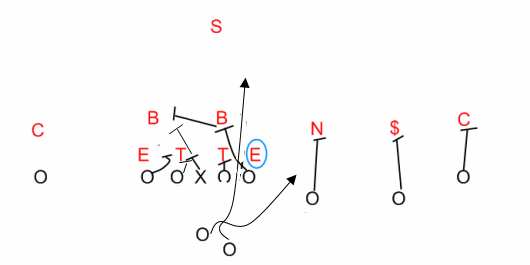
I'm going to disagree with the description of the play as a variant of the zone-read, though all of these plays fall within the same spread option family. Indeed, this is a play I've seen Florida and Urban Meyer use before, though the pulling guard is a nice wrinkle. I call it an "inverted veer."</p>
In the typical veer play from a spread set, the line blocks down and double-teams the defensive linemen on up to the linebackers. They leave the defensive end unblocked (except when they <font color="#213752">run midline veer</font>, in which case it is a defensive tackle) and read that man. If he steps down for the runningback, the QB just gives the ball and steps around him. It is just the old first-read of the triple option adapted for spread sets.</p>
 </p>
</p>
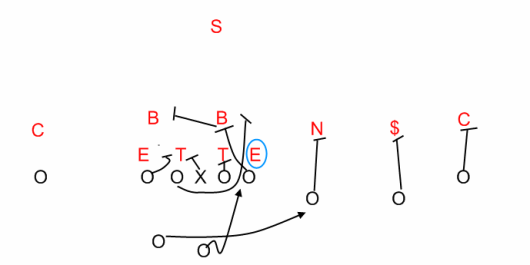
But TCU ran a variant, one I've seen other teams use. They just "inverted" the runningback and quarterback: The runningback runs a sweep or outside zone action laterally. If the defensive end takes him, then the quarterback shoots up inside the defensive end. If the defensive end sits for the QB, the runner should be able to hit the corner. Remember, the defensive end is often the hardest guy to block, and especially so when you want to "reach" him to seal the corner.</p>
 </p>
</p>
In that way I disagree with the characterization of the play as a fake-zone read where the QB then runs back to the other way. You can see the runner is taking a wide angle. That said, I don't know what TCU's read was, but this is a play I've seen at least for a few years. And again, Meyer uses it at Florida with his fast runners heading outside and Tebow, the better inside runner, going inside. Below is video of TCU using it against Clemson. (Again, thanks to reader Jay Miller.)</p>
Finally, the one wrinkle TCU has is the pulling guard. I think that was just designed to get better blocking at the point of attack, though TCU had them so crossed up he didn't even end up blocking anyone. This scheme has a lot of similarities with how teams block <font color="#213752">the shovel play</font>.</p>
I suppose the reason Steele and Clemson had so much trouble with this hinges on what his linebacker's reads were. I take it they were reading the quarterback and thinking backside with the zone read. If they read the pulling guard, for example, there wouldn't be an issue with where the play was going. (This is one reason the veer blocking works so well, because the line steps one way and the play hits the other. The pulling guard can give this away.) It is just like on the famous counter trey play: if the linebackers read the pullers there are no issues with stopping it (though they may be weak to some other play), but if they read the fullback blocking away they can get crossed up. It's all a cat-and-mouse game.</p>
 </p>
</p>
Pulled from article on TCU's inverted veer option
"They were spreading us out and forcing us to play one linebacker and forcing that one linebacker to play two gaps," Maye said. "All you can say is they did a good job scheming us up."</p>
I'm going to disagree with the description of the play as a variant of the zone-read, though all of these plays fall within the same spread option family. Indeed, this is a play I've seen Florida and Urban Meyer use before, though the pulling guard is a nice wrinkle. I call it an "inverted veer."</p>
In the typical veer play from a spread set, the line blocks down and double-teams the defensive linemen on up to the linebackers. They leave the defensive end unblocked (except when they <font color="#213752">run midline veer</font>, in which case it is a defensive tackle) and read that man. If he steps down for the runningback, the QB just gives the ball and steps around him. It is just the old first-read of the triple option adapted for spread sets.</p>
</p> But TCU ran a variant, one I've seen other teams use. They just "inverted" the runningback and quarterback: The runningback runs a sweep or outside zone action laterally. If the defensive end takes him, then the quarterback shoots up inside the defensive end. If the defensive end sits for the QB, the runner should be able to hit the corner. Remember, the defensive end is often the hardest guy to block, and especially so when you want to "reach" him to seal the corner.</p>
</p> In that way I disagree with the characterization of the play as a fake-zone read where the QB then runs back to the other way. You can see the runner is taking a wide angle. That said, I don't know what TCU's read was, but this is a play I've seen at least for a few years. And again, Meyer uses it at Florida with his fast runners heading outside and Tebow, the better inside runner, going inside. Below is video of TCU using it against Clemson. (Again, thanks to reader Jay Miller.)</p>
Finally, the one wrinkle TCU has is the pulling guard. I think that was just designed to get better blocking at the point of attack, though TCU had them so crossed up he didn't even end up blocking anyone. This scheme has a lot of similarities with how teams block <font color="#213752">the shovel play</font>.</p>
I suppose the reason Steele and Clemson had so much trouble with this hinges on what his linebacker's reads were. I take it they were reading the quarterback and thinking backside with the zone read. If they read the pulling guard, for example, there wouldn't be an issue with where the play was going. (This is one reason the veer blocking works so well, because the line steps one way and the play hits the other. The pulling guard can give this away.) It is just like on the famous counter trey play: if the linebackers read the pullers there are no issues with stopping it (though they may be weak to some other play), but if they read the fullback blocking away they can get crossed up. It's all a cat-and-mouse game.</p>
i'm not disputing that the 17'ing VEER and TRIPLE OPTION are great tools in slowing defenses down. Not at all. Thats the **** I ran as I coach. I know more option football than you ever will. Hell, my damn father spent a week with the Bear's staff in the late 70's studying the freaking Wishbone. I know how to run it.
And if we ran that **** against Bammer, we would have some success until Tyson got his head knocked off and we would be stuck with Relf the rest of the season.
But we have been running the speed option, trying to get to the corner, and that **** wont fly vs Bammer. Running the **** WE'VE BEEN RUNNING ALL YEAR won't cut it- option-wise. Thats what I was disputing in your statement. You said we should run the option, you didnt mention anything about veer plays and adding the triple threat.
And if we ran that **** against Bammer, we would have some success until Tyson got his head knocked off and we would be stuck with Relf the rest of the season.
But we have been running the speed option, trying to get to the corner, and that **** wont fly vs Bammer. Running the **** WE'VE BEEN RUNNING ALL YEAR won't cut it- option-wise. Thats what I was disputing in your statement. You said we should run the option, you didnt mention anything about veer plays and adding the triple threat.
the 2007 Egg Bowl. Henig played the third quarter for some God unknown reason, and started chunking it downfield. He did complete that long pass to Dixon, but he almost completed a couple to the Ole Miss safeties to.