Why does SPACEX do the things it does?
- Thread starter firegiver
- Start date
You are using an out of date browser. It may not display this or other websites correctly.
You should upgrade or use an alternative browser.
You should upgrade or use an alternative browser.

Not sure why this is the route they are taking unless that is the only way to monetize space x. Mobile networks work great for virtually everyone. Why create a 4th? They will have to figure out direct to device and terrestrial. The first seems possible. The second seems like a lift and one that would eat away at margins. No one is going to want a phone that doesn’t work indoors.


Why? Because they can do it at a better price. We will see I suppose.Not sure why this is the route they are taking unless that is the only way to monetize space x. Mobile networks work great for virtually everyone. Why create a 4th? They will have to figure out direct to device and terrestrial. The first seems possible. The second seems like a lift and one that would eat away at margins. No one is going to want a phone that doesn’t work indoors.
What is a monthly cell bill - $40? How much cheaper can it get?Why? Because they can do it at a better price. We will see I suppose.
space is cool and all, but I just don’t see the use cases. I wonder if they will also build their own phone because it will need specialized hardware just for starlink.
My monrhly cell bill is like $400. Probably $500 Im scared to look. 4 kids will do that to you.What is a monthly cell bill - $40? How much cheaper can it get?
space is cool and all, but I just don’t see the use cases. I wonder if they will also build their own phone because it will need specialized hardware just for starlink.
I don’t think they build their own phone. Elon repeatedly said he doesn’t want to.
This spectrum allows them to service indoors, it will directly compete with AT&T
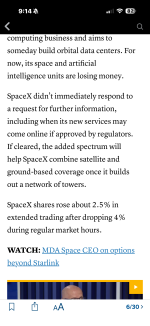
So they have to build out a network of towers like all other networks? I remember reading in advance of the ipo how poorly positioned starlink was to compete as a mobile carrier. Doesn’t make a lot of sense to me when the market is saturated and not growing, and is viewed as a commodity.Attached
But I guess I can see why he would do it. Starlink is the majority of revenue and 2/3 of space x launches are for starlink. He has to find a way to create more demand for launches.
So they have to build out a network of towers like all other networks? I remember reading in advance of the ipo how poorly positioned starlink was to compete as a mobile carrier. Doesn’t make a lot of sense to me when the market is saturated and not growing, and is viewed as a commodity.
But I guess I can see why he would do it. Starlink is the majority of revenue and 2/3 of space x launches are for starlink. He has to find a way to create more demand for launches.
If I had to guess, only in densely populated cities or for areas like tunnels. I don't know though. Maybe it's the carriage pushing the horse .... maybe Starlink is capable of delivering a lot of bandwidth and he is looking to create demand (your point above).

What are peoples thoughts on local llm rage? Open models being installed by nvidia at uber etc? Yall saying AI credit costs going down, while ignoring the price hikes of subscriptions is weird. We pay more today for these closed models that we did before.... at least in my anecdotal experience.
People are making wild claims that private ai companies maybe undone by Nvidia and open models. Maybe there's new lower cost deals happening. Idk
People are making wild claims that private ai companies maybe undone by Nvidia and open models. Maybe there's new lower cost deals happening. Idk
What are peoples thoughts on local llm rage? Open models being installed by nvidia at uber etc? Yall saying AI credit costs going down, while ignoring the price hikes of subscriptions is weird. We pay more today for these closed models that we did before.... at least in my anecdotal experience.
People are making wild claims that private ai companies maybe undone by Nvidia and open models. Maybe there's new lower cost deals happening. Idk
the intelligence in open weight models is good enough for most enterprise use cases. Doesn’t mean there isn’t massive value that will accrue to the frontier labs. Jevon’s paradox is applicable here. The only losers will be those not in the flow of tokens.
Sure, but you dont think that evolving paradigm puts a ton of stress on companies with balance sheets like openAI and anthropic? They were counting on hiking up rates.... now thr market is forcing them down. How are they gonna pay everyone back?the intelligence in open weight models is good enough for most enterprise use cases. Doesn’t mean there isn’t massive value that will accrue to the frontier labs. Jevon’s paradox is applicable here. The only losers will be those not in the flow of tokens.
When you are growing that fast at that kind of scale and still have less than 5% penetration in consumer and enterprise, you will be more than capable of paying everyone back. The only risk is if the open ai board doesn’t put a leash on Sam and his wasteful spending on all his pet projects.Sure, but you dont think that evolving paradigm puts a ton of stress on companies with balance sheets like openAI and anthropic? They were counting on hiking up rates.... now thr market is forcing them down. How are they gonna pay everyone back?
But why would I advise my leadership to pay the premium prices for the top models when I can create framework repos, steering and skills and use the open models and self host? I just think the open models are like 80% as as good, and good enough when it comes to almost everything.,When you are growing that fast at that kind of scale and still have less than 5% penetration in consumer and enterprise, you will be more than capable of paying everyone back. The only risk is if the open ai board doesn’t put a leash on Sam and his wasteful spending on all his pet projects.
why pay a ton? the open models do almost just as good... so... why?
Dude, you got to get a better plan.My monrhly cell bill is like $400. Probably $500 Im scared to look. 4 kids will do that to you.
I don’t think they build their own phone. Elon repeatedly said he doesn’t want to.
This spectrum allows them to service indoors, it will directly compete with AT&T

Yeah, i think i may head over there tomorrow. it's ridiculous at this point.Dude, you got to get a better plan.
A lot of people are asking the same questions as you. I don't have a great argument for you.But why would I advise my leadership to pay the premium prices for the top models when I can create framework repos, steering and skills and use the open models and self host? I just think the open models are like 80% as as good, and good enough when it comes to almost everything.,
why pay a ton? the open models do almost just as good... so... why?
Scientific breakthroughs. Cyber defense. AI native services. It’s like saying a Clemson grad is good enough for most jobs in the company. Why should I hire someone from Harvard or mit? And why should I hire a PhD from mit? For enterprise workflows, yes, open weights are good enough. But there are thousands more use cases that are much more valuable and would need frontier intelligence.But why would I advise my leadership to pay the premium prices for the top models when I can create framework repos, steering and skills and use the open models and self host? I just think the open models are like 80% as as good, and good enough when it comes to almost everything.,
why pay a ton? the open models do almost just as good... so... why?
I think he is saying that you wouldn't hire someone from Harvard or MIT to run the local 7-Eleven.Scientific breakthroughs. Cyber defense. AI native services. It’s like saying a Clemson grad is good enough for most jobs in the company. Why should I hire someone from Harvard or mit? And why should I hire a PhD from mit? For enterprise workflows, yes, open weights are good enough. But there are thousands more use cases that are much more valuable and would need frontier intelligence.
Kinda like you don't always need a suburban, sometimes a small 2 door sedan will do. They cost less to buy and operate.
I don't think there is any doubt token demand stays strong, but how is the question. This is why i like the hardware portion (semi's) of the trade.
I get what he’s saying and there has been a huge shift to open weight but many people are ignoring things like drug discovery, material sciences advances, and applying advanced math to things like insurance or semiconductor design etc. the frontier labs will hold so much intelligence that they will be solving for problems that today’s businesses don’t even attempt to solve. And that is where the real revenue will come from.I think he is saying that you wouldn't hire someone from Harvard or MIT to run the local 7-Eleven.
Kinda like you don't always need a suburban, sometimes a small 2 door sedan will do. They cost less to buy and operate.
I don't think there is any doubt token demand stays strong, but how is the question. This is why i like the hardware portion (semi's) of the trade.
I would expect them to have A CFO that hedges interest rate risk also. Just because you get a loan at x % doesn’t mean they hold that to maturity. I would expect it something the manage, Intrest rates markets are some of the biggest in the worldSure, but you dont think that evolving paradigm puts a ton of stress on companies with balance sheets like openAI and anthropic? They were counting on hiking up rates.... now thr market is forcing them down. How are they gonna pay everyone back?
Following its earlier comments, SpaceX bought a portfolio of low-frequency cellular spectrum in the USA that would be needed to build an actual terrestrial network. US mobile operator stocks fell sharply. As I’ve I pointed out before, while SpaceX technology is extremely cool, satellite is either impractical or useless for the vast majority of real cellular use, and so if SpaceX actually wants to build a US mobile service, it will have to build what everyone else has built, spend more or less what anybody else would spend, charge more or less the same prices, and provide probably a mostly inferior service (the best sites are already taken). The most cynical interpretations remain that this is really leverage to get a good MVNO deal.
- Benedict Evans
- Benedict Evans
I’d disagree with some. I can see why SpaceX may need supplemental towers in NYC or other high density places, but they don’t need a tower in the countryside. So the costs and infrastructure would not be the same imo.Following its earlier comments, SpaceX bought a portfolio of low-frequency cellular spectrum in the USA that would be needed to build an actual terrestrial network. US mobile operator stocks fell sharply. As I’ve I pointed out before, while SpaceX technology is extremely cool, satellite is either impractical or useless for the vast majority of real cellular use, and so if SpaceX actually wants to build a US mobile service, it will have to build what everyone else has built, spend more or less what anybody else would spend, charge more or less the same prices, and provide probably a mostly inferior service (the best sites are already taken). The most cynical interpretations remain that this is really leverage to get a good MVNO deal.
- Benedict Evans
Additionally, the unit economics are different as I put in a couple posts above. This will allow them
To compete in certain areas.
Last, I don’t think anyone is claiming that the regular networks will disappear, just that they may have some competition in certain areas.

I’d disagree with some. I can see why SpaceX may need supplemental towers in NYC or other high density places, but they don’t need a tower in the countryside. So the costs and infrastructure would not be the same imo.
Additionally, the unit economics are different as I put in a couple posts above. This will allow them
To compete in certain areas.
Last, I don’t think anyone is claiming that the regular networks will disappear, just that they may have some competition in certain areas.
Does Starlink have the bandwidth to work indoors or in a car and without an additional antenna directly to smartphones like AST Spacemobile through agreements with existing carriers??
NoDoes Starlink have the bandwidth to work indoors or in a car and without an additional antenna directly to smartphones like AST Spacemobile through agreements with existing carriers??
D
In a car? Yes. Indoors? depends. They can't compete in a skyscraper. They just bought some additional spectrum that will let them get into cars and light walls.Does Starlink have the bandwidth to work indoors or in a car and without an additional antenna directly to smartphones like AST Spacemobile through agreements with existing carriers??
Ai gave a long answer
**Yes, partially today for light use, with major upgrades aimed at closing the gap—though pure satellite direct-to-smartphone has inherent physics limits compared with terrestrial networks or AST SpaceMobile’s larger-antenna approach.**
### Current Status (as of late 2026)
Starlink already offers commercial **Direct-to-Cell** service (branded T-Satellite through T-Mobile in the US, with other carrier partners internationally). It connects to unmodified standard smartphones—no special antenna, app, or hardware changes required on compatible recent phones.[](<https://smartphones.gadgethacks.com...erage-limitations-whats-approved-vs-untested/>)[](<https://www.t-mobile.com/support/coverage/satellite-support/>)
- **Capabilities now**: Texting, location sharing, limited app data (e.g., WhatsApp, maps, selected apps), and emerging/low-bandwidth voice or video. Speeds are roughly ~4 Mbps.[](<https://longbridge.com/news/276899770>)
- It works in areas with no terrestrial coverage by treating satellites as “cell towers in space” using partner spectrum.
- **Indoors and in cars**: SpaceX testing and reports indicate it can function near windows, in a pocket (even facing away), and inside vehicles (through windows). Connectivity often drops under heavy tree cover or deeper indoors. Performance is designed primarily for outdoor/dead-zone use; consistent deep-building penetration remains limited due to path loss from hundreds of kilometers of altitude plus material attenuation.[](<https://www.benzinga.com/news/24/10...phones-indoors-spacex-engineer-clears-the-air>)[](<https://www.pcmag.com/news/starlink-vs-physics-can-cell-towers-in-space-reach-devices-indoors>)
- Vehicle boosters exist commercially to improve in-car reliability for the current service.
This matches the “direct to smartphones via carrier agreements” model AST SpaceMobile targets, but Starlink’s current version is lighter-duty (messaging + light data) while AST’s architecture prioritizes higher-capacity broadband from the start with much larger phased-array antennas.
### Bandwidth, Capacity, and Future Plans
Current bandwidth is constrained by limited partner spectrum and first-generation satellite design, which is why it suits texts and light use rather than high-bandwidth indoor streaming for many users.
SpaceX is actively addressing this:
- FCC approval for up to 15,000 next-generation Direct-to-Cell satellites (optimized for higher capacity, lower orbits in some plans).
- Spectrum acquisitions (including from EchoStar and a recent agreement for ~14 MHz of paired 800 MHz low-band spectrum) specifically to improve capacity and penetration. SpaceX states the mid-band (around 2 GHz) supports higher bandwidth while the new low-band layer is intended to help signals reach devices inside buildings, as most phones already support these frequencies.[](<https://wccftech.com/spacex-grabs-a...le-and-verizon-after-they-refused-to-partner/>)[](<https://arstechnica.com/tech-policy...s-musk-plan-to-beat-att-t-mobile-and-verizon/>)
- Targets include roughly 20× throughput per satellite and >100× overall system capacity versus the current generation, with peak speeds up to ~150 Mbps per user in the upgraded system (aiming for a more terrestrial-like 4G/5G experience in many situations). Rollout of the major upgrades is expected around late 2027 onward, pending spectrum closings and satellite deployment.[](<https://longbridge.com/news/276899770>)
- Longer-term vision includes hybrid satellite + terrestrial elements (e.g., femtocells) so Starlink Mobile can function as a more complete carrier rather than only a dead-zone complement.
### Comparison to AST SpaceMobile and Physics Limits
AST SpaceMobile uses fewer but much larger satellites with huge phased arrays designed for better link budgets, aiming for stronger performance directly to ordinary phones (including better vehicle and single-story indoor potential in some analyses) and higher peak speeds. Starlink currently leads in scale, deployment, commercial availability, and number of carrier partnerships; AST is still earlier in commercial scaling.[](<https://findcheapbroadband.com/blog/starlink-vs-ast-spacemobile/>)
Independent analyses note that pure satellite-to-phone links (especially from smaller antennas) face significant challenges for reliable high-bandwidth indoor use or dense environments due to free-space path loss, building materials, and shared capacity. A large share of mobile traffic is indoor or in vehicles. Low-band spectrum and denser/more powerful constellations help, but satellite service is widely viewed as a strong complement (or rural/remote primary) rather than a full replacement for dense terrestrial networks without additional ground infrastructure.[](<https://www.satellitetoday.com/opin...udget-comes-up-short-for-the-d2d-opportunity/>)[](<https://www.notebookcheck.net/T-Mob...-Starlink-Mobile-s-indoor-woes.1420928.0.html>)
**Bottom line**: Starlink already does direct-to-smartphone (no extra antenna) via carrier deals for light indoor/car use in many real-world conditions. It does not yet match high-bandwidth, consistent indoor performance like good terrestrial coverage or AST’s design targets, but the company is acquiring spectrum and launching higher-capacity satellites explicitly to improve both bandwidth and penetration. Results will depend on the upgraded constellation density, spectrum use, and any hybrid terrestrial elements.
### Current Status (as of late 2026)
Starlink already offers commercial **Direct-to-Cell** service (branded T-Satellite through T-Mobile in the US, with other carrier partners internationally). It connects to unmodified standard smartphones—no special antenna, app, or hardware changes required on compatible recent phones.[](<https://smartphones.gadgethacks.com...erage-limitations-whats-approved-vs-untested/>)[](<https://www.t-mobile.com/support/coverage/satellite-support/>)
- **Capabilities now**: Texting, location sharing, limited app data (e.g., WhatsApp, maps, selected apps), and emerging/low-bandwidth voice or video. Speeds are roughly ~4 Mbps.[](<https://longbridge.com/news/276899770>)
- It works in areas with no terrestrial coverage by treating satellites as “cell towers in space” using partner spectrum.
- **Indoors and in cars**: SpaceX testing and reports indicate it can function near windows, in a pocket (even facing away), and inside vehicles (through windows). Connectivity often drops under heavy tree cover or deeper indoors. Performance is designed primarily for outdoor/dead-zone use; consistent deep-building penetration remains limited due to path loss from hundreds of kilometers of altitude plus material attenuation.[](<https://www.benzinga.com/news/24/10...phones-indoors-spacex-engineer-clears-the-air>)[](<https://www.pcmag.com/news/starlink-vs-physics-can-cell-towers-in-space-reach-devices-indoors>)
- Vehicle boosters exist commercially to improve in-car reliability for the current service.
This matches the “direct to smartphones via carrier agreements” model AST SpaceMobile targets, but Starlink’s current version is lighter-duty (messaging + light data) while AST’s architecture prioritizes higher-capacity broadband from the start with much larger phased-array antennas.
### Bandwidth, Capacity, and Future Plans
Current bandwidth is constrained by limited partner spectrum and first-generation satellite design, which is why it suits texts and light use rather than high-bandwidth indoor streaming for many users.
SpaceX is actively addressing this:
- FCC approval for up to 15,000 next-generation Direct-to-Cell satellites (optimized for higher capacity, lower orbits in some plans).
- Spectrum acquisitions (including from EchoStar and a recent agreement for ~14 MHz of paired 800 MHz low-band spectrum) specifically to improve capacity and penetration. SpaceX states the mid-band (around 2 GHz) supports higher bandwidth while the new low-band layer is intended to help signals reach devices inside buildings, as most phones already support these frequencies.[](<https://wccftech.com/spacex-grabs-a...le-and-verizon-after-they-refused-to-partner/>)[](<https://arstechnica.com/tech-policy...s-musk-plan-to-beat-att-t-mobile-and-verizon/>)
- Targets include roughly 20× throughput per satellite and >100× overall system capacity versus the current generation, with peak speeds up to ~150 Mbps per user in the upgraded system (aiming for a more terrestrial-like 4G/5G experience in many situations). Rollout of the major upgrades is expected around late 2027 onward, pending spectrum closings and satellite deployment.[](<https://longbridge.com/news/276899770>)
- Longer-term vision includes hybrid satellite + terrestrial elements (e.g., femtocells) so Starlink Mobile can function as a more complete carrier rather than only a dead-zone complement.
### Comparison to AST SpaceMobile and Physics Limits
AST SpaceMobile uses fewer but much larger satellites with huge phased arrays designed for better link budgets, aiming for stronger performance directly to ordinary phones (including better vehicle and single-story indoor potential in some analyses) and higher peak speeds. Starlink currently leads in scale, deployment, commercial availability, and number of carrier partnerships; AST is still earlier in commercial scaling.[](<https://findcheapbroadband.com/blog/starlink-vs-ast-spacemobile/>)
Independent analyses note that pure satellite-to-phone links (especially from smaller antennas) face significant challenges for reliable high-bandwidth indoor use or dense environments due to free-space path loss, building materials, and shared capacity. A large share of mobile traffic is indoor or in vehicles. Low-band spectrum and denser/more powerful constellations help, but satellite service is widely viewed as a strong complement (or rural/remote primary) rather than a full replacement for dense terrestrial networks without additional ground infrastructure.[](<https://www.satellitetoday.com/opin...udget-comes-up-short-for-the-d2d-opportunity/>)[](<https://www.notebookcheck.net/T-Mob...-Starlink-Mobile-s-indoor-woes.1420928.0.html>)
**Bottom line**: Starlink already does direct-to-smartphone (no extra antenna) via carrier deals for light indoor/car use in many real-world conditions. It does not yet match high-bandwidth, consistent indoor performance like good terrestrial coverage or AST’s design targets, but the company is acquiring spectrum and launching higher-capacity satellites explicitly to improve both bandwidth and penetration. Results will depend on the upgraded constellation density, spectrum use, and any hybrid terrestrial elements.
Latest
-
01
 Tiger Illustrated Basketball
Wednesday Update: What we are hearing inside Clemson Basketball - injuries & Hunter's eligibility
Tiger Illustrated Basketball
Wednesday Update: What we are hearing inside Clemson Basketball - injuries & Hunter's eligibility
-
02
 Tiger Illustrated Football Recruiting
Clemson legacy O-line offer planning return trip after impressive recent visit
Tiger Illustrated Football Recruiting
Clemson legacy O-line offer planning return trip after impressive recent visit
-
03
 Tiger Illustrated Football
WEDNESDAY CLEMSON FOOTBALL INTERVIEWS: Chris Johnson, Jeremiah Alexander & Champ Thompson
Tiger Illustrated Football
WEDNESDAY CLEMSON FOOTBALL INTERVIEWS: Chris Johnson, Jeremiah Alexander & Champ Thompson
-
04
 Tiger Illustrated Football Recruiting
Clemson Football Roster & Recruiting Big Board: Defensive End
Tiger Illustrated Football Recruiting
Clemson Football Roster & Recruiting Big Board: Defensive End
-
05
 Tiger Illustrated Football
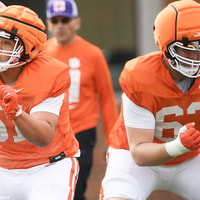
Injuries, issues and changing rotations still linger up front as Clemson approaches midseason
Tiger Illustrated Football
Injuries, issues and changing rotations still linger up front as Clemson approaches midseason