Arizona Preview

Riding a four-game winning streak, featuring a potent offense and a stingy defense, the Wildcats are coming to Tempe with the same record as the Sun Devils and quite a bit of momentum on their side. Here’s a closer look at what ASU’s in-state rivals are bringing to the table.
Arizona Offense
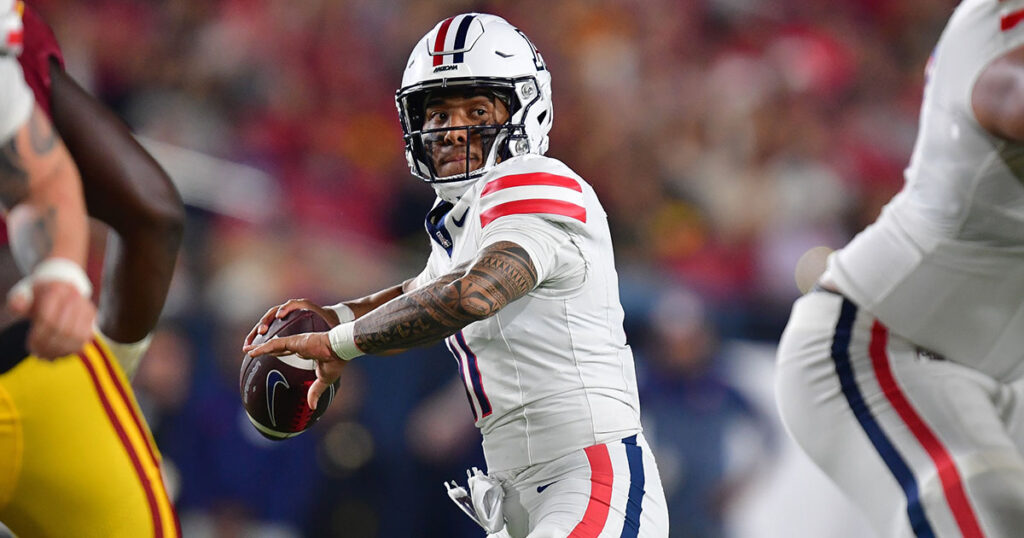
After a breakout season in 2023, quarterback Noah Fifita’s production dipped dramatically last season, but like the team as a whole, he has bounced back incredibly in 2025.
Through 11 games, Fifita has completed 64.22% of his passes for 2,677 yards with 25 touchdowns to just five interceptions. Additionally, a bit of a new wrinkle to his game has been introduced this season as he’s rushed for 131 net yards with three touchdown runs, quite a difference from the combined -16 yards with one score he had across both the 2023 and ’24 seasons.
Fifita’s two best days of the year have come against Arizona’s two poorest opponents, as he threw for 373 yards with five touchdowns against FCS Weber State and then threw for 376 with another five touchdowns against Oklahoma State.
On the ground, Texas State transfer Ismail Mahdi leads the team with 732 rushing yards on 108 carries – an impressive 6.8 yards per carry average – with four touchdowns. A known all-purpose threat from his days with the Bobcats, Mahdi also has 12 receptions for 90 yards with a touchdown and is the team’s top kickoff returner.
Arizona has used multiple players out of the backfield in addition to Mahdi, with Kedrick Reescano leading the team with eight rushing touchdowns as part of his 72 carries for 370 yards. Reescano enters this game riding a hot streak, as he scored three rushing touchdowns last week against Baylor. Reescano also has one catch for nine yards on the year.
Also contributing on the ground is Quincy Craig, who has totaled 333 rushing yards with two scores on 51 carries, along with 12 catches for 86 yards with a touchdown.
In the pass game, though Arizona was tasked with replacing the gaping absence left by first-round NFL Draft pick Tetairoa McMillan, the Wildcat pass offense has improved this season as a series of qualified pass-catchers have stepped up in McMillan’s absence.
Leading the way is former Oregon and Washington State transfer Kris Hutson, who has team highs of 50 receptions for 645 yards along with four touchdowns. Like Reescano, Hutson enters this game on a torrid pace, as in the last two games, he’s caught a total of 17 passes for 256 yards with a touchdown.
Ranking second on the team in receiving is Javin Whatley, who has totaled 36 receptions for 418 yards with four touchdowns. Another weapon to keep an eye on is former Kansas State transfer Tre Spivey, who has just 18 offensive touches but has scored seven touchdowns on the year. For the season, Spivey has 17 receptions for 328 yards with six touchdowns and has also had a three-yard touchdown run.
Also at wide receiver, Chris Hunter has caught 21 passes for 314 yards with two touchdowns, Luke Wysong has hauled in 20 receptions for 265 yards with two scores, and Gio Richardson has totaled 16 receptions for 244 yards with two touchdowns.
At tight end, Sam Olson leads the way with 14 receptions for 103 yards and two scores.
The Wildcat offensive line figures to start left tackle Ty Buchanan, left guard Chubba Maae, center Ka’ena Decambra, right guard Alexander Doost, and right tackle Matthew Lado.
Arizona Offense Summary
Overall, Arizona has spread the ball around in both the run and pass games as opposed to extremely heavy doses to individual players. In all, the Wildcats have three players with at least 300 rushing yards, four players with at least 300 receiving yards, and six total players with at least 240 receiving yards.
Statistically, on a national scale, Arizona generally thrives in two key areas as the Wildcats tie for 27th nationally with 11 lost turnovers and rank 29th in the country in scoring offense (33.5 points per game). Arizona ranks around the top 50 nationally in team passing efficiency (40th, 146.50), pass offense (42nd, 251.5 yards per game), and total offense (51st, 407.6 yards per game).
The Wildcats also tie for 64th nationally in tackles for loss allowed (5.27 per game), rank 68th in time of possession, and 70th in rushing offense (156.1).
The areas of most notable statistical concern on offense for Arizona are its 78th-place ranking in third-down conversion offense (.387), while the Wildcats tie for 89th in red-zone offense (.812) and rank 112th nationally in sacks allowed per game (2.64).
Arizona Defense
Up front, the starting Wildcat defensive line figures to feature ends Mays Pese and Dominic Lolesio with interior linemen Leroy Palu and Deshawn McKnight.
McKnight leads the team with 11.0 tackles for loss as part of his 26 total tackles with 2.0 sacks and two quarterback hurries. Palu has 24 tackles, including 2.5 for loss, with a split of a sack, along with one pass breakup, one quarterback hurry, and one fumble recovery.
Pese has recorded 20 tackles this year, including 2.0 for loss, with a share of a sack, along with one quarterback hurry. Lolesio has registered 18 tackles, including 2.0 for loss with a sack, a pass breakup, and a quarterback hurry.
At linebacker, the starters for Arizona should be Chase Kennedy, Max Harris, and Taye Brown.
Brown leads all Arizona linebackers and ranks second on the team with 80 tackles, including 8.5 for loss with 1.5 sacks, along with three quarterback hurries, one interception, one forced fumble, and one pass breakup.
Harris ranks fourth on the team with 68 tackles, including 2.5 for loss, with one pass breakup, one forced fumble, and five quarterback hurries.
Kennedy has a team-high 4.0 sacks along with 8.0 tackles for loss as part of his 37 total tackles. He also has six quarterback hurries, two forced fumbles, and one fumble recovery.
In the secondary, either Michael Dansby or Jay’vion Cole should start at one cornerback spot with Ayden Garnes or Marquis Groves-Killebrew at the other cornerback position. The rest of the secondary should be occupied by starters Genesis Smith, Dalton Johnson, and Treydan Stukes.
Johnson leads the team with 94 tackles, including 2.0 for loss with a sack, along with three interceptions, five pass breakups, and a fumble recovery.
Smith ranks third on the roster with 71 tackles, including 3.0 for loss, with seven pass breakups, two forced fumbles, one interception, one quarterback hurry, and one fumble recovery. Stukes has collected 49 tackles, including a sack, three interceptions, and six pass breakups.
Cole has a team-best four interceptions along with 23 tackles, including 3.0 for loss with a sack, as well as three pass breakups and a forced fumble. Dansby has 15 tackles, including a share of a TFL, with seven pass breakups and a fumble recovery.
Garnes leads all Arizona cornerbacks with 30 tackles, adding a split of a TFL, a team-best eight pass breakups with an interception, and two quarterback hurries. Groves-Killebrew has six tackles, including a split of a TFL, in six games.
Arizona Defense Summary
Largely due to the offseason promotion to Danny Gonzales to defensive coordinator – ironically a former ASU assistant who coined the ‘Anti-200s’ label for supporters of the Arizona football program, a reference to the late 1950s proposition that enabled Arizona State to become a university which Arizona supporters staunchly opposed – the Arizona defense has improved dramatically and in many areas is among the nation’s elite.
Through 11 games, Arizona ranks sixth in the nation in pass defense (159.7 yards per game) and is tied for sixth nationally with 23 forced turnovers. The Wildcats also rank 14th in the country in team tackles for loss per game (6.9).
The Wildcats also have top-25 national rankings in total defense (21st, 309.5 yards per game and scoring defense (tied for 24th, 20.0 points per game). Arizona also ranks 32nd in the nation in third-down conversion defense (.348).
The main areas of any measure of relative weakness for the Arizona defense are in its tie for 65th nationally in red zone defense (.839), its 73rd place national ranking in rush defense (149.8 yards per game), and its tie for 79th nationally in team sacks per game (1.91).
For ASU in this game, the script is simple – not easy, but simple – that ASU needs to lean heavily into the run game, tread lightly on the pass game, and above all else, significantly limit turnover situations.
Arizona Special Teams
An area that has proven pivotal in many Territorial Cup games, the special teams woes for ASU are well known, but Arizona has challenges of its own as well.
Kicker Michael Salgado-Medina has made just 64% of his kicks (16-of-25), though he does have a long field goal of 57 yards this season. As a team, the Wildcats have connected on just 61.54% of their total field goal attempts.
Punter Isaac Lovison averages 42.33 yards on his 30 punts with a long of 57.
On returns, Ismail Mahdi averages 20.5 yards on four kickoff returns with a long of 22, while Luke Wysong averages 9.0 yards on 10 punt returns with a long of 27.
Overall Summary
Entering the 98th Duel in the Desert, a rivalry game played for the Territorial Cup, the oldest rivalry trophy in college football, both teams are ranked in the top-25 of the College Football Playoff rankings, with ASU clocking in at No. 20 and Arizona listed at No. 25.
These two teams had very different preseason expectations in 2025: ASU was labeled a strong contender to repeat as Big-12 champions, while the Wildcats were predicted to struggle mightily yet again.
After 11 games, both teams enter this clash with 8-3 records, and though Arizona is eliminated from contention for the Big-12 championship game, ASU still has a slight hope of a repeat trip to Arlington.
Though ASU is the higher ranked team, few would argue that Arizona enters the game with more momentum as they are tied with Utah and Texas Tech for the longest active winning streak in the Big-12 (four games).
The Wildcats surely hope to claim their third Territorial Cup game win in the last four tries, and to prevent that, ASU will need to improve its trend of sluggish starts, take excellent control of the ball, and avoid major lapses on special teams.
/">