ASU Baseball Season Preview

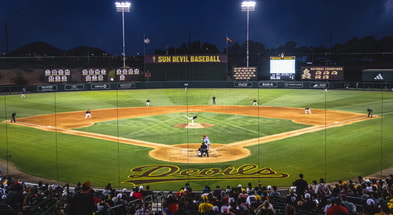
Every year, just as the Arizona winter gives way to spring, ASU fans are reminded of what this program once was. Five national championships, fifth-most all-time. Twenty-two College World Series appearances, fourth in history. The numbers are impossible to miss, plastered across the outfield. Yet no new date has been added since 2010. Three head coaches have passed through since ASU last reached Omaha, a drought now more than a decade and a half long.
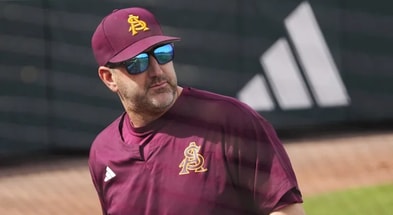
When Willie Bloomquist took over, the program needed a reset. A former Sun Devil and major leaguer, he also stepped into a new era of college baseball, navigating NIL and the transfer portal in real time. The adjustment was not immediate, but in 2025, the trajectory turned. ASU returned to the NCAA tournament for the first time under Bloomquist, finished just shy of the Big 12’s best record, and watched nine players come off the board in the MLB draft, all within the first ten rounds, a school record.
MLB U felt earned again. Results carried into recruiting and the portal, where ASU landed the No. 13 transfer class according to D1Baseball. Increased resources allowed Bloomquist to retool a roster gutted by the draft without losing momentum.
The team blends returners hungry for another postseason run with newcomers eager to prove themselves. Bloomquist emphasizes age, leadership, and experience, and ASU checks those boxes. The rotation remains unproven but deep. The bullpen is intriguing, led by pitching coach Jeremy Accardo, whose staff topped the Big 12 in strikeouts. The offense looks poised to follow suit.
Skepticism is fair after losing six of their last seven games of the season. Bloomquist embraces it. This season is about proving that 2025 and the NCAA Tournament berth were not an outlier, but a step back toward where ASU baseball believes it belongs, among the sport’s true powers.
Here’s how the 2026 ASU squad shakes out.
OFFENSE
When ASU ran out its lineup for the final game of the 2025 season, a regional matchup against UC Irvine, only two of those names are set to return: sophomore outfielder Landon Hairston and sophomore infielder Beckett Zavorek. Everyone else is gone.
That reality makes Hairston the clear focal point. Just one year into his college career, he already carries the weight of the lineup. An All-Big 12 First Team selection as a freshman and a D1Baseball Second Team Freshman All-American, Hairston slashed .333/.441/.467 with a .908 OPS.
His season unfolded in two acts. Over his first 26 games, he managed just one extra-base hit. Over the final 28, he erupted, piling up 11 doubles and four home runs. By season’s end, he was entrenched as ASU’s everyday two-hole hitter and has stepped into a leadership role. Fall workouts hinted at added strength, and if that pairs with his elite bat-to-ball skills, the second-half version of Hairston may be here to stay.
Beyond Hairston, the offense was stripped down. Key contributors like Brandon Compton, Matt King, Isaiah Jackson, Kyle Walker, Kien Vu, and Jacob Tobias are all gone, leaving clear gaps in power, experience, and leadership.
Bloomquist addressed those losses aggressively in the offseason.
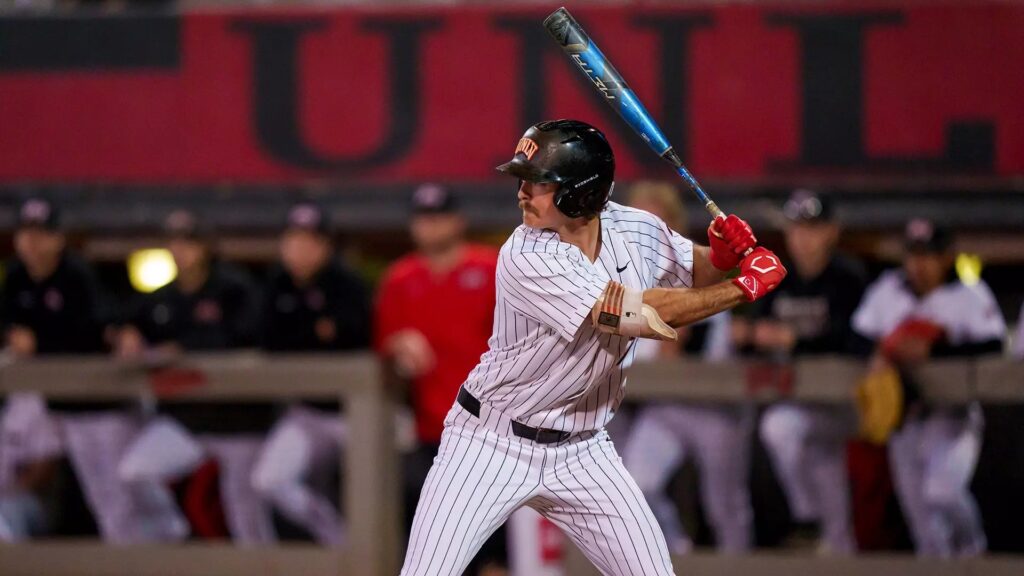
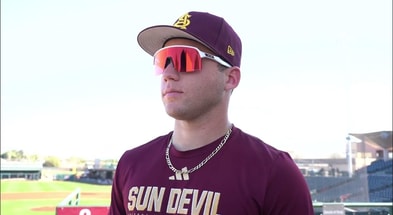
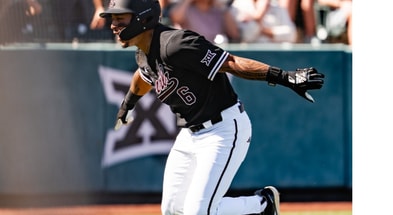
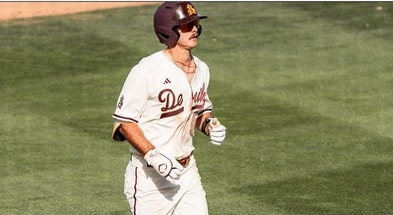
The headliner is UNLV transfer Dean Toigo (pictured above), a graduate outfielder and 2025 Mountain West Co-Player of the Year. Toigo hit .377/.450/.682 with 18 home runs last season, pairing production with personality. The mustache stands out, but so does the bat, and he projects as ASU’s everyday right fielder.
Utah transfer Austin Roelig brings a different look. An incoming sophomore third baseman who began his career at LSU, Roelig was one of the Big 12’s most productive freshmen last season, earning All-Big 12 Freshman Team honors and an honorable mention after hitting .341 with an .832 OPS. At 5-foot-11, he’s compact but polished and profiles as a potential top-of-the-order presence in the mold of last year’s Kyle Walker.
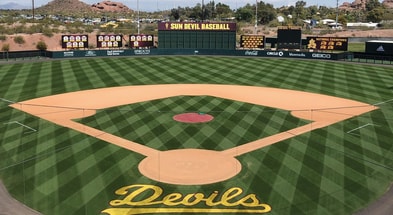
ASU then turned to California to round out the rebuild. Dominic Smaldino arrives from Cal as an incoming junior first baseman with real power upside. In his first full season as a starter, he hit 11 home runs with 12 doubles and an .862 OPS. He followed that by mashing eight homers in just 23 Northwoods League games, posting a 1.008 OPS. At 6-foot-6 and 230 pounds, his pull-side swing should play exceptionally well at hitter-friendly Phoenix Municipal Stadium.
Alongside him is PJ Moutzouridis, a junior shortstop expected to handle the position every day. The bat remains the question. After posting an .846 OPS as a freshman, he dipped to .697 last season. The move to Tempe offers a reset. Defensively, his .944 fielding percentage and experience give ASU the needed stability at shortstop.
Utah Valley transfer junior Dominic Longo adds production and postseason experience. Longo was part of a Utah Valley team that reached the Oregon Regional, collecting two hits against Arizona and a home run versus Cal Poly. He finished last season with 11 home runs, 31 extra-base hits, a .305 average, and a .932 OPS.
Rounding out the veteran additions are two bats with upside but something to prove: Vanderbilt transfer senior Matthew Polk and Virginia Tech transfer junior Garrett Michel. Polk missed all of 2024 while finishing his degree, but returns as a three-year Commodore who slashed .316/.372/.492 with an .864 OPS across 104 career starts. He’ll compete for a corner outfield spot.
Michel has played three college seasons but appeared in just 36 games over the last two years due to a broken wrist. He’s chasing the form he showed in 2023, when he hit .339 with a 1.091 OPS and 11 home runs in 51 games. Likely a DH more than a first baseman, a healthy Michel is a proven impact bat.
Oregon transfer sophomore catcher Coen Niclai could be a sleeper. Bloomquist has described him as a work in progress defensively, but his bat showed flashes during fall scrimmages. He posted a .779 OPS with five extra-base hits in 23 games as a freshman for the Ducks.
Among the returners, a clear standout beyond Hairston is junior Nu’u Contrades. The D1Baseball No. 21-ranked second baseman returns after a hand injury cut short his 2025 season. Draft-eligible but unselected, Contrades was in the midst of his best year, slashing .304/.410/.519 for a .929 OPS, striking out just twice more than he walked while stealing 14 bases. He returns to second base in 2026, the position he played his entire life before ASU, and was named one of the team’s two captains.
Behind the plate, redshirt sophomore Brody Briggs is set to take over as the primary catcher. He split time last season with Josiah Cromwick during a productive freshman year that included five home runs, 10 extra-base hits, and a .760 OPS. Defensively, Briggs caught nine runners stealing in 35 attempts with just one error, throwing out four more runners than Cromwick despite appearing in eight fewer games. His play will be vital with a younger catching core.
Zavorek also appears ready for an expanded role. He hit .385 with a .448 on-base percentage across 29 plate appearances as a freshman, including two starts in ASU’s postseason run. He carried that momentum into the Northwoods League, hitting .360 with a .442 OBP while stealing 28 bases in 28 games. At 5-foot-10, he’s not a power bat, but his value lies in getting on base, applying pressure, and scoring runs.
Two freshmen to watch are Brenden Lewis and Cooper Clouser. Lewis, a two-way shortstop and pitcher, hit .349 over four varsity seasons and boasts 20–6 with a 1.32 ERA on the mound. Clouser, Perfect Game’s No. 32-ranked catcher in his class, has earned early trust with advanced at-bats and steady defense. Both could carve out small roles in 2026.
The roles of TCU transfer Sam Myers and sophomore Ky McGary remain unsettled. Myers, an All-Big 12 honorable mention in 2024, is fully healthy after an arm injury and has “surprised” hitting coach Jason Ellison this preseason. McGary, a 20th-round Astros pick and former No. 99 national prospect, saw limited action as a freshman. With more experience, his role may again be limited, though his path to playing time is clearer than it was a year ago.
PITCHING
It’s no secret the bats have carried a heavy load under Bloomquist. Some nights, seven or eight runs weren’t enough, and a three-out save felt like nine. Last season ended the same way, with back-to-back regional losses after surrendering 11 runs.
But last year showed Phoenix pitching is trending up. Accardo, a former eight-year big leaguer, took over and immediately lowered ASU’s team ERA from 6.53 in 2024 to 5.38 in 2025, the lowest of the Bloomquist era. Four pitchers were drafted in the first ten rounds, a clear sign of progress.
Sustaining it is the challenge. Ben Jacobs and Jack Martinez anchored Friday and Saturday rotations a year ago, but both are gone. ASU returns just four pitchers who started last season, and only two with more than five starts. Stability is gone, and the opportunity is wide open.
That spotlight falls on sophomore left-hander Cole Carlon. After a 7.52 ERA across 40.2 innings as a freshman, he rewrote his story in 2025. Carlon threw 54 innings with a 3.33 ERA, struck out 86 against just 25 walks, earned All-Big 12 First Team honors, and secured a spot on the USA Baseball Collegiate National Team. His high-velocity fastball and wipeout slider powered a breakout that included 28 consecutive retired hitters and a 10-strikeout outing against Arizona.
At 6-foot-5, Carlon already proved he can handle length, finishing third on the team in innings despite not making a start. Two Cape Cod League starts, and Team USA work made the transition to the rotation feel like a natural progression. Baseball America named him a preseason third-team All-American starter, and MLB.com ranks him the No. 39 prospect for the 2026 MLB Draft. Much of his draft stock and ASU’s pitching direction will hinge on how he performs on Fridays.
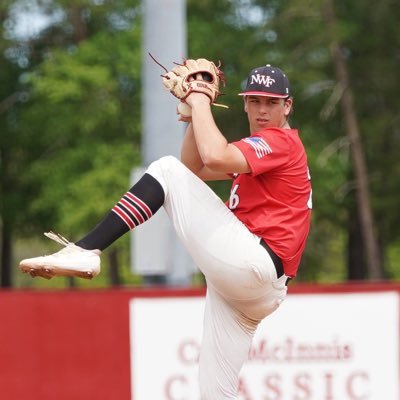
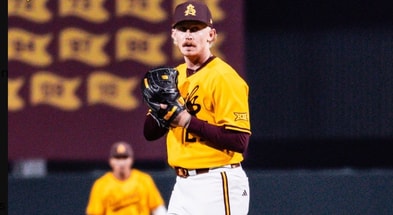
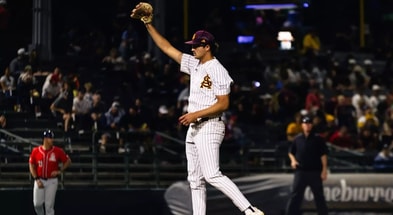
For Saturdays, ASU will turn to junior right-hander Colin Linder (pictured above). Linder missed all of 2025 with an arm injury, but his track record suggests a quick impact. A former Texas A&M commit, he spent three seasons at Northwest Florida State College, posting a 3.79 ERA in 2024 while making eight starts in 11 appearances and striking out 50 batters in 35.2 innings. At 6-foot-4, 235 pounds, Linder brings power stuff, with a fastball in the 94–96 mph range that can touch the upper 90s. If he holds down the Saturday role, he should log significant innings early.
Sophomore left-hander Easton Barrett will open the season in the Sunday role, a spot he claimed late last year as a true freshman. Barrett threw 39.2 innings with a 4.31 ERA and 41 strikeouts, then added 21.1 innings in the Cape Cod League, cutting his BB/9 nearly in half and missing more bats. That progress should allow him to handle a larger workload in 2026.
No two arms enjoyed a stronger summer than junior right-handers Josh Butler and Wyatt Halvorson. Butler finished second in the league in ERA at 1.03 and earned All-Star honors. Halvorson ranked sixth at 1.95.
Both followed those performances after their first seasons with meaningful innings at ASU. Butler posted a 4.73 ERA over 32.1 innings but paired it with a 3.1 BB/9 rate, and his 6-foot-7 frame and sinker-slider mix project well for ground balls. Halvorson’s 7.48 ERA over 21.2 innings masks his upside, as 32 strikeouts and late-inning lapses skewed the results. Reducing his 5.4 BB/9 from last year will be key to his success.
TCU transfer and Phoenix native Kole Klecker is another arm to watch. Once one of the nation’s top freshmen, Klecker led TCU with 97.2 innings and 72 strikeouts while posting a 3.72 ERA and 10–4 record. Injuries and inconsistency followed, resulting in a 5.59 ERA over the past two seasons. Accardo believes Klecker’s confidence is back, giving him a chance to trend upward if healthy.
UNLV transfer Alex Overbay has also turned heads this spring. The Rebels’ closer last year, he recorded seven saves and 42 strikeouts in 28 innings. While his 5.14 ERA was uneven, his swing-and-miss stuff stands out. Accardo has added a changeup to Overbay’s fastball-slider mix, raising his ceiling and keeping hitters off balance.
Junior right-hander Derek Schaefer returns as one of ASU’s most versatile arms. A former Tennessee Volunteer, he transferred after limited freshman innings and quickly became a bullpen piece, throwing 32.1 innings with 35 strikeouts. In the Cape Cod League, he added 28 innings with a 3.86 ERA and made four starts. Returning noticeably stronger, his fastball, cutter, and swing-and-miss slider give him rotation potential if needed.
Sophomore right-handers Eli Buxton and Finn Edwards are two names to watch for a Carlon-style breakout. Buxton’s release point has long been tough on hitters, and he has added weight, up from 195 to 210 pounds, boosting velocity. Working with a fastball, splitter, and slider from an over-the-top arm slot, he could compete for a setup or closer role as the season progresses.
Edwards, a 6-foot-7, 210-pound righty, passed on the Dodgers after being drafted in the 18th round and spent last year at Iowa Western CC, throwing 34.1 innings with 45 strikeouts and a 3.67 ERA. His fastball has touched 98 mph, giving ASU a powerful backend option as he adjusts to high-level four-man rotation work.
Junior right-hander Jaden Alba’s role remains uncertain. Originally slated as the Sunday starter last year, he struggled and shifted into long relief. Alba threw 40.1 innings with a 5.80 ERA but ended the season on a high note with a seven-inning scoreless streak and nine strikeouts. Long relief may again be his most natural role in 2026.
Western Kentucky transfer sophomore Taylor Penn is another bullpen arm to monitor. He flashed potential with 3.1 hitless innings against No. 23 Vanderbilt last year and finished the season with 31 innings and a 3.48 ERA. His 25 strikeouts were modest, but he walked just five hitters, showing a pitch-to-contact approach. At 6-foot-5, 200 pounds, Penn pairs a three-pitch mix with a devastating changeup that could generate more swings and misses this year.
Jacksonville transfer Nick Anello brings proven credentials. An All-ASUN third-team reliever, Anello served as Jacksonville’s closer, saving nine games with a 3.72 ERA across 19.1 innings, including three scoreless outings against then-No. 14 West Virginia. At 6-foot-2, 210 pounds, his over-the-top delivery, competitive fire, and diving changeup make him a promising weapon in the Sun Devil bullpen.
Two left-handers are expected to fill situational roles in 2026: senior Sean Fitzpatrick and Florida State transfer Brady Louck. Fitzpatrick struggled last year, throwing just 14 innings with an 11.57 ERA after posting a 6.52 ERA across 29 innings in 2024. He still managed key outs against left-handed hitters. Fitzpatrick also serves as a team captain alongside Contrades.
Louck had limited work at Florida State, throwing 11.2 innings with a 3.86 ERA in 2025 but struggled in the Cape Cod League, posting a 10.13 ERA across 10.2 innings. If he can harness his low-90s fastball and big curveball, Louck could provide effective depth in short relief.