Depth holds firm as ASU Baseball prepares for uncertain rotation

The late winter air hasn’t yet given way to opening weekend, but the buzz around Sun Devil baseball already feels like game day. At Phoenix Municipal Stadium, the energy among players is palpable. Pitchers are throwing harder, hitters are staying late, and every lineup card that goes up sparks conversation.
This year feels different. Not because the schedule has changed or because ASU has cracked the preseason polls. It feels different because this version of ASU is built less around certainty and more around opportunity.
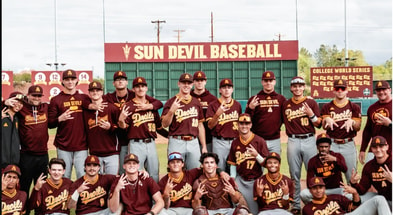
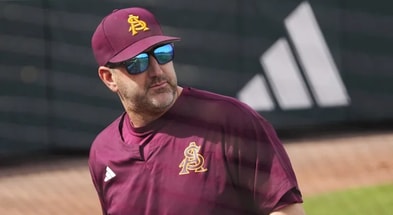
Head coach Willie Bloomquist has watched this group grow from a scattered collection of returners and transfers into something that feels like a team.
“We have a lot of guys in the fight and that are winning jobs, but at the end of the day, we have to pick a few to start and a few to close,” Bloomquist noted.
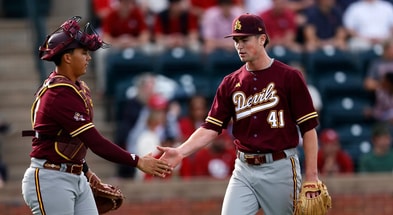
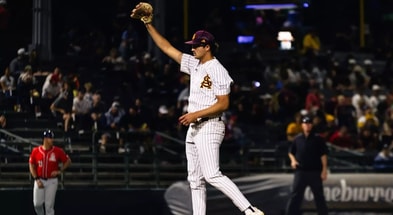
That competition is most pronounced on the mound. Last season, Ben Jacobs and Jack Martinez were reliable weekend starters, the kind of arms you could pencil into the Friday and Saturday rotation.
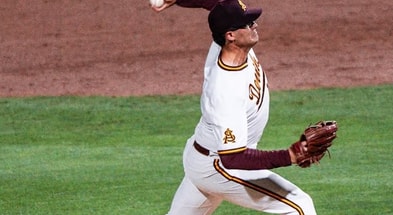
This season, junior left-hander Cole Carlon looks like the only sure thing in the weekend rotation. After posting a 3.83 ERA over 54 innings with 86 strikeouts last year, Carlon’s electric stuff and ability to handle multiple innings have earned coaches’ trust. Still, uncertainty lingers over who will round out the rest of the rotation.
Pitching coach Jeremy Accardo highlighted that the staff’s depth is encouraging.
“We have several guys confident and capable of doing it. It’s just a matter of who can put it all together and who’s the most polished of those guys,” Accardo noted.
Accardo highlighted several pitchers showing promise this spring for spots in the rotation, including sophomore left-hander Easton Barrett and junior right-handers Josh Butler, Alex Overbay, Colin Linder, Derek Schaffer, and Jaden Alba.
Senior right-hander Kole Klecker also deserves mention. Accardo said Klecker “has his confidence back,” though after a freshman season at TCU with 96.2 innings pitched and a 3.72 ERA in 2023, injuries have caused a downward trend. Accardo was cautious about assigning him a defined role just yet.
More than individual names, Accardo emphasized approach. Working ahead in counts, throwing strikes, and limiting free bases will be crucial to earning significant innings. That focus on fundamentals helped him, in his first season as pitching coach, lower ASU’s team ERA from 6.53 in 2024 to 5.38 in 2025.
“The work we put in with these guys, you have to understand what they do well and how to apply it,” Accardo explained.
Even with depth, the rotation isn’t settled. Accardo suggested early-season usage might look creative, with piggyback starts and matchups that vary week to week, all designed to find who can best give the Sun Devils a chance to win. Whoever earns that role will have to prove consistency, limit free bases, and handle pressure.
On the offensive side, hitting coach Jason Ellison is eager to see how his group performs when the games count.
“We have guys who can flat-out hit, and we still have power throughout the lineup,” Ellison added. “Contact leads to power. Especially in a ballpark like this, most days the ball is going to fly. Just be accurate and on time. The rest will take care of itself.”
ASU’s offense has a reputation for making pitchers sweat, and for good reason. The Sun Devils ranked 29th in the country in runs last season and 30th the year before, showing they can turn any at-bat into a threat and rattle any bullpen. 2026 looks set to keep that streak alive.
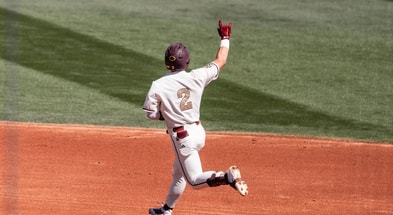
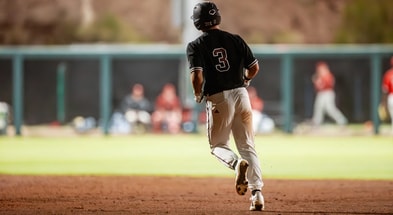
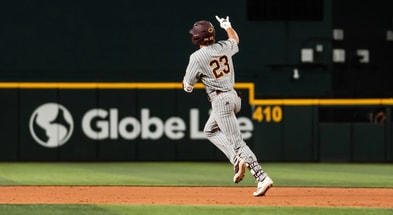
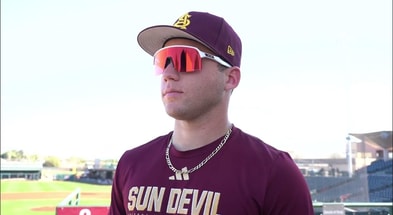
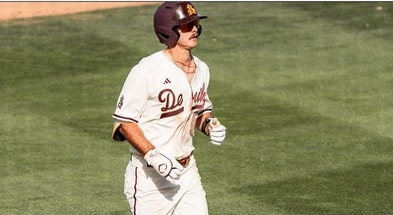
Ellison’s group blends returners with transfers. Sophomore outfielder Landon Hairston has been a breakout story, showcasing increased maturity and sharper plate discipline. Junior infielder Nu’u Contrades returns after a hand injury ended his season early last year, bringing veteran leadership and a potent bat. Graduate outfielder Dean Toigo, last year’s Mountain West Co-Player of the Year, adds not just power but a vibrant, joyful presence to the lineup.
Behind the plate, ASU has long leaned on veteran stability, from Ryan Campos to Josiah Cromwick. Now, sophomore Brody Briggs is stepping into the role. His freshman season showcased defensive reliability, throwing out four more runners than Cromwick despite eight fewer games, while pairing that with a consistent bat. Briggs brings a calm, steady presence that allows pitchers to focus on their game.
“You can’t hide a bad catcher. We have to have someone step up back there. Briggs is that guy—he understands what we expect, and the pitchers trust him,” Bloomquist noted.
Transfers have also been a major factor in reshaping ASU’s roster. With a portal class ranked among the nation’s best by D1Baseball, the Sun Devils added experienced players who bring both skill and leadership to the clubhouse. Bloomquist emphasized early in the fall that experience is key to winning in the new era of college baseball—a quality ASU now has in abundance.
That blend of veterans and returners has created depth the team lacked a year ago, sparking internal competition at every position and raising the level of play across the roster.
“Once the culture is established, that’s their job to come in and fall in line,” Bloomquist noted. “We let them be individuals to a certain extent, but as far as what we expect and how we view things, that’s it. You’ve got to fit in or get out.”
Depth also brings competition in the lineup. Some positions feel settled; others are still up for grabs. Ellison pointed out that internal competition is healthy and keeps players sharp.
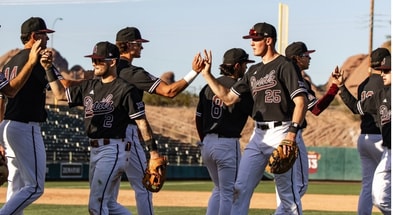
“There’s been a lot of competition,” Ellison mentioned. “And I think guys, these guys, are a pretty tight-knit group already, which is pretty cool to see that happen early on. And I think it’s just kind of understanding your role. Opportunities will come, just be prepared.”
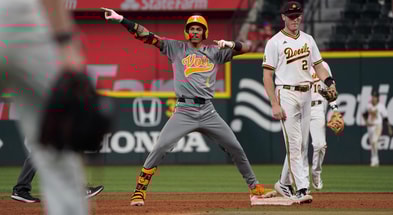
That push to perform isn’t just about hitting or fielding; it extends to every aspect of the game. Players know that being aggressive and smart on the bases can be just as valuable as putting up runs at the plate.
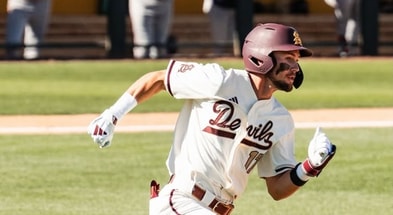
“We have a few guys who can do it whether it’s sheer speed or just instinctually,” Ellison explained, referring to aggressiveness on the bases.
That aggressiveness and smart, calculated base running will help define ASU’s offensive identity. The Sun Devils swiped 113 bases last year, second in the Big 12, but with Kyle Walker and Kien Vu gone, it remains to be seen how much emphasis will be placed on stealing this season.
Bloomquist has also spoken about attention to detail as a theme for 2026. By improving the running game, cleaning up routine defense, and strengthening two-strike hitting, the Sun Devils aim to become a more complete, well-rounded team.
“That’s what can elevate us from a good group with potential to a team capable of deep postseason success,” Bloomquist noted.
ASU’s schedule will put that complete identity to the test. Non-conference games offer early measuring sticks, including a grueling five-game stretch at the end of February against four SEC teams, three of them ranked in D1Baseball’s top 25. Every Big 12 weekend, like the home opener against No. 10 TCU, will demand that the Sun Devils refine their approach and adjust on the fly. Bloomquist and his staff want the team battle-tested well before the postseason begins.
The transfer portal has given ASU a roster rich in talent, but depth also creates decisions. Who starts? Who closes? Who thrives under the bright lights, and who surprises? Bloomquist embraces that uncertainty.
“As competition’s part of it, these kids are competing. We’re big advocates of competition. That’s what’s going to feed right into the season,” Bloomquist noted.