Preseason Hoops post No. 7: Ridley & Ibeh

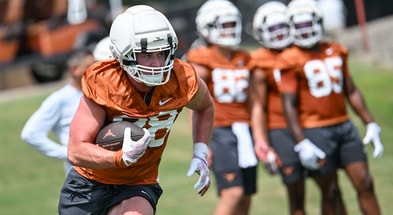
Cam Ridley. (Will Gallagher/IT)
In continuing our Preseason Hoops Post series, we look closer at Cameron Ridley and Price Ibeh in lucky No. 7.
Background: Cameron Ridley
● 6’9” 285 lb Center
● Fort Bend Bush (Richmond, TX)
● Recruited by Rob Lanier
● Ranked as the #21 overall prospect in the country
● Committed on January 14, 2011
● Averaged 11.2 pts, 8.2 rbs, 0.4 asts, 2.2 blks, .5 stls on 55/63% shooting in 25.6 minutes per game last season.
Strengths
Turnarounds don’t get a whole lot bigger than what Texas fans got out of Cameron Ridley last season. His worth questioned by even the most optimistic Longhorn fans, Ridley put together a season that was worthy of his lofty ranking as a prep-star and McDonald’s All-American at Fort Bend Bush.
Cameron’s production increase was glowing as he more than doubled his scoring, rebounding, assist and free throw shooting percentage numbers. In fact, the only things that didn’t double were his blocks (which went up from 1.4 to 2.2), his steals (which stayed firm at .5) and his overall shooting percentage (which went up from 46% to 55%).
That’s what Texas fans were hopeful for when he came in with the accolades he did. And it was fun to see a guy live up to his potential, especially when all of his hard work getting his body into shape was so evident.
So, what particularly does he do well on offense?
• He has great feet and loads very well for a guy his size
• Turns the load into force quickly
• Nimble in traffic with flexible hips and ankles
• Explosive around the basket
• Good at running the break down the pipe
• Can go over either shoulder with the ball
• Takes good angles as a rebound chaser
• Got his body into a position where he could play long, difficult minutes
• Has soft touch out to eight feet
• Wants to be aggressive at the rim and take it to defenders when he has the advantage
On defense?
• Maybe the best shot blocker/help defender in the Big 12 (one of the best in the country)
• Moves well side to side in both man and zone
• Can hedge some and stay out of foul trouble
• Progressing as a defensive rebounder, though still a better offensive rebounder
As far as true post players go, Texas has one of the top three or four of them in all of college basketball as a complete player who can impact winning on both ends of the floor. The amount of opposing defenders who can handle his skill and physicality are few. As are the opposing centers with a height/athleticism combo that can hurt him consistently on the low block.
He’s one of the best true post players Texas has had in a long time.
Weaknesses
Cameron’s progression last season saw him not only become a far better player than he had been as a freshman, but also one of better centers in the country. He worked hard to shore up his weaknesses and that he did.
That doesn’t mean, of course, that he is without his issues.
• He doesn’t have a consistent game beyond four feet from the rim, he needs to develop something more productive between 5-10 feet
• He is too hesitant as a passer (teams are going to crash and sag hard this year and we’ll need him to be better about recognizing the pressure and finding the open man)
• He struggles some on hedges on his recovery (though his fundamentals and footwork are solid)
• His free throw shooting still has a ways to go to be good, particularly at crunch time
• Ridley isn’t going to win any speed contests, but his speed isn’t a deterrent to his effectiveness
How to Best Utilize Ridley
Ridley’s utilization issues are the same as all good, true centers. Namely, he’s dependent on the teammates for post entries and spacing through shooting. Post entries we should be fine with (Taylor, Holland, Croaker, Lammert and Yancy are all good to very good…Felix, Holmes and Turner are all fine).
Shooting, on the other hand? Well, we’ll have to see how that plays out.
Regardless, Ridley can function as a good high post screener (though I don’t know how much we’ll see him above the three point line with Holmes and Turner on the floor with him). We’ll likely see him as a predominantly strong side player with Taylor and one of Holmes or Turner.
Defensively, if you hard hedge him, you do it very sparingly, and only against a point guard that will struggle to turn the corner. On the interior, he’s better playing straight up man or playing as an interior zone with dead ahead principles in zone, moving laterally is not a strength. Otherwise, let him defend by “getting tall” and establishing early positioning.
Best Case: 13.5 pts, 8 rbs, 2.5 blks on 55/70% shooting in 28 mpg.
Worst Case: 10 pts, 6.5 rbs, 2 blks on 55/55% shooting in 25 mpg.
The Endgame
Taylor gets a lot of the credit for last year’s return to prominence, but Ridley’s production was every bit as consistent and seminal in Texas’ uptick.
It’s also important to notice that Ridley did that with a lineup that generally consisted of ZERO pure shooters on the floor (largely Taylor, Holland, Felix and Holmes). Now, that problem may well persist this season (we’ll see what swapping out, likely, Turner for Felix would mean), so it will be important to follow if his efficiency can stay as high as it was last year against teams that will sag, sag, sag against the Longhorns.

Prince Ibeh. (Will Gallagher/IT)
Breakdown: Prince Ibeh (pronounced: EE-bay)
● 6’10” 260 lb Forward
● Naaman Forest (Garland, TX)
● Recruited by Chris Ogden
● Ranked as the #44 rated prospect in the nation
● Committed to Texas October 13, 2011
● Averaged 3.5 pts, 3.4 rbs, 0.1 asts, 1.8 blks on 50/51% shooting in 13.6 mpg as a sophomore.
Strengths
For all of the things Texas learned about its players last season, the question marks about Prince persist, but more on those later.
Ibeh’s strengths are profound. Physically he’s one of the most imposing players in the country. Gifted as a 6’10” athlete with a 7’4” wingspan and a 40-inch vertical, there are few players at any level that can boast more natural athleticism than Prince can. That works right along with his movement, which he does very well in transition and in getting back on defense.
He has some physical limitations (again, more on that later), but his athleticism is his biggest strength.
Top 10
- 1Breaking
Notre Dame
Declines Bowl Invitation
- 2Live
Confirmed Bowl Games
Full list of postseason matchups
- 3Hot
Official CFP Bracket
The 12-team field is set
- 4
Notre Dame AD
Rips CFP Committee
- 5
CFP Point Spreads
1st Round games released

Get the Daily On3 Newsletter in your inbox every morning
By clicking "Subscribe to Newsletter", I agree to On3's Privacy Notice, Terms, and use of my personal information described therein.
That plays itself out with his ability to protect the rim (where his block per minute rating was the sixth best in the country), his offensive rebounding (the second best ratio on the team behind Ridley) and his ability as a finisher in space around the rim (essentially the only place he’s all that effective, but at least he doesn’t venture away from that area often).
I think it’s also important to applaud Prince for his willingness to attempt being an important piece of the offensive puzzle. He’s worked hard to get better and be a back to the basket type of player (though he hasn’t really excelled).
Weaknesses
His post moves are weak and his mid-range game is essentially non-existent.
His offensive awareness is a work in progress.
While his physicality in some areas is all-world, his core strength, his wrist flexibility and his body control when he reaches are all sub par.
He fouls at an alarming rate (1 foul per every 4.6 minutes!).
All of that is news to exactly no one, but his limitations definitely affect how the staff is able to consider using him.
How to Best Utilize Ibeh
You let him play instinctively. You limit the types of screening looks you give him so that he can become a better anticipator of the action and you tell him to run up and down the floor until he can’t do it anymore.
You let him play aggressively. You take some of the foul trouble because when he does foul it’s going to be as a guy that’s looking to dunk on you or meet you with verticality to block your shot.
You let him play worry-free. You keep him as close to the basket on both ends of the floor as possible, and instruct him that any ball that comes close to the rim is his before or after whenever makes the most sense.
Prince is not dumb. He’s capable of learning offensive and defensive systems and assignments. He’s just not there yet, and he hasn’t been given the necessary skills instruction over the length of time others have that would allow for him to be performing at the kind of level we might all normally hope (with the understanding that it’s time for him to be figuring this stuff out considering how long he’s been under college level tutelage).
It’s key that the fan base embraces him for what he brings and doesn’t lament too much what he doesn’t because he’s an overly sensitive cat and a guy that can be a game changer if we can put him in the right situations to be successful.
The Endgame
If I were coaching this Longhorn team, I redshirt Prince. He still has a long ways he can go, physically, and I just don’t know what he will bring that couldn’t be replaced by Ridley, Turner and Lammert.
But if we’re going to play him, I hope we allow him to play a reactive style on the court where we don’t bog him down with assignments (on either side of the ball) that keep him from using by far his best trait…his athleticism.
I think his minutes and production will be small, regardless of the role he plays.
Best Case: 5 pts, 5 rbs, 1.5 blks, .5 stls on 55% shooting overall and 55% shooting from the line in 15 mpg.
Worst Case: 2 pts, 2 rbs, 1 blk, .2 stls on 55% shooting overall and 40% shooting from the line in 9 mpg.