Musings from Arledge: Gary Patterson's 4-2-5
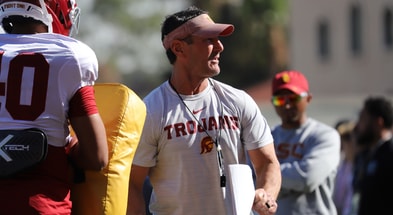
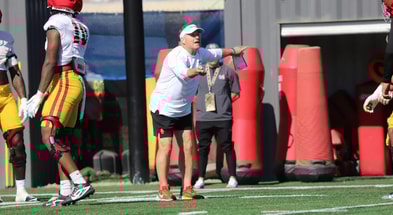
Gary Patterson is the new defensive coordinator for the USC Trojans. So let’s talk a little bit about what he’s likely to bring with him in terms of scheme.
And let me be clear what this is. This is an effort to piece together some thoughts based on materials that are publicly available on the internet: an old TCU defensive playbook, speeches and interviews given by Gary Patterson, and some secondary sources analyzing his defense. Those are not the ways that people are supposed to learn a defense; Patterson doesn’t tell his players to go root around on the internet and see if they can learn something about his scheme. And this is not a scheme I ever played in. So there are undoubtedly mistakes here—perhaps glaring ones—and more omissions than content. Still, I hope it gives a taste of the challenge that Gary Patterson’s defense poses for offenses.
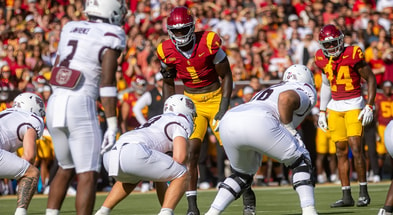
Patterson is, of course, famous for his 4-2-5 defense, which he helped to originate and popularize. At a basic level, that means Patterson’s base defense has four defensive linemen, two linebackers, and five defensive backs (two corners and three safeties).
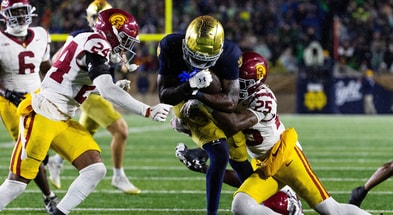
Even though Patterson’s base defense has one fewer linebacker, make no mistake about this: he puts an emphasis on stopping the run. In fact, that’s on his list of the five primary goals of his defense (at least how he listed them in a presentation some years ago), and he has made very clear in a coaching clinic presentation that “you must stop the run first [because] if you can’t do that, nothing else matters.” If you watched USC’s defense against Notre Dame last year, you know this to be true.
Patterson’s five primary goals:
1. Out hit the opponent.
2. Stop the run.
3. Create takeaways.
4. Eliminate big plays.
5. Don’t flinch.
To accomplish those five goals, Patterson relies on five basic principles within his 4-2-5 defense:
1. Create offensive confusion at the line of scrimmage.
2. Play with great leverage.
3. Establish the eight-man front.
4. Establish a pressure package.
5. The five-spoke secondary.
The primary benefit of a 4-2-5 is, of course, speed. Patterson replaces a linebacker with an extra safety, and in the process gives up some size in exchange for additional athleticism. The goal is to have personnel who can play in space against modern spread offenses.
But you might say that Patterson has actually replaced two linebackers from the old 4-4 defense with two additional safeties, because his 4-2-5 is essentially the old 4-4 but with both outside linebackers replaced with two safeties who should be more athletic and able to play a bigger role covering players in space. I also assume that Patterson can easily replace one of the safeties with a larger player, particularly at the strong safety or weak safety position, and essentially gain an extra linebacker. I don’t know how often he does that, and it may depend on personnel. I’d take a 215-pound Groots over most 235-pound linebackers anyway; size isn’t everything.
Thus, Patterson’s defense is more than capable of creating eight-man fronts to stop the run. The front six are responsible for A, B, and C gaps. The safeties are additional run support as contain. Here’s a simple diagram from one of Patterson’s presentations:

Note that the diagram shows the linebackers with potential A or C gap responsibilities. The linebacker could be given B gap responsibilities also if the DT were shaded inside of the offensive guard.
This means that the six-man front can cover all six inside gaps (the C gap is inside of the tight end if one is on that side), but it can, of course, involve late shifting to disguise which players are responsible for which gap to confuse the offensive line. And Patterson’s defenses frequently involve pre-snap movement to confuse defenses.
By bringing the strong and weak safeties up closer to the line of scrimmage, Patterson is able to create the old 4-4 look and give his defense an eight-man front. This is a quote from a presentation Patterson gave about this defense while he was the defensive coordinator at New Mexico in the late 90’s: “What we have hung our hat on at the University of New Mexico is establishing the eight-man front. The reason for using the eight-man front is that we believe you must stop the run first. If you can’t do that, nothing else matters. The 4-2-5 front allows us the multiplicity to always try to have one more player at the point of attack than the offense.”
The safeties are (usually) smaller than the prototypical linebacker, but Patterson isn’t really relying upon them to take on offensive linemen in the box. “The philosophy behind being able to play the run with only six in the box is that we want the ball to get pushed to the outside safeties. The safeties’ leverage allows us to stunt or slant any way we need to control the line of scrimmage.”
And depending on the offensive formation, Patterson might put nine in the box: “With the addition of the three safeties, this gives us the possibility of nine players playing the run against a two-back set.”
The basic idea is this: with an extra safety and eight men in the box, an offense always has to account for eight guys in the run game. That doesn’t mean Patterson is always committing eight guys to the box; but the offense must assume that they are in order to have everybody blocked.
Patterson: “Because of the leverage positions of the safeties, we are able to move our front six around without risking leverage problems. This allows our linebackers to show in their gaps without worrying about being an overlap player. The outside blitz position by our safeties makes offenses account for them on all run and pass plays.”
Note also that with eight players this close to the line of scrimmage, Patterson can easily bring anywhere between three and eight blitzers and should be able to effectively disguise who is coming. The same basic look can bring eight or drop eight—or anything else in-between.
This matters because, from Patterson’s perspective, “The threat of a blitz to an offense is sometimes worse than the blitz itself.” Patterson, like most defensive coordinators, wants to keep the offense guessing. More than that, he wants to force them to audible. To paraphrase one of his statements, he wants the threats posed by the defense to force the offense to audible into something other than its preferred play.
Patterson also believes having so many players in the box also gives his defense an advantage in terms of leverage. If I understand Patterson’s statements here, he means to say that his defense doesn’t get outflanked. If you remember back to the home game against Washington during the Sad Era of Grinch, you might remember that Washington frequently outflanked USC on the edge and was running toss sweep repeatedly as a result. Patterson believes his set up avoids such problems and then teaches the following leverage rule to all players: “The phrase is inside and in front …as long as all eleven players keep the ball inside and in front of them then good things will happen”. The second, related principle is that once a ballcarrier makes his intentions known, he is not allowed to cross your face. Simply put, defensive players are taught to keep the ballcarrier inside of them, but if the ballcarrier is outside (sometimes that’s inevitable—imagine a quick tunnel screen and you’re a linebacker), the ballcarrier is not allowed to cross inside of you. That’s leverage, and it’s not a Gary Patterson concept. It’s a football concept that he stresses to his defenders. Patterson just thinks the extra guy in the box makes it easier to keep leverage.
Now what makes Patterson’s system most interesting, however, is that he splits up the calls between the front six and the back five. Traditionally, the calls go together. That is, what the front six (or seven) play determines what the secondary must play. Patterson has changed that. He uses the front and the secondary independently. In other words, regardless of how Patterson has the front six positioned in order to handle the A-C gaps on both sides, the secondary is still free to mix up their coverages in any way Patterson sees fit. The front does not control the back.
In fact, he even splits up the secondary, and the two sides of the field might not be playing the same coverage. The strong safety aligns to the offense’s strong side, which is essentially the side of the offense with the greatest receiving threat. If there are two wideouts to the left side and one wideout to the right, the left side is the strong side. And the two sides might be doing different things. More from Patterson: “It used to be you would see if you could beat people with seven in the box against a two-back team. Now people are willing to add more in the box to stop the run, so now you have more susceptibility to getting the ball thrown over your head. That’s one of the reasons I went to a five-defensive-back system. Somewhere on the field I can play man coverage and add a guy to the box, and in other places, I could play zone.”
You can see an example here from one of TCU’s old playbooks.

This is his cover 2—which isn’t exactly the same as a traditional cover 2—against an offense in an 11 set (1 back and 1 tight end) with twins to the defense’s left. The strength is to the left (because two wide receivers is more of a threat than one wide receiver and one tight end).
Top 10
- 1Hot
March Madness
Freshmen ready to make impact
- 2
Will Wade
LSU paying close attention
- 3New
Billy Donlon
Leaves Clemson for HC job
- 4
UNC Basketball
Transfer Portal needs
- 5Trending
Greg Sankey
Change will be uncomfortable
Get the Daily On3 Newsletter in your inbox every morning
By clicking "Subscribe to Newsletter", I agree to On3's Privacy Notice, Terms, and use of my personal information described therein.
Both corners are in what Patterson calls a man clue; if the #1 receiver (the guy farthest to the outside) goes vertical, the corner has him man-to-man, and there’s a good chance he’s not getting any help. If the outside receiver doesn’t run a vertical route, the corner essentially has a deep zone and will be available to help with deep threats coming to that side of the field from elsewhere. Note that this means one corner might be in man and the other in zone, and nobody knows before the play starts.
The strong safety is in zone coverage in the flats, but if the number three receiver (the back) runs out and up, he has to run with him. Remember, if the #1 receiver to that side went vertical, the corner to that side might be somewhere else on the field in man coverage—for example, defending a post route. So if it’s a wheel route, the strong safety has him.
The free safety is in a robber technique. If the #2 receiver to the strong side (the slot receiver) runs a vertical route, the free safety has him in man coverage. If he doesn’t go vertical, the free safety is free to undercut his short route and hunt for an interception. This also frees him to be a ninth defender in run support, because as soon as the slot receiver does anything other than a vertical route, he is free to move to the line of scrimmage.
This clip from TCU against Arkansas shows how the robber technique can give Patterson’s defense a ninth player in the box against the run. When the #2 receiver (the tight end) doesn’t go vertical, the free safety is free to come to the line of scrimmage, where he makes the tackle for a short gain.

Back to the other assignments. The Mike backer is dropping to the middle of the field in zone coverage, but if the running back goes vertical, he has him in man coverage.
The Sam backer is in zone coverage in the hook-curl space, but if the #2 receiver (the TE) goes vertical, he has him, and if the tight end tries to cross his face and drag across the field, he has to wall him off. And the weak safety is in a short zone unless the tight end runs and out and up, in which case he has to run with him.
What this means is that you can have some players in a man coverage and some in a zone, and nobody knows at the snap where they’ll be. This is why Dana Holgorson told a reporter some years ago, “Sometimes I get confused if it’s man or zone because there’s a lot of matching routes that goes on that looks like man. It’s 50 percent man and 50 percent zone pressure.”
Note that, at least on this call, the cornerbacks have it easy. It’s easy enough to play a deep zone if the number one receiver runs a short route and play man if he goes vertically. The strong and weak safeties also have relatively easy assignments: play zone but if your guy runs out and up, you go with him.
Same with the free safety. If the slot goes deep, take him. If he cuts it off, you come up hard and look for a pick.
The linebackers, however, better be good on their reads. Remember, they have run gap responsibilities in addition to either zone or man coverage. If the Mike reads run, he fills the hole. The only issue is if the running back runs vertically on a pass route (not an out and up; the strong safety would have that). But this is the nature of playing linebacker in the days of the RPO. It’s just a tough thing to do.
This is, of course, just one defense against one set. And keep in mind, this is assuming that Patterson gave the entire secondary a single call. But because he sometimes splits up the coverages between the strong and weak sides, it’s possible that the reads might be more complicated for the quarterback. So you can see how Patterson can make things very complicated for a quarterback while still maintaining defensive responsibilities that are (for the most part) fairly simple.
And understand what this means. Offenses want to know whether the back seven is playing man or zone coverage. Often, offenses use pre-snap motion to see how the defense reacts in order to know this. Quarterbacks and receivers must know and be on the same page. In zone, receivers sit down in the open spaces. In man, they can’t stop. So quarterbacks and receivers need to know what the defense is doing in order to adjust. A defense where some players are in man and others are in zone—and nobody knows until the play has started—can obviously cause confusion for an offense.
I’ll close with this. Scheme doesn’t make a defense, at least not by itself. In addition to a scheme that can create confusion for an offense, Patterson has shown two major strengths over the years. First, he is a master evaluator of talent. This is crucial for recruiting, of course, and for figuring out what players are capable of. You can’t give players assignments for which they are not physically capable.
Second, Patterson is a legendary scouter of opposing offenses. Take this quote from Tom Herman, the former Texas head coach: “His defenses do a really good job of mixing zone with man, mixing fronts, mixing blitz in kind of at the right time. He’s going to scout you, you know, until his eyeballs come out. He’s going to know when the back is 6 centimeters shaded to the left, you’re 92% likely to get this run or this pass or whatever it is. You’ve got to be cognizant of all of your tendencies. You can’t overthink it either because if you’ve got a tendency and that tendency is working, there’s some merit to it as well.”
I don’t know if this hire will work. There are some concerns with hiring a guy in his mid-sixties who hasn’t coached full time in four years and got fired when his program fell off at the end of his legendary tenure. Still, Patterson is a serious guy, a Hall of Famer for a reason. I’m cautiously optimistic. And I’m pretty sure this is the hire that will determine whether Lincoln Riley succeeds at USC and finishes out his 10-year contract or gets fired after the 2027 season.
It won’t be boring.