Inside the Gameplan: Oklahoma State


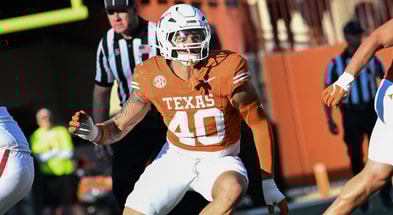
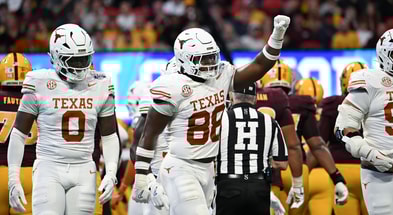
Malik Jefferson. (Will Gallagher/IT)
The 2017 schedule for Texas is shaping up to be rather challenging. The Longhorns were somewhat fortunate to draw a beat up Jesse Ertz when they took on Kansas State, although the Wildcats fared well in the adjustments that brought on, but are unfortunate that the road trips to Fort Worth and Morgantown now look more ominous than they did before the year began. But first Texas has to finish this daunting three-game stretch and take down Oklahoma State to get back over .500. A win here would make bowl eligibility a much surer thing with Baylor and Kansas still remaining to help Texas reach six victories.
The Cowboys were a preseason favorite by many to win the Big 12, largely due to the extreme potency of their offense which includes three and a half-year starter Mason Rudolph, returning 1k yard back Justice Hill, two-time (soon to be three-time) 1k-yard receiver James Washington, and then several other really good WRs like Marcell Ateman, Jalen McCleskey, Tyron Johnson, and Dillon Stoner. They’re a loaded crew that has scored 59 points three times already this season and had their worst day against TCU in a game where they still scored 31 and put up 499 yards of total offense.
For Texas to win this game, priority one is at least matching what TCU did as a defense against what may be the most explosive Mike Gundy offense we’ve seen to date.
An archetypical Gundy offense
The 2017 Oklahoma State Cowboys are not terribly different from the 2011 Oklahoma State Cowboys. Gundy offenses tend to boil down to spread formations, run/pass balance, and tons of play-action shots in which their QB is making a quick read and throwing to a spot down the field where he can reasonably expect a sensationally athletic WR to be.
Their offense can basically be summed up as “a million ways to run post routes to James Washington against an isolated cornerback.” Amongst the more common ways that crop up for them are with the dig-post combo paired with play-action…
…and now they often run it from four receiver sets with a shallow cross and a deep comeback or fade opposite the post to big Marcell Ateman (6-4, 215).
As you can see on either of these, Rudolph is just making a quick read and throwing to a spot with the ball coming out within three seconds.
The run game that Gundy uses to set the stage for these routes is mostly outside zone oriented and tends to employ a fullback and pass options for Rudolph attached.
They’re looking to control penetration, crease the defense, and then allow speedy runner Justice Hill to get to work in the open field.
It’s a good system with several years of 10-win seasons and top 10 ranked offenses on the resume and the 2017 Cowboys are as good at executing this system as any other Gundy unit we’ve witnessed. In some ways it mirrors the run game strategies of Snyder’s Kansas State by emphasizing double teams and careful blocking of opposing DL while generating run/pass conflicts. In other regards it resembles the Art Briles system by featuring so many deep shots and vertical route combos from spread sets.
Obviously the major key to stopping this offense is taking away the big plays, the challenge is how to do so. The most obvious way that suits the Texas defense is to push the pocket and disrupt Rudolph’s ability to just read and chuck. When he’s resetting his feet late before the throw he’s no longer deadly accurate:
Rudolph’s footwork moving to a second progression, particularly when pressured, is not nearly as good but you need either quick inside pressure or to force him to have to get through progressions and make hitch steps to avoid the “1…2…3…TD pass!” effect you so often see from him in this offense.
This is very difficult to do though because Rudolph is not nearly as statuesque as you’d think from looking at him (he’ll run zone-read in the red zone for an easy TD every other week) and their deep shots tend to include either play-action and max protection or the shallow cross to give him a hot read.
Orlando has two main weapons to deploy against this type of offense. The first are his overload pressures that I’m sure everyone is used to seeing regularly from Texas this season:
They tend to work with the DE crashing inside, the nickel chasing behind him, and then the middle linebacker looping outside of the nickel to contain the edge. Orlando likes to use them to discourage particular runs to a given side of the formation and they aren’t terribly easy to beat with a quick pass because the DBs rotate into man coverage with a single deep safety.
Orlando’s other solution for this sort of spread/play-action system is the quick four-man pressure, typically with Malik hunting for an inside gap while Hughes drops into coverage:
The Sooners had a nice shallow cross available here that was well set up by a pair of routes that held the attention of the middle linebacker and nickel, they also had Baker Mayfield who’s the best QB in the league at quickly setting his feet and firing an accurate ball. Still, Texas forced a quick pass and made a tackle before the marker on a four-man pressure. Against Oklahoma State, who relies on deep shots to win and not quick hitters, that’s a major win.
On the single-high blitzes the Longhorns are probably going to want to shade their deep safety towards James Washington’s side and take their chances against Ateman in man coverage. The biggest difficult is when the ‘Pokes have Washington on the boundary with a slot receiver inside of him running a dig route to hold the safety.
Texas has two challenging tasks in dealing with this offense and James Washington in particular. One is that they can’t afford any more mental errors or assignment busts that give up freebies because OSU takes too many vertical shots with too much proficiency. The other challenge is that even after you successfully match up, you still have to keep up with Washington on route combos that are designed to be very difficult to cover.
The question then is whether Orlando wants to rely on execution of the base coverages against James Washington or if he feels like he can drill in a “steal” coverage this week into the minds of his DBs to allow them to bracket these concepts:
Top 10
- 1Breaking
Kansas State
Nearing deal for head coach
- 2Hot
Big 12
Abandoning LED basketball court
- 3
NCAA rebuffs Big Ten
SEC, ACC, Big12 back punishment
- 4
Will Wade
Addresses LSU rumors
- 5Trending
Bracketology
Shift with conference tourneys
Get the Daily On3 Newsletter in your inbox every morning
By clicking "Subscribe to Newsletter", I agree to On3's Privacy Notice, Terms, and use of my personal information described therein.

These routes are most concerning when Washington is on the boundary and the B-backer is potentially having to help cover the dig route with the safety splitting the difference and inevitably leaving the corner out to dry against Washington. But if you roll over the opposite safety that negates this concern and now you “just” have to worry about Kris Boyd losing his mind against Marcell Ateman in man coverage.
Those are the choices though, keep it simple and hope you out-execute James Washington or make OSU beat you throwing to Ateman all day. It should be interesting to see which direction the staff leans for this game and the answer may lean on how confident they feel in their ability to help their DBs with pressure up front.
Helping Sam take down OSU
The Oklahoma State defense is basically 11 hard working guys doing their jobs and hoping to out-scheme you. They have an exceptional multiple package with several different versions of quarters, “cloud 38” as Herman called it when it came from Iowa State, and cover 3 all of which they can play from three-down, four-down, nickel, and dime sub-packages.
From snap to snap they tend to disguise and play lots of different coverages while aiming to rush only three or four and get extra defenders in position to stop the run. The inside linebackers Justin Phillips and Chad Whitener are quite good and safeties Ramon Richards and Tre Flowers are versatile and good open field tacklers but Flowers definitely gives up something from Jordan Sterns as a first responder against the run. Some of their most dangerous features this season leaned on their now injured nickel safety Kenneth Edison-MacGruder credibly playing as a box LB, space player, and deep safety and disguising which of those roles he’d play on a given down.
Without Edison-MacGruder they don’t really have any particular standout athletes on this unit that terrify you but they do have more than 11 guys that will play very sound, fundamental football. That combination has to be concerning for Herman and his staff, who have to figure out how to deal with the inevitable invitation from the Cowboys to try and beat them down the field by running the ball.
Against Oklahoma, the only runs that were effective for Texas were basically the ones that involved Ehlinger running through Sooner tacklers. The gameplan against Oklahoma included a variety of different schematic tweaks intended to allow the Longhorns to run inside zone on a lighter box. They ran zone read, zone extra (WR sweep), and lead zone with Brewer trying to help secure the A-gaps and none of it worked, in large part because Terrell Cuney couldn’t block the Sooner DTs. You can’t be a downhill running team if you don’t have good guard play.
The primary reason Texas has been able to be a successful spread passing team is that most teams in this league don’t have an Obo Okoronkwo to chew up these freshman tackles and because Sam Ehlinger is like a Russell Wilson for the Longhorns, magically erasing any chances of the opponent successfully inflicting a negative play.
If Oklahoma State attempts to drop eight, Ehlinger can probably do enough damage on scrambles, draws, and quick tosses to the backs or Cade Brewer to light them up and force them out of it. The problem is that this could result in Ehlinger racking up another 15-20 carry kind of day. As our own Justin Wells put it to me recently, “he’s the best OL or RB on the team” and it’s surely hard for the staff not to lean on that come gameday if nothing else is working.
An alternative is just to continue handing off to the backs into the pile to keep the Cowboys honest and hopefully pick up small, positive gains while learning on Ehlinger wizardry on passing downs to sustain drives. That was more or less the Texas offense from 2008 to 2009 with Colt McCoy, after all.
If the staff opts for the plan Scipio put forth the other day on 104.9 the Horn it would feature at least eight “RB counter” calls designed to try and give this OL a chance to create a lane for a back while Sam watches safely from the backfield. There’s actually some reason to believe this could work if Jake McMillon is back in the lineup at guard as MacGruder was their best run support safety. The only challenge is that it requires that Texas play primarily in 11/20 personnel, you can’t run counter without a lead blocker and you don’t have one in 10 personnel unless it’s QB counter with the RB leading for Ehlinger.
The counter blocking scheme is favorable though for Texas’ personnel as it uses the TE to lead up to a linebacker while the guard gets the more challenging duty of handling the DE.

It’s a rep-intensive scheme because the guard has to adjust on the fly to how the unblocked DE plays it and then the TE has to make a decision on whether to go downhill to find the linebacker or to wrap around the DE and lead on the perimeter. Then the RB has to read all of this and make the best decision on how to find running room. Here’s Ehlinger running the concept:
Vahe struggles to control Obo in the huge crease created by Kerstetter’s effective down block and Kyle Porter ends up helping to stop the Sooner OLB, which means Ehlinger has to account for the linebacker on his own. Since Porter has more experience in this scheme Texas could run the play from 20 personnel and have #21 execute the lead block rather than Brewer but either way this play is probably their best chance at starting to build a run game identity.
If Texas can take away Oklahoma State’s big passing plays, or at least drastically reduce their rate of occurrence, and then run the ball well enough to keep drives going they have a shot to be within striking distance in the fourth quarter once more. The Cowboys have depth on defense but they lack the pass-rushers to hold up against Ehlinger in winning time, perhaps at home that trump card serves up another Texas victory.