The latest reason why passing is important to rushing potency

A modern axiom to tilting football games is winning the explosive play battle. While old heads will preach the value of ball control and limiting turnovers, logging chunk plays and field-flippers have had a better correlation to college football victory than any element the last half-decade.
Instead of relying on perfectly executing a dozen reps in a row, one snap can be a saving grace to pay dirt. Some may still strive for three yards and a cloud of dust. But, points come much easier — and faster — from offenses that strive to capture big gainers. Studies are out there to back that thinking up.
From dazzling motions, new RPO wrinkles, deception designs , and other creative and innovative tactics, play callers aren’t pulling many punches when it comes to landing haymakers against their counterparts. But while viral highlights and splashy clips are as bountiful as ever, defenses are quietly winning the war.
| CFB 10-Year Trend | 2025 | 2015 | 10-Year Change |
| Possessions/Game | 24.0 | 26.9 | -10.8% |
| Points/Game | 52.1 | 57.0 | -8.6% |
| Plays/Game | 134.0 | 143.8 | -6.8% |
| Points/Possession | 2.19 | 2.11 | 3.8% |
| Plays/Possession | 5.61 | 5.29 | 5.7% |
Over the last decade, the recent defensive momentum coupled with tweaked clock rules has seen offenses have fewer scoring opportunities and overall points, on average. Surrendering less big gainers and striving to keep things in front of them has also resulted in defenses forcing opponents to run more plays per drive. In fact, 2025’s 5.61 plays/possession mark was the highest in 19 years.
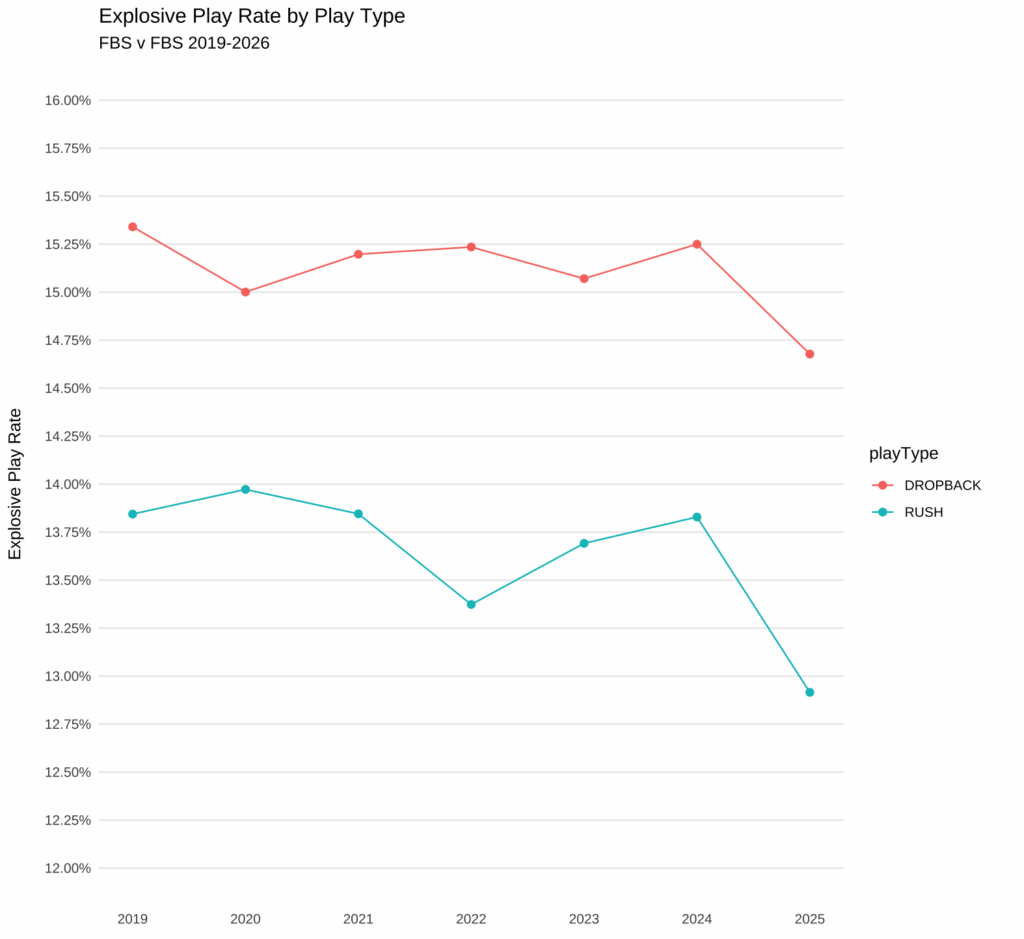
Since 2019 in FBS vs FBS matchups, the national average Explosive Play Rate on dropbacks and designed runs have dipped from 15.3% and 13.8% to 14.7% and 12.9%, respectively.
For the sake of scope and detailed data, let’s focus on The Land Where It Just Means More. Moreover, the SEC has produced the most NFL draft picks across the last decade and tends to operate with “optimal” resources compared to the majority of its contemporaries. So, it’s a nice representation of the sport at large.
Enhanced investments, top-tier talent, and copycat coaching has slowed down the spread revolution. Defenses are smaller, twitchier, and more versatile than ever. And like in the professional ranks, units overly base out of nickel (5 DBs) and routinely feature 2-deep coverages to cap downfield passing attacks.
As you’d expect, more coveragemen on the field has helped limit aerial explosives, or pass plays that gain at least 20 yards. Down from 10.6% in 2023, this fall’s 9.0% clip is the lowest since the pandemic. Ole Miss was the only team in the conference with an Explosive Pass Rate north of 12%. Plus, the majority of the league rocked a single-digit mark in 2025. Ball knowers should hardly be surprised by those findings.
| SEC Explosive Pass Rate | 2025 | 2024 | 2023 | 2022 | 2021 |
| SEC EXP% | 10.5% | 11.9% | 12.7% | 11.0% | 10.4% |
| SEC TEAM AVR EXP% | 9.0% | 10.1% | 10.6% | 9.4% | 9.1% |
However, the fact that this defensive style of lighter boxes and more multi-safety shells has also undercut ground games is quite curious. It’s downright counterintuitive, really.
A traditional setup has 7 players in the box — matching the 5 OL, QB, and RB — adding 1/2 more for beefier formations than involve tight ends or fullbacks.
Recent SEC defenses, however, have been able to alter the math and prove 1+1 = 3; despite favoring 5/6-man boxes.
| SEC Explosive Run Rate | 2025 | 2024 | 2023 | 2022 | 2021 |
| SEC EXR% | 12.9% | 13.6% | 14.8% | 15.2% | 16.0% |
| SEC NEG% | 9.1% | 8.9% | 9.1% | 9.6% | 8.9% |
| SEC Rush Success% | 45.8% | 46.2% | 44.8% | 46.4% | 46.8% |
For five-straight seasons, the league’s Explosive Run Rate on RB, QB, and WR planned carries all have worsened. In that span, the cumulative SEC mean is down over 3-percentage points. Or in other words, only 1/8 runs top 10 yards on average compared to about 1/6 just a few years ago.
Running backs, especially, have been neutralized as of late. The conference as a whole logged 620 explosives compared to 628 in 2023, when two fewer teams were members. Naturally, our normal ball carriers handle more weight in this equation; even with the dwindling returns from other positions. And for what it’s worth, WRs were almost twice as prone to explosives in comparison.
| SEC Explosive Run Rate | 2025 | 2024 | 2023 | 2022 | 2021 |
| RB EXR% | 11.9% | 12.7% | 13.4% | 14.0% | 15.0% |
| RB NEG% | 7.8% | 7.8% | 8.4% | 8.7% | 8.6% |
| QB EXR% | 15.1% | 16.7% | 18.3% | 18.4% | 22.3% |
| QB NEG% | 12.6% | 14.1% | 10.3% | 11.9% | 11.6% |
| WR EXR% | 20.8% | 24.3% | 25.9% | 27.2% | 30.2% |
| WR NEG% | 18.3% | 17.7% | 12.5% | 20.6% | 11.3% |
Clever fronts, cutting-edge techniques, and textbook tackling certainly can be attributed to helping curb rushing potency at large. And, kudos to defensive staffs for getting Uncle Mo largely back in their corner.
- 1

LSU Coaching Buzz: Matt McMahon's future ... and Will Wade's
- 2
 New
NewBilly Donovan reacts to UNC speculation
- 3

Bill Self addresses rampant retirement rumors
- 4

UNC Head Coach Hot Board
- 5

Michigan AD responds to rumored UNC interest in Dusty May
Get the On3 Top 10 Newsletter in your inbox every morning
By clicking "Subscribe to Newsletter", I agree to On3's Privacy Notice, Terms, and use of my personal information described therein.
One area, however, is providing offenses a good amount of W’s: Scrambles.
While every other aspect has experienced waning potency, backyard heroics remain bankable and crucial to buoying bottomlines. If an offense lacks a QB that cannot improvise or lacks sweet feet, containment isn’t as much of a chore. Rooted, systematic approaches are far easier to stop than chaos or off-schedule playmaking.
Captain Obvious also wanted me to remind you erasing sacks and limiting negatives are vital for sustaining series. Think of it to the inverse of that aforementioned study. A loud loss is linked just as much to a team’s scoring chances as a big gainer.
| SEC Scramble Explosiveness | 2025 | 2024 | 2023 | 2022 | 2021 |
| Sack% | 5.9% | 6.6% | 6.8% | 5.5% | 5.7% |
| Scramble% | 8.3% | 7.9% | 7.2% | 7.1% | 6.0% |
| Scramble EXR% | 28.9% | 26.7% | 31.8% | 32.0% | 25.2% |
| Sack+SCR EXR% | 16.9% | 14.6% | 16.3% | 18.0% | 12.3% |
Scrambles themselves have lost a bit of juice since the SEC expanded, but these plays still are the best, most consistent method to producing explosive runs.
Though defensive structures can keen in on designed runs and admirably bend but not break, resource allocation is constantly at a near breaking point when dealing with backyard ballers, extenders, and multi-faceted stressors. If the goal of defensive matchmaking is to play 11-on-11, using two or three extra dudes to account for one offensive player frankly isn’t ideal in the slightest.
Furthermore, what may originally be a brilliant defensive call that sees all routes clamped or a rusher come Scot-free might end up a demoralizing defeat. Not all losses on the gridiron hit the same. But, the pure alchemy of turning nothing into something is a surefire way to snatch the souls of your foes and wear them down efficiently.
| SEC Runs of 10+ Yards | Scramble EXR | RB EXR | QB EXR | WR EXR |
| 5 Year AVR | 28.9% | 13.4% | 17.8% | 25.0% |
Interestingly enough, 5-of-the-6 most-explosive rush offenses in the SEC (Arkansas, Auburn, South Carolina, Texas A&M, and Vanderbilt) had mobile QBs this fall. Not to mentioned, that group also included 3-of-the-5 best units in overall Yards/Play.
To combat our recent trends, teams have shown a higher proclivity let their QBs cook and maximize each snap. SEC offenses averaged 477 dropbacks in 2025, the most the last four years. Subsequently, the league’s Scramble Rate is on a clear upswing. SEC offenses are good for ten more combined sacks+scrambles (67.6 vs 57.6) and 90 total scramble yards (296.9 vs 204.8) than five years ago.
| SEC Yards Per | 2025 | 2024 | 2023 | 2022 | 2021 |
| Yds/Dropback | 6.6 | 6.9 | 7.1 | 6.8 | 6.8 |
| Yds/Scramble | 7.5 | 7.6 | 8.4 | 8.6 | 6.9 |
| Yds/Pass | 7.7 | 8.0 | 8.2 | 7.8 | 7.7 |
| Yds/Run | 4.9 | 5.1 | 5.2 | 5.4 | 5.3 |
No matter how you slice it, passing is still the bee’s knees. Even with new wave emphasis to cap homeruns, the average pass gains more than the average run. Throwing the ball flatly has higher down-to-down ceiling; especially when accounting for scrambling. Teams experience a wider margin of error, move the ball less-arduously, and typically score more points. And when it comes to winning ball games, that’s a worthwhile process from where this analyst sits.
A reinvestment in size, girth, and heavy personnel packages might invigorate typical rushing production. Some are already tinkering bringing back the I-Formation and trotting out two or three tight ends on the reg. But, the numbers scream the magic scrambling provides is unmatched and undeniably important for any offense in today’s landscape.