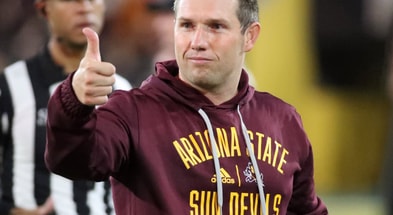
Will ASU deliver the ultimate Christmas present and retain Kenny Dillingham?


The 2025 season for Arizona State football was exasperating at times. Granted, an 8-4 mark is one that many teams in the Big 12, let alone around the country, would love to trade places with. Yet it did come after the euphoria of the 2024 season, which culminated in a Big 12 Championship and an appearance in the College Football Playoffs.
This year, long-term injuries to many of their key players and evident offensive struggles for literally the entirety of this campaign made this year an exercise in frustration. The fact that ASU not only lost to their in-state rival but was dominated to the tune of 23-7 in Tempe only added to the misery index of Sun Devil fans.
But the possibility of head coach Kenny Dillingham leaving ASU for Michigan would easily topple all those disheartening moments of the Territorial Cup game.
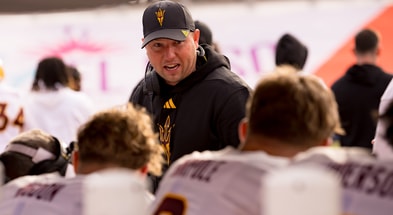
At press time, negotiations have been ongoing between Kenny Dillingham and his agent, Clint Dowdle, and Arizona State. Those deliberations are not only regarding a restructured contract that would provide more guaranteed money for the ASU head coach, but also, and probably more importantly, grant the program more financial resources as in a higher operating budget let alone increase the funding of name, image, likeness (NIL) that the team would use to retain significant players as well as attract quality newcomers.
As we speak, the two sides remain apart in the negotiations, and with each passing day in December, the anxiety among Arizona State’s followers is growing tenfold. And at this point, even the most even keeled ASU fan cannot claim this apprehension to be equated to paranoia, but rather portray the grim reality of a school that is giving the appearance that it is not willing to provide the financial resources for the football program to remain successful, and be in position once again, to repeat all the incredible feats that the 2024 season provided.
In an interview on 98.7 FM on Thursday afternoon, Arizona State Athletic Director Graham Rossini characterized the negotiations with Dillingham and Dowdle as: “A fluid, active conversation. We’re working through it. We’re working through some details. It’s an exciting moment for our program.”
He added, “We’ve got tremendous leadership in place under Coach (Dillingham). Kenny Dillingham is the right leader for our program.” Rossini acknowledged that, even in long-term contracts such as Dillingham’s, the landscape is changing daily and that ASU needs to adapt to it and ensure it gets the contract right. He added that college sports are very complicated these days and that his role is to give Dillingham the tools he needs.
Needless to say, I’m not doubting these words by Rossini. Yet, the fact that the conversations, that have been taking place nearly three weeks now have not reached a point where Dillingham and his agent will politely tell Michigan: “thank you, but no thank you” and have the always transparent ASU head coach tell the media and thus communicate to the masses that he’s unequivocally staying in Tempe in 2026, is causing undeniable unrest.
These negotiations aren’t solely about Dillingham’s salary, but it is obviously an element being discussed. According to USA TODAY, the most Dillingham can earn in salary, including bonuses from Arizona State for the 2025-26 season and school year, is $8,014,000. The negotiations aim to make that dollar figure a base salary, rather than one heavily contingent on bonuses, as it’s currently structured. The compromise could require smaller dollar bonuses and a larger buyout amount if Dillingham leaves ASU for another job (his current buyout is $4 million). Dillingham has proven, through his words and actions time and time again, how committed he is to the school, and Arizona State restructuring his contract in those terms would show that loyalty is a two-way street.
Alas, the main sticking points in these dialogues appear to be the overall size of the football budget and NIL. The former would largely consist of higher assistant coach salaries aimed at deterring suitors from trying to beat that compensation number, and a budget that can also allow for hiring a seasoned general manager to navigate the complex and dynamic NIL waters.
University President Dr. Michael Crow greatly helped the athletic department by having the university cover the cost of scholarships for over 600 student-athletes, thereby reducing the department’s budget burden.
The caveat to that? The conscious decision to offer the maximum number of scholarships across its Big-12-leading 26 sports. This also meant it lost roughly $2.5 million from the $20.5 million cap established through the House Settlement, as the revenue share cap decreased to approximately $18 million.
So, right out of the gates, even though ASU football players were getting 75% of that cap, they were at an inherent disadvantage compared to other schools that had fewer sports that didn’t maximize the number of scholarships and had the $20.5 million cap at their disposal.
But having 26 sports in a conference where all but one university, ironically, the in-state rival Arizona, has fewer than 20 sports naturally drains the athletic department’s budget, even though they are off the hook for scholarship expenses, coaches’ salaries, travel, and recruiting expenses of most sports pale in comparison to what football demands and receives. Yet those smaller sports still take a slice of the pie that could be used to increase the football budget. Most of those sports are not money-making sports or endowed programs, so they have football, in essence, subsidize their expenses within the frame of the entire athletic department budget.
Naturally, there is a financial challenge in maintaining such a high number of sports while ensuring the football program’s budget keeps up with the Joneses and does not fall behind colleges that sponsor fewer sports. I personally am not advocating for cutting sports at Arizona State. Having said that, while giving as many student-athletes as possible an opportunity to be on scholarship, play the sport they love, and represent ASU admirably, it cannot come at the expense of limiting the resources that are going to be at the football program’s disposal.
So, in the negotiations between Dillingham and the School, that dichotomy arises when setting limits on the football budget. This is not to suggest that the university as a whole has not supported the football program, but the figures that were adequate last year and the year before aren’t at a level that allows this program to remain competitive in the college landscape that even its athletic director acknowledged is far from stagnant.
And then you have the NIL, which is a behemoth of its own. And you don’t have to look past the Big 12 to realize the absurd arms race that is going on with Texas Tech, BYU, and Utah leading the charge. Dillingham simply wants ASU to be in the ballpark with the Utah schools (because reaching Texas Tech’s level is unattainable). I’d like to think the powers that be at ASU understand the situation, but the fact that negotiations are still ongoing creates the impression that ASU isn’t willing to commit the necessary funds.
A $4 million-plus buyout to a former coach who was later found guilty by the NCAA for recruiting violations attributed to him? Sure, ASU found the funds for that.
But to have perhaps half that amount to help increase the football budget of a program that has demonstrably brought much more pride than the Herm Edwards era? Apparently, not something ASU is willing to commit to. Otherwise, these negotiations would have been wrapped up, saving the Sun Devil nation from the white-knuckle sentiment they have been experiencing for roughly a week now.
On November 14th, Dillingham met with ASU officials who reportedly pledged to increase the program’s NIL pool. And Dillingham was certainly optimistic, as he mentioned following the West Virginia game a day later: “I have a lot of confidence that they’re all in,” Dillingham remarked. “I have a lot of confidence that our administration is pushing the chips to the table on winning in football here.”
These days, though, Arizona State seems to be singing a different song and being less committed to this topic. And again, if that wasn’t the case, why are these negotiations not coming to a successful conclusion, especially when the interest from Michigan in Dillingham is only growing stronger, not weaker by the day?
And reportedly, Alabama head coach Kalen DeBoer is also a prime candidate for the Michigan head coaching job, so ASU fans on Friday night will be in Boomer Sooner mode, hoping for an Oklahoma win in the first round of the playoffs that could at least keep the DeBoer-to-Michigan possibility still viable.
Placing as U.S. News & World Report’s top innovation school in the country 11 consecutive years, and establishing an ASU Medical School after decades of political battles, are outstanding accomplishments by Arizona State, and will still not move the needle compared to retaining an alumnus like Dillingham, and committing long term to a budget level and NIL pool that will help the program be another model of excellence for ASU.
The Valley got activated fairly quickly under Dillingham, and selling out every home game in only his third year at the helm redefines impressive. The added parking and concessions revenue, which had not been there for a while, was a welcome sight for the athletic department. And the businesses on and around campus certainly were not complaining about the increased foot traffic and sales in the last three months. The cost-benefit analysis of a successful negotiation between both sides is as clear as a cloudless day in Tempe.
But anybody who lived long enough in this neck of the woods knows that this is a town of front-runners. Following a potential Kenny Dillingham departure, apathy can descend on this football program just as quickly as it vanished ever since Dillingham was hired in November of 2022.
A Valley deactivated was never anyone’s New Year’s resolution, but it can become a stark reality.