The Gameplan: Unleash the LBs


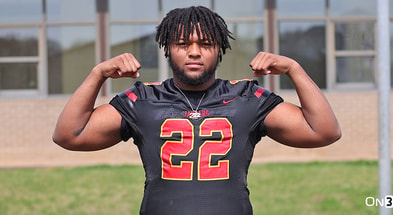
Malik Jefferson. (courtesy of ETSN.fm)
5-star linebacker signee Malik Jefferson highlighted an exceptionally athletic 2015 NSD haul for Texas. As one of the most freakishly athletic linebackers in Texas high school football history, he came onto the recruiting scene at precisely the right time for Strong in his mission to build a defensive tradition in Austin.
Strong is looking for athletic and versatile LBs to run amok in his 3-3 Under spread-busting defense with Jefferson and his fellow ’15 LBs, Anthony Wheeler, Cecil Cherry, Cam Townsend, Breckyn Hager all fitting the bill perfectly.
Strong also grabbed some big safeties to enforce the law in the middle of the field, led by DeShon Elliot. This physical and rangy enforcer is already 6-foot-1, 200 and likely to play at 210+. Some of Texas’ other five DB takes are likely to end up inside as well, or perhaps “RB” Kirk Johnson who’s already 6-foot-0, 205 himself.
The vision for this group will be to own the middle of the field with big athletes who can attack the line of scrimmage, intimidate receivers crossing over the middle, and bring nasty disguises by virtue of having speedy linebackers who can cover and blitz backed by safeties that can drop down in the box and do the same.
However, none of this will come to fruition unless Texas has some coverage players on the outside that will allow Strong’s 8-man fronts to work properly.
Matching up with the 8-man front
Although Strong’s defense usually shows a cover 2 shell first, either right before or after the snap the defense will usually rotate a safety down to match the strength of the offense’s formation or replace a blitzing linebacker.
Against a 4-receiver spread, it means the matchups will look like this against an even, 2×2 spread formation:

The cornerbacks take the first receiver from the sideline, the outside receivers who are generally some of the most talented on the team. Occasionally a teams’ best receiver will be that Y or slot receiver, who’s usually lined up as the No. 2 receiver to the wide side of the field.
The nickel will matchup with him in space and look to control his release by forcing him inside where there’s a deep safety and at least one unoccupied linebacker.
The linebackers are following receiver No. 3, usually the running back. The rules are simple for the backers; if the running back releases to your side of the formation, you cover him. If he doesn’t, you look to help with crossers over the middle. Against 2×2 the strong safety is covering the 4th best receiver, in this instance the tight end, and he has less space to navigate and more nearby help in doing so.
So against a common passing play like “4-verticals” the coverage distribution could look like this:

If the opponent is using a 3×1 unbalanced trips set, which are very popular these days, the safety will drop down to match up like this:

And a typical a horizontal stretch passing combination that teams will throw from trips formations can still be easily matched by the defense:

The nature of the matching coverage and the 8-man front allows the linebackers to find their work around the box while the quicker athletes at corner, nickel, and strong safety handle the tougher coverage assignments and the wider spaces.
The importance of coverage players
Getting an 8-man front with another safety coming down the pipe from the deep middle is a huge advantage to the defense IF they can hold up on the outside without conceding easy gains from the passing game.
Very frequently, Texas would forego having an extra pass defender in the middle and bring five pass-rushers, which put even more pressure on the coverage defenders to lock down hot routes without conceding any big gains in the passing game.
When executed, this aggressiveness with the blitz put a lot of pressure on opponents and really limited the route combos they were willing to attempt since they were afraid of trying to block Texas without leaving extra blockers in the backfield.
Again, this only works if the offense doesn’t have easy options to throw the ball outside against the corners or nickel. If the opponent has a good tight end or plays a 4th WR regularly, then the strong safety also needs to be fairly solid in coverage.
Finally, the deep safety has to have the instincts/range to provide timely and violent support in the middle of the field against runs and passes. He’s generally not going to impact sideline passes unless the QB is really bad with his eyes and/or throws ducks, the corners have to handle those on their own.
It’s quite a challenge for a defense to field enough good coverage players to allow them to pack seven defenders near the box, which is why success in recruiting DBs for the 2015 class was so essential for Strong.
Let’s take a 2015 opponent with a strong passing opponent and see how these matchups look against the more dangerous offenses in the league. Despite losing Bryce Petty, Baylor is still likely to have a really nasty attack next season that will include the following components:
Z receiver: Corey Coleman (5’11” 190), 64 catches, 1119 yards, 11 TDs in 2014
X receiver: Jay Lee (6’3” 215), 41 catches, 633 yards, 6 TDs in 2014
Y receiver: KD Cannon (6’0” 170), 58 catches, 1030 yards, 8 TDs in 2014
H-back: Tre’Von Armstead (6’6” 265), 5 catches, 62 yards, TD in 2014
Running back: Shock Linwood (5’9” 200), 7 catches, 90 yards, 0 TDs in 2014
If you can cancel out the first three threats without undermanning your front and leaving it at the mercy of Armstead and Linwood in the run game, then Baylor’s offense starts to become much more manageable. They’re looking to isolate you either deep or in the box and then press their advantage. If they can’t draw any benefit from isolating your receivers, their system becomes fragile.
The resulting possibilities
When the opposing teams’ top three receivers are accounted for with only three defenders (and the safety over the top looking to erase big plays), it becomes really easy to get creative and multiple in the middle of the field.
Top 10
- 1Breaking
Donald Trump
Executive Order on college sports
- 2
Caleb Wilson
UNC star injured in practice
- 3New
Darius Acuff
Hogs guard out vs. Mizzou
- 4
Brian Kelly
Addresses coaching future
- 5Hot
New CFB hires
Poised to make major impact
Get the Daily On3 Newsletter in your inbox every morning
By clicking "Subscribe to Newsletter", I agree to On3's Privacy Notice, Terms, and use of my personal information described therein.
If your tools for doing so include athletes like Malik Jefferson, then you are really cooking.
To go back to the earlier example, it allows Texas to attack Baylor with the blitz from the nickel package and force the Bears to play in confined spaces where they aren’t comfortable. Here’s a blitz that Texas ran against the Bears last year to achieve this result:

The weakside linebacker and strongside end are working to force the ball inside to the teeth of the blitz as well as obscure Petty’s vision for the quick outside throws he loves to throw against pressure.
Vertical responses will take time and it’s hard to find that time if there are athletes coming up the middle like the Fox linebacker or tackles such as Hassan Ridgeway and Malcom Brown.
Here’s another way Texas could attack the Bears:

Now you’ve got two of the team’s more explosive athletes overloading a side of the OL that probably begun the play simply worrying about how to block Ridgeway. The middle linebacker is in easy position to track his assignment (the tight end) and fill on a running play while the strong safety has responsibility for covering the running back and either playing the run in place of the will linebacker or covering that back out of the backfield.
With an LB corp as versatile as the future Longhorn bunch, there are endless combinations of how to divvy out the responsibilities in the middle of the field in order to best exploit the opponent on a given Saturday.
Provided that the matchups sort out okay on the outside.
What if Malik stays on the edge?
One factor that could throw a wrench in this system would be if Malik’s best fit was as a Texan version of Eric Striker, a space-backer who kept the team from employing the nickel package save for in obvious passing downs.
In that event, Texas’ defense would look more like this:

Or this:

Essentially, Malik will play the role previously played by the strong safety while the strong safety slides outside to take on the role of the nickel. There can still be disguise, especially in regards to who’s blitzing or playing where underneath, but the coverages have to be simplified some.
The benefit to this would be having Malik on the edge opposite the Fox linebacker at all times, which would present blitz possibilities that opposing teams would struggle to counter, and result in a stouter run-defense since Malik would be closer to the action than the strong safety was in the previous scheme.
However, you still need to be able to cancel out the top three receivers with three defensive backs and the strong safety has to become the third good coverage player on the field and perform as the nickel did in the 2014 defense.
The prospective starting safety tandem of Jason Hall and Dylan Haines are probably not going to be able to manage that role as effectively as Diggs and Thompson did in 2014 so if Strong and Bedford determine that the best defense in 2015 features Malik at Sam linebacker, then the team will probably have to find a strong safety who can play some man coverage or the main coverage and the fire zones become much less effective.
The better answer to utilizing Malik in the event that he doesn’t fit inside would be to play a 2-4-5 package that leaves a nickel on the field while playing only two true DL on the field:

This would require re-structuring some of the fronts and disguises in the defense on a pretty wide level but it’d be more than feasible if the staff determined that was the best way to use Malik.
Long-term it seems more likely that the 2015 DB class will provide players that will provide more overall flexibility to the team than they’ll find from the 2015 starting lineup.
It’s likely that getting the most out of Malik will be the major variable that determines how the rest of the pieces fit together over the next few years.
There’s a lot of ways for Texas to get a lot of schematic mileage out of all the athletes they’ve assembled in Strong’s first class and some of them will likely be on display as early as 2015. So long as the DB class develops and produces enough pure coverage players to allow Strong’s 8-man fronts and aggressive matching to come together, then athletes like Malik will bring ruin to Big 12 offenses.