Inside the Gameplan: Strong gets staffing right


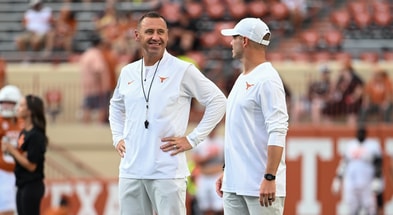
Sterlin Gilbert and Davion Curtis chat during the Spring game. (Will Gallagher/IT)
Probably the single biggest problem for the Charlie Strong era at Texas has been a lack of offensive identity to help guide the development and deployment of the team’s talent in a unified direction. Besides the lack of a strong passing QB to make things easy, a bigger issue has been a lack of staff unity and vision from the top.
Without that, both choosing and developing talent as well as leveraging it becomes very difficult….
Charlie Strong wanted a physical offense that could control tempo, protect the defense, and wear teams down. In pursuing that goal he ended up assembling a staff in 2014 with two different OCs that had two different visions for how to achieve that goal (Shawn Watson and Joe Wickline), then in 2015 tried to solve that problem by adding two additional and also uniquely different coaches in Jay Norvell and Jeff Traylor.
Only one of those coaches survived the purge initiated by Charlie in the wake of 5-7, Traylor, who’s background is as TX HS coach, and Strong followed up the purge by filling out the staff with more Texans with the goal of finally uniting the offensive meeting room behind a singular vision. He also sought to replace Chris Vaughn with a new DB coach that could keep up recruiting and maintain Texas’ physicality in the secondary.
Sterlin Gilbert and a consistent direction on offense
The most important hire was of course, Sterlin Gilbert, who now wields the authority over the direction of the Texas offense. His chosen direction for the offense is the veer and shoot, the Art Briles spread system that is starting to take over the game.
The veer and shoot is best explained by remembering the Mike Leach Air Raid that established the spread as “the offense” in Texas. Leach’s reasoning process basically went, “if the quick passing game from an up-tempo pace is the hardest offense to defend and the easiest way to score points quickly, then how can I design an offense to make it as deadly as possible?”
Everything about his original Air Raid was designed to achieve this goal from the personnel choices (tall obstacles across the OL, speedy slot receivers rather than big TEs or FBs), the practice schedule (nail down those passing concepts then practice them again!), and the formations (spread out WRs and spread out OL).
The veer and shoot takes a similar approach in that it embraces the extremes in asking “how do we make it as difficult as possible for opponents to defend both the power run game and the vertical passing game?”
The OL, RB, TE, and run schemes are chosen for their ability to run over defenses if they don’t load the box while the passing concepts and WRs are chosen for their ability to attack the opposite ends of the field with speed. It’s the ultimate spread offense, taking “divide and conquer” to its logical extremes by engineering the offense in every respect to isolate and overwhelm individual defenders.
Gilbert has been running this system for quite some time. He was a star QB himself, first at San Angelo Lake View HS and then at Angelo State University. From there he started his coaching career in the Texas HS ranks before getting his big opportunity as a GA for Art Briles at Houston, working with the QBs and RBs.
He took Briles’ veer and shoot system into the HS ranks and dominated at Abilene Cooper, his own San Angelo Lake View, and then Temple before re-entering the college coaching scene and following Dino Babers on the veer and shoot’s tour through the Midwest, and then joining Phillip Montgomery in Tulsa.
With Briles likely out of football, Gilbert is now one of the pre-eminent offensive coaches with a chance to become the most notable of all if he can parlay his opportunity at Texas into big success and a HC opportunity elsewhere.
Matt Mattox, Gilbert’s right hand man

Matt Mattox. (Will Gallagher/IT)
Mattox met Gilbert in 2005 when both were serving as GAs at Houston under Briles, at this time Mattox was fresh off a successful college career that included being recognized as an All-American TE at Butler Community College before transferring to Houston and getting converted into an offensive tackle.
I suspect that personal life experience may pay off reasonably soon as he helps oversee Peyton Aucoin’s career at Texas.
After working a few years as a S&C and OL assistant under Briles, Mattox went back north and coached at Butler and Coffeyville community colleges in Kansas. If you aren’t familiar with these schools these are top-notch football programs from which a considerable portion of the nation’s JUCO talent hails from. Many of Kansas State’s walk-ons are actually JUCO players from these nearby programs that are invited to join up.
After a few years in Jayhawk JUCO land, Mattox joined up with Babers and Gilbert in Eastern Illinois and has followed Gilbert since to Bowling Green and then Tulsa before landing in Texas. Mattox’s coaching career has been at stops where evaluation and teaching are primary, much like his predecessor Wickline who had a similar talent for transforming less highly recruited OL into maulers.
Landing Mattox was key in signing Gilbert as he’s essential to helping him install a totally new and unique system at Texas with his phenomenal background both in this particular system and as a teacher in general.
Bringing Anthony Johnson back home
Perhaps the only Toledo coach that Matt Campbell didn’t bring with him to Iowa State was RB coach Anthony Johnson, who now holds that same title at Texas. Campbell elected to keep Iowa State’s RB coach, who’d just gone there from Toledo himself, opening up an opportunity for Strong to bring Johnson back home.
Johnson started on scholarship, then was moved walk-on RB at Texas from 2001-05 after multiple foot injuries, had a short run in the Texas HS ranks, and then served as a quality control assistant for Mack from 2007 to 2009. From there he went on to Sam Houston State and was part of coaching the RBs in an option-heavy attack that dominated the FCS ranks and has produced assistants that are now propping up at Houston under Tom Herman and at Tulane under Willie Fritz. In essence, he was involved in both trips to the National Championship game under Mack.
Top 10
- 1Breaking
Donald Trump
Executive Order on college sports
- 2
Caleb Wilson
UNC star injured in practice
- 3New
Darius Acuff
Hogs guard out vs. Mizzou
- 4
Brian Kelly
Addresses coaching future
- 5Hot
New CFB hires
Poised to make major impact
Get the Daily On3 Newsletter in your inbox every morning
By clicking "Subscribe to Newsletter", I agree to On3's Privacy Notice, Terms, and use of my personal information described therein.

Anthony Johnson. (Will Gallagher/IT)
At Toledo, Johnson was part of a unique rushing attack that propelled RBs Kareem Hunt and Terry Swanson to a combined 1896 yards on 321 carries at a 5.9 ypc clip. The specialty at Toledo was running gap schemes that pulled the center, schemes which Texas will have the joy of defending in the coming season when they’re deployed at Iowa State. Because of Johnson’s background with the Texas recruiting scene and his experience teaching a variety of power and zone-option schemes he should be a natural fit in Gilbert’s offense.
Charlie Williams, the highly qualified outlier
Williams’ professional background is simultaneously both impressive and a strange fit for what Texas is now attempting to do. He’s had a long history of success dating back to Tony Dungy’s Tampa Bay team that was QB’d by Strong supporter Shaun King. From there he went to UNC and coached up several athletes that went on to become pros such as Hakeem Nicks, then he landed in Indianapolis where he coached their WR corps for the last few years before being moved to “coach” veteran Frank Gore and their RBs last year. He’s also had a stint with Lou Holtz at South Carolina, under Strong connection.
Williams clearly has a strong grasp of the pro-style West Coast offense and the proper execution of its route tree, which incidentally is not exactly how the veer and shoot offense works. Gilbert’s system includes parts of the normal route tree but also includes more free wheeling, “run to open grass” maneuvers, doesn’t rely on drop-back timing, and is generally more adjustable than the more rigid execution of the professional approach.
Williams is a 30-year coaching vet that probably landed this gig through connections to Strong and it’ll be interesting to see how well he adapts to the life of a full-time recruiter as well as adjusting his normal teaching regimen to the needs of Gilbert’s offense. Texas got a great coach here but the fit is definitely curious.
Clay Jennings, maintaining DBU
Clay Jennings has a really strong track record of success that includes multiple stops across the Lone Star state in roles where recruiting would have been a big part of his job description.
He’s a Waco man (ironically a ton of Baylor connections in this round of hires) that played DL at UNT and entered the world of coaching at Sam Houston State. His first D1 job as a DB coach was in Houston with Briles and he actually beat Art to Baylor, coaching their CBs in 2007 before moving on to work with Briles’ arch-nemesis Gary Patterson at TCU.
Jennings’ run at TCU represents a major part of his career as he was there from 2008-2013 for a variety of different but wildly effective Patterson defenses that all relied rather heavily on exceptional cornerback play. From there he went to Arkansas to help Brett Bielema and DC Robb Smith rebuild a unit which had just finished a tough initial season under Chris Ash before he left for Ohio State.
They were highly successful, taking Arkansas from 69th in defensive S&P in 2013 to 6th in 2014.
Arkansas then plummeted back down to 71st in 2015 after losing several players to the NFL.
Jennings background at both Arkansas and TCU included a lot of quarters coverage, which Texas doesn’t really utilize, but also a great deal of man coverage technique for the cornerbacks and a good deal of Charlie and Vance’s favorite change-up, cover 6.
One of the more interesting success stories Jennings enjoyed at Arkansas was when they shut down Amari Cooper and Alabama in 2014 and held Cooper to two catches for 22 yards. This was when Lane Kiffin had brought spread RPO (run/pass option) concepts to Alabama and was forcing defenses to simultaneously defend quick routes to Cooper and inside runs to T.J. Yeldon or Derrick Henry.
They did this largely by steadfastly bracketing Cooper with safety help over the top but Jennings’ charges were effective at still supplying run support from their conservative coverages so the Bama run game wasn’t able to get going either.
Jennings is a strong fit at Texas both for his expertise in developing smart, physical, well-rounded DBs as well as his long-standing recruiting connections across the all-important DFW region that supplies so much of the state’s talent.
Charlie’s plan for putting Texas back on the throne in THE football state always depended on having an offensive identity to capitalize on all of the talent and fielding physical, lockdown the secondary that could dominate games. With this last round of hires Strong may have found the right combination of staff to get that project off the ground.