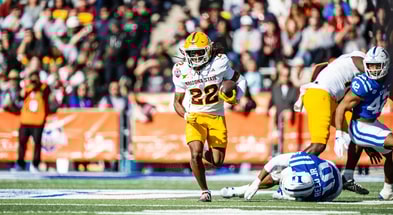
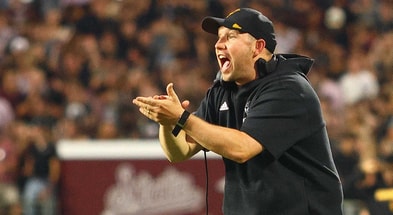
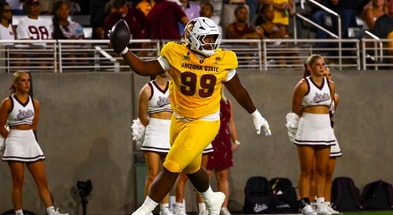
Brian Ward guides emerging leaders on ASU's defense


This year’s second spring practice under defensive coordinator Brian Ward looked different, and not just because of an abundance of new faces lining up on this side of the ball. For the first time since he arrived in Tempe, Ward isn’t tied to one position group. With veteran assistant David Gibbs now coaching the safeties, Ward has spent his time during sessions moving from drill to drill, observing, and learning a roster still taking shape.
“It’s going well,” Ward said. “I’m just walking around bugging other position coaches. I don’t think it’s got to the point where they’re like, ‘Oh, here he comes.’ But it’s a new adjustment, and it’s been really good.”
Last season, Ward was heavily involved with the safeties and nickel group. Now, with Gibbs, who has over 30 years of coaching experience both at the NFL and college level, handling that room and adding experience across the defensive staff, Ward has the freedom to evaluate the defense as a whole, something he believes will help the unit develop faster during a spring built around installation and teaching.
“The more experience you have with guys that have been in the fire, coached all types of athletes, the better listener you become,” Ward commented. “The challenge for me is finding the non-negotiables: here’s our system, here’s what we do, here’s why we do it. I’m doing more learning and watching than teaching right now, but I couldn’t be more pleased with the development of those rooms.”
That development is especially important this year. ASU’s defense has undergone significant turnover, losing several veteran starters while bringing in transfers and younger players expected to take on bigger roles. Through two practices, Ward said the focus has been less on results and more on how quickly players understand the system.
“It’s still early, and we’re really focused on the install,” Ward explained. “We knew who these guys were athletically before we came out here. Now we’re seeing if they can understand what they’re doing, how to do it, and why. The sooner they can do that, the faster they can play. It’s really a mindset.”
Part of that mindset comes from the mix of returning players and newcomers working through the scheme together. Veterans know the expectations, while new additions are adjusting to different teaching styles under the expanded staff.
“I think everything’s going really smooth,” Ward stated. “The guys who have been here know what to expect; they can anticipate the install. The big learning curve is getting used to the teaching techniques that Coach Gibbs and the other coaches are bringing in, and that’s going to make those rooms even better.”
One player Ward singled out is redshirt sophomore cornerback Rodney Bimage, who enters spring with a chance to step into a larger role after the departures of two starting defensive backs.
“We’re only two practices in, so his development as a player is still to be seen,” Ward said. “But as a person, you see the maturity level. When you lose guys like Keith (Abeny II) and Javan (Robinson) out of that room, he’s been able to learn from players who started a lot of games. You can see the influence. He’s taken the attitude that this is his time to show what he can do.”
Two practices in, Ward knows the defense is far from finished. Roles are still forming, the depth chart is fluid, and the system is being implemented piece by piece. But with a veteran staff, emerging leaders, and a roster full of players chasing opportunity, he believes the foundation is present.
“Every practice we’re learning more about this group,” Ward remarked. “And I’m excited to see where it goes.”
***
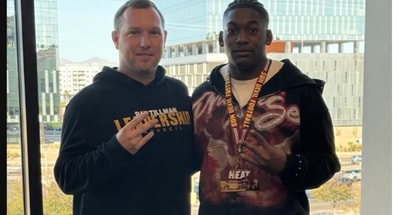
Rodney Bimage spent last season proving he could belong. This spring, he’s trying to prove he can lead.
Two practices into ASU’s spring session, Bimage has already found himself in a different position than a year ago. With veterans Keith Abney II and Javan Robinson gone, the secondary suddenly looks to Bimage as one of its most experienced voices, even after a season in which he played in just 10 games with two starts.
The numbers from those limited opportunities were hard to ignore. Bimage allowed only 0.21 yards per coverage snap last season, second best in the Big 12, and held opposing receivers to a 41.7 percent catch rate, fourth best in the conference. Now, the focus has shifted from flashes of brilliance to consistency.
“Last year I felt pretty good,” Bimage admitted. “All the things I worked on during the offseason, getting stronger, faster, then bringing it into last year, just being a technician on the field, being aggressive, showing that I got stamina and I can be on the field, play special teams, do whatever they need.”
His season nearly ended early after a shoulder injury late in the year, which caused him to miss the last three games, a moment he called “pretty scary,” but one that forced him to attack the offseason differently.
“I did a lot of rehab on my shoulder,” Bimage said. “At first, it was weak; I couldn’t lift my arm up. Just being in the training room every morning, getting it back together, getting stronger. Now I feel good.”
The opportunity in front of him is clear. With Abney preparing for the NFL Draft and Robinson transferring, Bimage enters the spring as one of the top returning defensive backs on the roster. He said the biggest change isn’t physical, but mental.
“Just learning from the mistakes and taking mental reps from Javan and K1 (Abney),” Bimage noted. “Bringing it here, showing the younger guys what they need to work on. If they need help, I’m there to help them. I’ve been here for a while now, so I know the defense, I know the players, and that builds confidence.”
That confidence got a boost earlier this offseason when Abney, who was at Saturday’s practice, mentioned Bimage by name while speaking at the NFL Combine, praising his work ethic and potential.
“Honestly, that made my day,” Bimage commented. “Him saying that, it gave me more confidence. Just keep going, don’t let nothing stop me.”
The praise carries weight coming from a player who set the standard in the secondary the last two seasons, and Bimage said the teachings he has absorbed from those veterans still show up every day in practice.
“Just being more vocal,” Bimage described. “In training, being the first guy up in sprints, telling everybody, ‘Come on, we got to work.’ Stuff like that. That’s what I learned from them.”
For Bimage, the goal over the rest of the spring is simple: stay healthy, stay consistent, and finish stronger than he starts.
“I just got to keep the right mindset,” Bimage said. “If I mess up on a play, bounce back, keep going, make the next one. Take care of my body, stay in the training room, and keep fresh legs. By the end of spring, I want to be playing my best.”
***
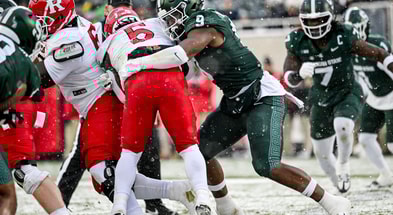
Jalen Thompson, a defensive end transfer from Michigan State, said the adjustment to ASU started before he ever set foot on campus. Thompson pledged to the Sun Devils before taking a visit to ASU, relying instead on relationships, mainly with ASU defensive line coach Diron Reynolds, who also coached him in East Lansing, conversations, and trust that the move would put him in the right place for his final college season.
Two practices into spring ball, he believes it already has.
“Man, it’s been great,” Thompson said. “From the scenery to the teammates to the coaching staff, everything here is great. You can’t ask for a better place.”
Thompson arrived in Tempe with experience few newcomers can match. He lettered three seasons at Michigan State, playing in 31 games with 26 starts while totaling 66 tackles, 13 tackles for loss, and 4.5 sacks. A two-time Academic All-Big Ten selection and campus recipient of the Big Ten’s Jackie Robinson Community and Impact Award, Thompson built a reputation for consistency on and off the field before injuries cut short his 2025 season.
He appeared in six games last year before being sidelined for the second half of the season, a setback that made his final year of eligibility even more important. When he entered the transfer portal, he said his priorities were clear.
“This being my last year, I really pinned it on being somewhere with a family-style environment, somewhere I know I could be developed,” Thompson described. “And the relationship I had with Coach (Diron) Reynolds is one of a kind.”
That relationship dates back to Thompson’s freshman year at Michigan State, when Reynolds recruited him before later leaving the program for Arizona State. When the opportunity to reunite came, Thompson didn’t hesitate, even without seeing his new college destination in person.
“I just went off what I seen visually,” Thompson commented. “The videos they sent me, and my relationship with Coach Reynolds.”
The move also reunited Thompson with familiar faces, including former high school teammate and senior tight end Khamari Anderson, who helped him get a sense of what life in Tempe would be like.
“I got insight from a player I know and trust,” Thompson noted. “He told me the weather is crazy, but I said that ain’t going to stop me if it’s going to help me get ready for the next level.”
Thompson’s goals extend beyond football. He plans to finish his undergraduate degree from Michigan State while beginning a master’s program in organizational leadership at ASU, and he has already started taking real estate classes with hopes of building a business after his playing career.
He also wants to stay active in community work, something that became a major part of his identity in Detroit.
“I feel like with me being in the position I’m in, it’s only right to give back,” Thompson explained. “I’m definitely going to do something here after spring, and I’m going to keep doing things back home too.”
With a new team, a new defense, and one season left to play, Thompson sees this spring as a fresh start and a final opportunity to show who he is.
“I just want people to know I’m a genuine person,” Thompson said. “You can count on me. Whatever you need, I’m going to be there.”
***
Zyrus Fiaseu is approaching spring ball with a perspective few players can claim. The sixth-year graduate linebacker, granted an extra year of eligibility by the NCAA through a combination of an injury redshirt and his original redshirt season, returns to ASU with one final opportunity to leave a mark.
“I just love seeing everybody play ball,” Fiaseu said on the first week of spring practices. “Seeing the new guys come in, mess with each other, playing with new guys to your left and right, it’s a little different, but playing has been a joy so far.”
Fiaseu brings experience, maturity, and leadership to a defense that has lost key figures like Keyshaun Elliott and Jordan Crook. His own 2025 season was cut short after just four games when a foot injury that required surgery, leaving him sidelined for the remainder of the year. Despite the setback, Fiaseu embraced the recovery process with patience and faith.
“I’ve learned to find my identity not just in football but in spirituality,” Fiaseu commented. “I’m a Christian man, so for me to know that, I put my faith in God. The glory is not for me, but for Him. That journey helped me find myself.”
Once cleared to return to the field, Fiaseu has quickly adjusted to the new group around him. One standout addition is junior transfer Owen Long from Colorado State, who led the FBS in tackles per game (12.6) and total tackles (151) in 2025.
“Owen’s been a great dude, a great addition,” Fiaseu commented. “It’s beautiful to watch him play his game. His style is very agile, very smart. Being on the field with him is a blessing.”
Fiaseu has also taken an active role in team building, emphasizing the culture ASU has cultivated. From bowling nights to meals out, he’s noticed how off-field connections have translated to chemistry on the field.
“I think everyone just wants to hang out with each other off the field,” Fiaseu explained. “That’s the great thing about this team. Especially in our position group, coming together and being friends, that translates to our play on the field.”
The sixth-year linebacker also described the moment he learned his eligibility was approved.
“We were in El Paso,” Fiaseu recalled, “and the compliance office came up and told me, ‘Congratulations, you got the sixth year.’ I was happy. For me to know that I was going to come back for another year and play one more time, it was amazing.”
At 6-foot-1 and over 230 pounds, Fiaseu is one of the oldest and most experienced players on the roster, blending leadership with a strong work ethic. He balances mentoring newcomers like Long and junior linebacker Martell Hughes, a linebacker learning to take on a more vocal role, while maintaining his own high standards on the field.
“Being connected spiritually and off the field makes us dangerous,” Fiaseu stated, “We can compete, we can play hard, and it starts with building that trust and bond.”
***
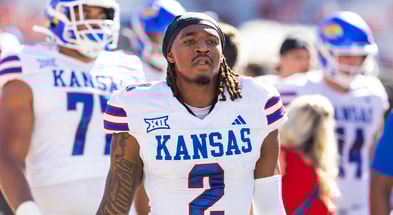
Lyrik Rawls arrived at ASU with a wealth of experience and a reputation for reliability in the secondary. The fifth-year graduate safety, transferring from Kansas after a season in which he started all 12 games, ranked second on the Jayhawks in total tackles with 73, including 57 solo stops, and contributed one interception and seven pass breakups.
Rawls also excelled in coverage, allowing no touchdowns on over 250 snaps and posting a 13.3% forced incompletion rate, ranking seventh among Big 12 safeties.
“The competitiveness, even just within our rooms, is where it needs to be right now,” Rawls said of the early practices. “Seeing any player make a play shows us we’re going to be good.”
His transition to ASU has been eased by connections to fellow Texans in the secondary. Junior defensive back Montana Warren, a high school teammate from Marshall, Texas, has been a familiar face, providing built-in chemistry from the start.
“Having him right there beside me, it already felt like home,” Rawls noted. “We played seven-on-seven together back in high school, so now, actually getting to play on Saturday together is going to be great.”
That familiarity has helped Rawls, who played at Oklahoma State prior to his one year at Kansas, adapt quickly to the climate, schedule, and competition of the Big 12, noting, “It’s not going to be anything new to me. I feel like I’ll be able to play more comfortably than ever.”
Relationships and opportunity influenced the decision to transfer.
“It came down to a tight race,” Rawls commented. “I followed my heart. The connections from Texas to Tempe and having guys over here from my hometown made it feel comfortable. That really drew me to ASU.”
Assistant head coach Bryan Carrington’s role in guiding the transition also factored heavily, providing clarity and structure as Rawls integrated into the defensive scheme. With experience in multiple systems, Rawls is poised to balance leadership and adaptation.
“Being a transfer with a lot of college experience, I have to sit back and see where everybody fits and figure out how I can elevate the team,” Rawls explained. “I didn’t have to do too much; the guys already swore to me with my leadership skills. Now it’s just expanding and letting my skills show.”
On the field, Rawls is already impressed with the defensive system under defensive coordinator Brian Ward.
“He puts the plays out there, and we can learn them quickly,” Rawls described. “Even the younger guys are flying around and making plays because they know the scheme. It’s great to see.”
For Rawls, the move to ASU is as much about community as competition. With a supportive safety room, established connections, and the chance to step into a leadership role, he’s ready to make an immediate impact.
“The intensity is right where it needs to be,” Rawls stated. “The competition in the room is real, and that’s what’s going to make us successful this season.”