Kenny Dillingham's new contract signals ASU’s commitment to compete

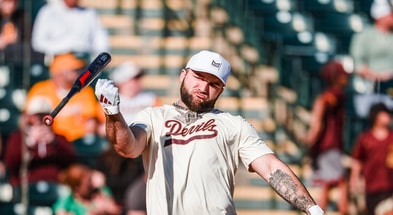
ASU head coach Kenny Dillingham never framed it as a decision.
From the outside, the timing invited speculation. A national power was suddenly searching for a head coach, a rising program was stabilizing, and a young coach was at the center of it all. Inside Arizona State’s football building, this was not about choosing between Tempe and Ann Arbor. It was about forcing alignment in a sport that no longer allows patience or ambiguity.
Consider it an early Christmas present for Sun Devils fans. Tuesday morning, ESPN’s Pete Thamel reported that Dillingham agreed to a new contract with Arizona State, averaging $7.5 million annually and expanding the assistant salary pool to $11 million. Furthermore, the new contract increases Dillingham’s buyout and addresses the increase in the school’s NIL funds.
And just as significant, the agreement ends Michigan’s pursuit following its head coaching vacancy and cements ASU’s commitment to Dillingham as the program navigates college football’s most volatile era.
For ASU, the numbers and particulars represent a shift in posture. For Dillingham, they represent successfully applied leverage.
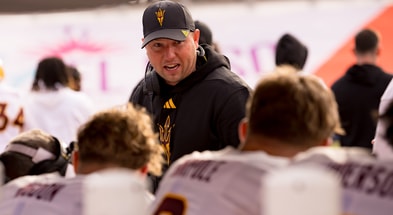
“It’s been something we’ve been working on for six weeks,” Dillingham said after practice. “So, it’s good to finally get it done.”
The meeting of the minds between both parties did have a sense of urgency attached to it as national circumstances narrowed Michigan’s options. Alabama’s weekend win seemingly stabilized Kalen DeBoer’s situation, as he was believed to be the leading candidate for that school, and intensified pressure on Michigan’s timeline. That sequence mattered; it created urgency not just in Ann Arbor, but in Tempe.
Ultimately, ASU understood the risk of waiting. Dillingham understood his value. More importantly, both sides recognized what was at stake if clarity did not arrive.
“College football, it’s absolutely chaotic and nuts right now,” Dillingham commented. “So, there’s got to be a plan to be able to stay aggressive in this thing for three, four, five years down the road.”
That chaos is no longer theoretical. NIL collectives, roster limits, transfer windows, and escalating coaching salaries have reshaped the sport into a year-round enterprise that rewards decisiveness and punishes hesitation. Programs that lag financially often find themselves rebuilding annually, not because of poor coaching, but because of structural gaps.
“If you don’t have that,” Dillingham noted, “then you’re just a ticking time bomb to failure.”
ASU’s willingness to meet Dillingham at that crossroads defines this new agreement. The deal is not simply about retaining a head coach. It is about acknowledging the realities of modern college football and choosing to participate rather than observe.
One of the most consequential moves is the expansion of the assistant coaches’ salary pool to $11 million, placing ASU firmly in the upper tier of the Big 12. For a program already staffed with Super Bowl-winning coaches and multiple head-coach candidates, that number allows Dillingham a better chance to retain one of the program’s strongest advantages: keeping elite assistants in place.
“Our staff wins,” Dillingham recognized. “Our players have what’s got us to this point. This isn’t Kenny Dillingham’s program. This is our program. I’m just a piece of it.”
That perspective informs how Dillingham has approached staff structure moving forward. He confirmed that Josh Omura will assume a significantly expanded role, functioning as a de facto general manager while remaining director of personnel and recruiting.
“That was the plan when we hired him,” Dillingham said. “Now we’re able to do that because I’ve worked with them for a little while and I trust him. That trust allows us to be more aggressive in staffing and recruiting.”
The ability to evolve internally matters as much as recruiting externally. College football’s new model places a premium on operational sophistication, and Dillingham has repeatedly emphasized that success depends on infrastructure as much as it does on scheme.
“We’re going to be able to take care of the people that were here and got us to this point,” Dillingham explained. “And to me, that’s the most important part. You take care of the people who got you to this point. Players, coaches, they take care of the people in Dodson at this point.”
When Dillingham first arrived in Tempe in November of 2022, the program was operating from a position of scarcity. Resources were limited. Expectations were fractured. Stability was aspirational rather than assumed. Despite a Big 12 Championship, a College Football Playoff appearance, and back-to-back eight wins seasons since 2013-14, the program was in a financial situation that didn’t ensure long term success as the arms race in the conference just in the last 12 months presented a landscape that wasn’t favorable for a program like ASU unless it was going to better its monetary position.
“Oh, drastic, drastic,” Dillingham said of those financial situations and their degree of change. “I said that week ten (this year) there were drastic changes. They’ve (ASU) stepped up from that perspective.”
Early conversations centered not on competitive ceilings but on basic guarantees, how to support the upcoming seasons, retain personnel, and operate within monthly shifting constraints.
“Are we going to continue to step up in year three, year four, year five?” Dillingham asked. “If it never keeps going, are we going to be able to stay committed? That’s what I was fighting for. Long-term commitment to our staff and to the program.”
The new contract answers that question with action rather than rhetoric. It gives Arizona State the ability to plan beyond the next signing day or transfer portal window, a necessity in a sport where roster continuity has become a luxury.
It also shapes how ASU approaches the transfer portal, which runs from January 2 through January 16, 2026. Coming into 2025, ASU boasted one of the best retention rates in the country, hovering around 80%. This year tells a different story. With departures to the NFL totaling ten announced players, including juniors Jordyn Tyson and Keith Abney II, and others entering the portal, including starters Sam Leavitt and Javan Robinson, Dillingham faces the task of revamping nearly larger sections of the roster. If the Sun Devils want to compete with the Texas Techs of the Big 12 and their reportedly $ 28 million NIL budget in 2025, they will need a Texas-sized budget to do so.
“We’re going to try to sign the best players we can that fit our program,” Dillingham declared. “Be a good person, make good decisions, have more fun, working harder than anybody in the country. That’s what we want here. Guys that truly love being here and enjoy being here.”
Michigan remained a constant undercurrent throughout the negotiation process. Dillingham did not shy away from acknowledging the job’s stature or appeal, even as he clarified that discussions never reached the point of a job offer.
“Michigan’s an unbelievable job with unlimited resources,” Dillingham acknowledged. “Somebody’s going to get an unbelievable opportunity. One of the best programs in the country with one of the best rosters in the country.”
The respect was genuine. The leverage was real. Dillingham emphasized that he never received an offer from Michigan, a point he has made repeatedly, even amid past LSU head coaching rumors.
“This was about getting the program what it needs,” Dillingham said. “This was never about me. It was about everybody else… trying to put a plan together for the players. And it’s about our coaches.”
That framing has been consistent. Dillingham repeatedly redirected credit toward his staff, players, and the broader infrastructure. He emphasized that the new contract’s purpose was not personal security, but collective sustainability.
“My job is to just never be satisfied,” Dillingham said. “The average fan has stepped up… very limited amount of people who could absolutely change the game here. Whether they’re alumni, whether they’re not, whether they’re just from here, and they want to be somebody that people remember.”
With the university’s commitment formalized, Dillingham has turned to what he views as the program’s final barrier: elite-level donor support.
“We need to find one of these really rich people in this city to step up and stroke a check,” Dillingham described. “And I’ll do everything I can to make you the most famous person in the city. There is somebody out here who can. There’s somebody who can. There’s somebody.”
He specifically mentioned Phil Mickelson and Jon Rahm, both highly decorated golfers and ASU alumni, as examples of individuals he’d like to see get involved.
“The average fan has stepped up,” Dillingham admitted. “Hope this message hits it. Some people say, ‘Oh, he’s begging again…’ No, I’m just stating facts in today’s era.”
He framed the moment in legacy terms.
“Somebody can step up and completely take this place from the direction it’s going to,” Dillingham said. “You have an opportunity to be remembered forever. Some people will, some won’t. It’s your choice.”
Today’s news positions Arizona State to capitalize on that support once he arrives. It ensures continuity in leadership, credibility in recruiting, and stability in staffing. It also places pressure on the broader community to match the university’s investment.
“You can be as good as you want to be,” Dillingham said. “Or you could be as bad as you ever want to be. I think there’s people out here who can take this program to the next level.”
This new contract ensures Arizona State has chosen its direction.
“I’m fired up for it,” Dillingham said.