Musings from Arledge: State of the USC Program
(Following a 9-3 regular season and a No. 1 recruiting class on National Signing Day, Musings delivers the State of the USC Program)
Are we finally on track?
The blue blood programs are what they are because they have had many periods of success—great teams over different decades and different coaching staffs. It’s what separates the blue bloods from upstarts, the teams that think they have earned a table with the elite despite never having won even a single title, much less multiple titles in multiple different periods. And wear different uniforms every week.
But no program is immune from down periods. In my lifetime I have seen Notre Dame, Alabama, Ohio State, Michigan, Texas, Oklahoma and, yes, USC have down periods and even losing seasons. Winning consistently is very hard; winning always is impossible. Some programs used to be great and no longer are. Some never will be again. The University of Chicago used to be a national power. UCLA used to go to minor bowl games.
The blue bloods have built-in advantages over most of their peers and, generally speaking, sustained commitment. But bad coaching, bad administration, and even bad luck can lead to time in the wilderness.
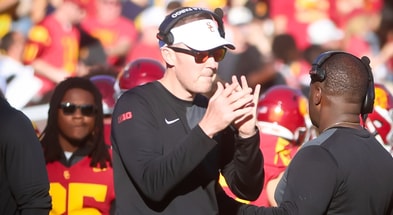
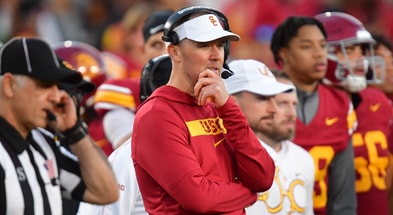
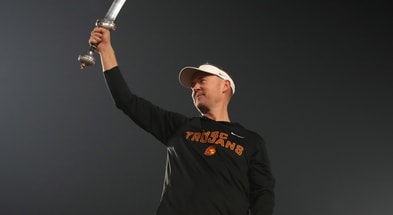
Lincoln Riley was hired to bring USC back to the elite. That process has gone much more slowly than many of us had anticipated. In part, the unexpected delay is due to Riley’s own mistakes. He focused heavily on the portal and had some major misses there, and his decision to bring Alex Grinch from Oklahoma and then keep him after Grinch had we the bed every week for a year was an inexcusable error.
But some of the unanticipated delay has nothing to do with Lincoln Riley. Clay Helton destroyed the USC football program. Helton was a nice man who undoubtedly wanted to succeed. He was also obviously and remarkably incompetent, and the incompetent athletic directors he reported to did nothing about that. He left Lincoln Riley a program with a losing culture and almost no talent.
And Riley couldn’t rebuild the roster in the NIL era when the USC administration was letting the Ghost of NCAA Past spook them into refusing to engage in pay-for-play—even as USC’s primary competitors were throwing around big bags of cash and crushing USC on the recruiting trail in the process.
USC only recently decided to play the game everybody else is playing. And so the rebuild has begun. This is an analysis of where we are now, what still needs to be fixed, and what we should expect in the coming year or two.
The off-the-field situation has never been better
Off the field, USC is in the strongest position it has been in a very long time. Jen Cohen is a first-class athletic director; she’s highly competent and fully committed to winning. Leadership matters, and for the first time in a long time, the person at the top of the athletic department is elite.
Chad Bowden is a first-class general manager. He is organized, a solid talent evaluator, and an elite relationship builder. I was skeptical of his policy against allowing committed players to visit other schools. Pete Carroll dominated the recruiting landscape while encouraging recruits to take their visits. But I’m skeptical no more. Bowden’s plan isn’t just to stop recruits from visiting. His plan is to tie committed recruits to each other and to the program. Before they ever enroll in classes the committed recruits are part of the team, part of a family. That’s a big part of the reason why USC held together a recruiting class that so many national pundits and cheerleaders for other programs assumed would fall apart. Bowden is elite, and so is his staff.
And USC’s resources are now elite. The Trojans’ NIL program can match any in the country, and that’s not something we could say a couple of years ago. Money matters, and USC has it. USC is also about to step into a sparkling new facility. Facilities matter, and USC will be able to compare theirs to any in the country. USC’s resources are elite.
All of this means that Lincoln Riley now has everything he needs to succeed. He has a great AD, a great GM, resources, and the heritage of USC football, which is still a draw. He will succeed or fail on his own merits; there are no excuses now.
That doesn’t mean it will be easy. It’s never been harder for a blue blood to recover or maintain dominance. NIL and the barely regulated free agency of the transfer portal allow far more schools to compete for players. Indiana has a good roster. Vanderbilt just stole an elite QB commit from Georgia. Things are weird, man.
But Riley has what he needs. So let’s turn our focus to things closer to the field.
Roster, coaches, and culture
What we see on the field on Saturdays is primarily a result of the roster, coaches, and culture of the program.
USC Roster
You cannot win big without great players. When you look at the great coaches in college football, you see guys with different personalities, different schemes, and different philosophies. But they all have this in common: they identify, recruit, and develop great players.
Urban Meyer, Pete Carroll, Nick Saban, Kirby Smart, John McKay, Bear Bryant, Ara Parseghian—any legendary coach you want to name—had great players. They couldn’t win without them. That means they could recognize potential, they could sell their program to recruits, their parents, and their high school coaches to get talented players into the program, and they knew how to develop the guys they landed.
This is why USC’s recruiting success this year matters so much. USC badly needs to improve its roster. It was better this year than it has been since Helton’s first couple of years when he inherited talent from Kiffin and Sark. But USC does not have an elite roster yet. This current recruiting class will help immensely. And if USC stacks another great class on top of it next year—and that looks very likely—USC will have the players to match up with Oregon, Notre Dame, and anybody else.
I won’t go player by player here; you can find that in a lot of other places. But I will point out that USC had success at every position group and had extraordinary success in the trenches. These are home-run offensive and defensive line groups. If you want to know who will be great in three years, look at the programs that are recruiting at a high level in the trenches today. Even a mediocre coach can win a lot of games when he has big guys that push everybody else’s big guys around. USC recruited California better than it has in years, and it pulled guys out of places like Ohio, New Jersey, and Texas that it would not have been able to land for the last 15 years. This recruiting class is an enormous accomplishment, and it will pay major dividends over the next three to four years.
USC Coaching and Culture
USC’s coaching staff through much of the Helton era was appalling. It’s not that USC didn’t have some good coaches—it did—but when the guy in charge is a goof, it’s hard to hire and maintain elite assistants.
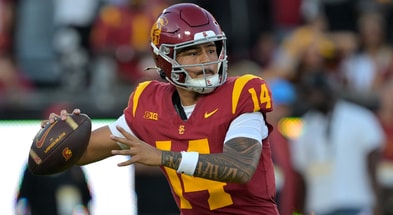
Things have changed. Lincoln Riley is the best quarterback developer in the nation and a skilled offensive coordinator. Yes, we have sometimes complained about his commitment to the run, and like any play caller, he’s had some bad plays and bad days. But his track record speaks for itself. And this past season really should remove any lingering doubt about his skills. Faced with a questionable offensive line that suffered more injury bad luck than any group I had ever seen, faced with the loss of his two top running backs, faced with a quarterback who often did not show poise or good judgment in limited playing time last year, and faced with a brutal schedule, Lincoln Riley still managed to put up elite offensive numbers.
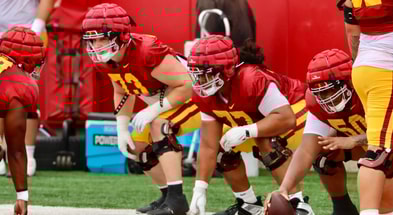
His young offensive line coach clearly deserves much of the credit. Zach Hanson was not a sexy hire. He just took the reins and did an amazing job. If you had told me before the season just how badly the offensive line would be hit by injuries, I would have expected 6-6 as the ceiling for this team. It wasn’t just a bad injury year; it was horrific. Stalingrad had fewer casualties. No, the O-line wasn’t always great; they got soundly whipped at Notre Dame and Oregon. But in light of their youth and the disastrous injury situation, they played well above expectations, and I think you have to say that Zach Hanson and his guys were probably the biggest, most pleasant surprise on the team.
USC is now in its best position in many years in the offensive line room. They will have a bunch of returning starters next year who will finally be upperclassmen—they may just bring back every starter—and they have lots of depth: big bodies with athleticism. In light of Hanson’s skills as a teacher and the last two recruiting classes, USC’s future looks bright upfront. And if USC has a very good offensive line, can anybody really doubt that USC will move the ball and score a lot of points? USC will always be able to recruit the skill positions. Lincoln Riley will always be able to put up yards and points when he has good players. USC will be one of the elite offenses in college football for the foreseeable future.
In the short term, of course, USC will need to replace two star receivers. USC will have a lot of talented receivers on the roster next year. Most will be young. I don’t know that the Trojans can afford to stick with just the young guys; I think you have to pull one alpha wideout from the transfer portal. And USC should be in a very good position to do so. Next year’s offense is a great opportunity for an elite transfer wide receiver.
I expect Waymond Jordan will return. King Miller—the best redshirt freshman walk-on in USC history (maybe college football history)—will be back. And a bunch of talented young guys will be with them. And USC’s tight end group will be strong, which matters because finally we saw a USC Lincoln Riley offense that uses the tight ends effectively.
The bottom line is that USC is probably one portal WR from having a top-five offense next year, and with Riley’s track record, Hanson’s skills as a coach, and USC’s current recruiting prowess, USC will be scoring points for the foreseeable future.
But that lingering issue….
The question, of course, has always been defense. The defense has improved the last two seasons. But let’s get real—how could it not? The defense from 2021 to 2023 was probably the worst three-season stretch in USC history. It was downright embarrassing.
The nagging question is whether Lincoln Riley is capable of putting an elite defense on the field. He has coached ten years at two of the top programs in college football history and it hasn’t happened yet. That’s not exactly a great sign.
He has shown a commitment to defense. When he finally fired The Grinch Who Stole Hope he hired what everybody saw as an elite staff. He spent a lot of money and hired coaches that everybody wanted. We’ve seen some progress as a result.
But it’s hard to see this year’s defense as anything other than a disappointment.
The key to every defense is upfront. This is where USC was supposed to make a giant move. The coaches talked about how big and talented this group was. We were told there was a lot of depth. We were told that Devan Thompkins was on the verge of stardom. USC had a fancy defensive line coach, and a respected defensive coordinator to unleash the bigs. Recruits were excited. The fans were excited. The coaches talked as if they were excited. Everything seemed to be lining up.
Yet the defensive line’s performance was brutal. Keeshawn Silver was average at best and not at all what USC expected when they paid him big money in the transfer portal. Devan Thompkins was average at best and not close to the budding superstar we were told he would be. Anthony Lucas was decent but not what we expected him to be. Kameryn Crawford and Braylan Shelby had moments but never made the big jumps forward that we expected.
Top 10
- 1Breaking
Caleb Wilson
UNC star injured in practice
- 2New
Brian Kelly
Addresses coaching future
- 3Hot
New CFB hires
Poised to make major impact
- 4
Trump's invite list
College Sports Roundtable
- 5Trending
Bracketology
New projections spark debate
Get the Daily On3 Newsletter in your inbox every morning
By clicking "Subscribe to Newsletter", I agree to On3's Privacy Notice, Terms, and use of my personal information described therein.
The defensive front was bad against the run and bad rushing the passer. Worst of all, it didn’t look like they played hard all the time. On an almost weekly basis the defensive front got pushed around in the first half only to turn it on in the second half and play with some fire. It’s unacceptable that this group put in poor efforts as often as they did. And against Illinois, Notre Dame, and Oregon, they got their butts kicked all game.
There were some bright spots with the young bucks. Jahkeem Stewart and Floyd Boucard look like future stars. Jide Abasiri showed growth. Carlon Jones flashed. There is some talent returning and I absolutely love the stud recruits on the way.
But I must admit that I’ve lost some faith in the defensive staff after what we saw last year. I don’t know that I’ve ever seen a group of coaches so wrong about their own guys. They expected an excellent group; they had a group that is in the bottom third of the conference. And they got a group that wasn’t willing to play hard far too often. I want to believe in Coach Henny and D’Anton Lynn. Recruits still do. But I will take with a grain of salt whatever they have to say about the defensive line group this offseason. That group and the guys coaching them were the biggest disappointment on the roster, and frankly they were probably as big a disappointment as we’ve seen in many years.
And most disappointing of all was the culture of that room. The coaching staff simply couldn’t get the defensive lineman to play hard all the time. The consistent inconsistency was infuriating. And it’s not just mistakes. It wasn’t just off days. USC had experienced defensive linemen—guys who were supposed to be the leaders of that group and the defense—consent to getting pushed around for large stretches of almost every game. I’m talking about getting driven back into the defensive backfield. It happened in the first half of almost every game.
USC has to figure something out this offseason in the defensive line room. The talent continues to get better. Now, can the development and the attitude match the potential? I don’t know. And because I don’t know the answer to that question, I don’t know whether USC can put great defenses on the field. You can’t play great defense if the guy who was supposed to control the A gap ends up where the free safety started out.
Equally unacceptable was the linebacker play. In fairness, this was a position where we didn’t have the same expectations. Eric Gentry has made plays when healthy, but we didn’t know if he could stay healthy, and we knew that he was at his best against spread, finesse offenses where his length and athleticism are at a premium. Desman Stephans was young and inexperienced. In fact, everybody else in the room was young and inexperienced or a guy that we already knew would never be a top-shelf player.
And somehow the linebackers still failed to meet those modest expectations. Gentry made some plays early but could not hold up physically against the wear and tear of the Big Ten offenses. Desman Stephans was at one point late in the season ranked as the worst linebacker in the country against the run by Pro Football Focus. I don’t always take PFF grades all that seriously, but that one struck me as quite plausible. Jadyn Walker flashed some but also played poorly, especially against the run, much of the time. Nobody else did anything of note.
You cannot be a great defense if you can’t stop the run. You cannot stop the run if your linebackers are unwilling or unable to play downhill. USC’s linebackers could not or would not. They consistently stood reading and reading and reading some more until an offensive lineman latched onto them four or five yards from the line of scrimmage. If that’s what they were taught to do, somebody needs to be fired. I don’t say that lightly. I think D’Anton Lynn is an excellent coach. I think Rob Ryan knows how to coach linebackers. I’m just a little less sure of both those things today than I was four months ago.
I do know that if the linebackers were taught to play downhill but could not or would not, they need to be replaced. And if they weren’t taught to play downhill, some coaches need to be replaced. Rob Ryan said in an offseason interview that the linebackers were going to play downhill and splatter people. With all due respect, the splattering seemed to go almost entirely the other way. Based on the advanced metrics, USC was one of the worst teams in the country against the run. Great defenses stop the run. Something has to change.
I have a different perspective on the secondary. The secondary also had its share of injuries. Kamari Ramsey missed a fair amount of time, Bishop Fitzgerald missed a couple of games, and some new guys who were supposed to get a lot of playing time—true freshman Alex Graham and sophomore transfer Chasen Johnson to name a couple—missed just about the entire season. The guys that were left didn’t always play well. The Illinois game was ugly, there were a ton of missed assignments early, and there was never a time you felt comfortable that the secondary could shut down a decent passing attack. But I think the group got better as the year went on, and I think the coaches deserve a ton of credit. Doug Belk and D’Anton Lynn did a great job developing Jaylin Smith before the 2024 season, and this year DeCarlos Nicholson made huge improvements also. These guys can coach.
Christian Pierce and Kennedy Urlacher will likely form a solid safety tandem next year, and there are enough young corners to fill both corner spots and nickel. That’s the short term. Over the long term, because USC’s recent recruiting in the secondary has been elite, there’s every reason to believe that this group will play very good football over the coming years. If the defensive line figures out how to rush the passer, I can virtually guarantee that these guys will perform well.
So what’s the summary defensively? I don’t know. I thought Riley hired a tremendous staff. I thought the defensive line was loaded with talent. I thought the defense would be good. And sometimes it was. But often it wasn’t. It didn’t always play hard up front. The linebackers were consistently poor. The secondary had its ups and downs but was never much better than an above-average unit.
So the question remains: can Lincoln Riley actually build a defense? I still don’t know. If he can, we certainly haven’t seen it yet. And if he can’t, this program can’t get back to the top. You can win games with great offense and an okay defense. You can’t win with a defense that gets run over by the good teams on the schedule. And I don’t think you can win a title unless you’re very good defensively. The number of teams who have done it are few.
Finally, special teams. Ryon Sayeri was fantastic for ten games and really bad the last two. I suspect he’ll be solid next year. USC will need to find a quality punter; I don’t think the offense will punt a lot, but there will be times when you need to flip the field. We’ll see if they can do that.
The biggest concern is the awful play from everybody else, especially the consistent inability to get productive returns or cover kicks over the last two years. Other than one punt return against the Bruins, USC was not a threat in the return game—and that’s ridiculous with the athletes they have on this roster. And USC was bad in kick coverage. The return touchdowns in South Bend and Eugene were devastating and unacceptable.
Lincoln Riley, like all football coaches, talks about the importance of special teams. But other than placekicking, USC’s special teams were well below average and crushed the team’s chance of an upset in the two toughest games of the year. Riley needs to find somebody who can coach this stuff, and he needs to find a way to make the special teams at least competent. That did not happen in 2025. It better happen in 2026 and beyond or USC will find itself kept out of the playoffs or knocked out of the playoffs because of special teams disasters.
The bottom line for the USC program
Where does this leave us?
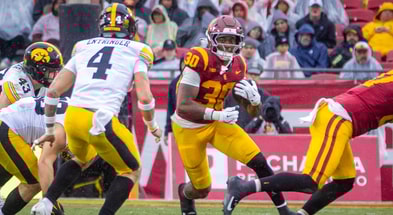
On the field, the 2025 season was a mixed bag. The big home wins against Michigan and Iowa were critical for many reasons, including as evidence to outsiders, fans, and maybe even the players and coaches themselves that USC could stand toe-to-toe with two of the bully programs in the Big Ten and outslug them. And nine wins with this roster against this schedule wasn’t underachieving. At the same time, USC was clearly outclassed by Notre Dame and Oregon—the team was simply not ready to compete with elite programs on the road—and the loss to Illinois was costly, possibly keeping USC out of the playoff.
USC is recruiting well, and with the NIL dollars it has, the administration it has, and a coaching staff that is popular with recruits, USC should continue to recruit well. In the next two years, USC should have a roster that is as good as Oregon’s, Ohio State’s, and Georgia’s. The question then will be whether USC has the right coach to win it all. We don’t know that right now. We do know the program took some steps forward this year and has a chance to take some more steps forward in 2026. To do that they’ll have to solve major problems in the front seven and navigate one of the most difficult schedules in the country next year and the upcoming schedules will likely be consistently difficult.
Right now, I suspect 10-2 and 7-5 are equally likely in 2026, and that’s not really where we want to be. At the same time, there are enough good things going on in this program and we have seen enough improvement that I’m solidly behind Lincoln Riley and his staff. I’ll criticize them when they deserve it, but there’s no Carthago delenda est from me these days. Let’s keep the progress going and get this program back where it belongs.