Mehringer’s Challenge: Unlocking Oregon’s Offense
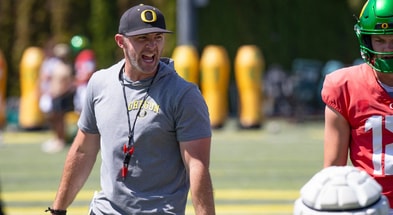
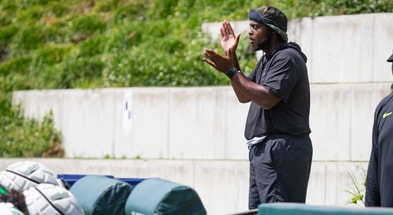
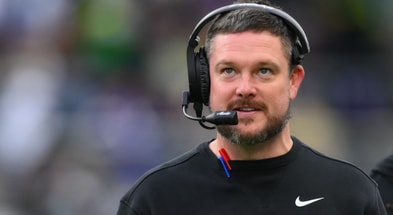
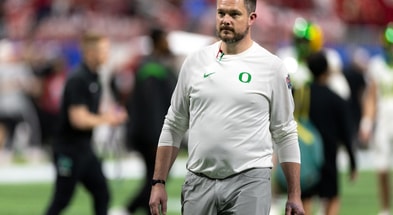
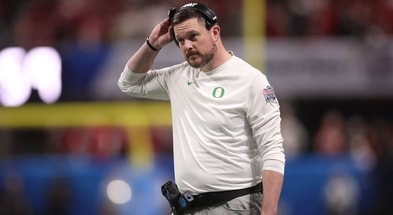
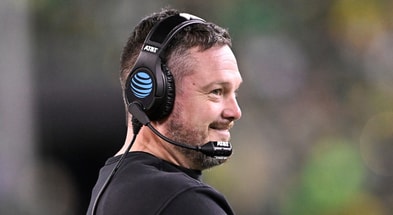
The Oregon Ducks have a new Offensive Coordinator. Gone is Will Stein and the infamous bubble screen (or is it?) In comes Drew Mehringer, who has been with Dan Lanning since the beginning of his time at Oregon. Originally serving as the tight end coach for the past four seasons, Mehringer has an impressive resume, with stops at schools including Ohio State, James Madison, Houston, Rutgers, and Texas.
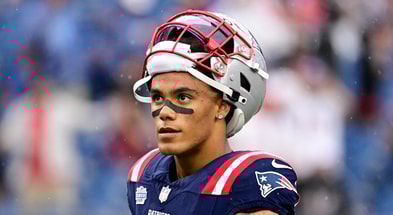
I wrote recently that Tosh Lupoi and the Ducks defense has steadily improved year after year since Lanning took over. The offense, on the other hand, has slowly tapered off since 2023. How much of that is on Dante Moore and Stein? Whatever the reason may be, Mehringer has to have immediate success as the new OC.
2026 will inevitably be different for the Ducks. Dante Moore is back. Lanning is bringing in the deepest and most talented receiver room that we have ever seen at Oregon. Now we will see if it’s more of the same from Mehringer, or do we see the Ducks spread their wings?
How Good Was the Oregon Offense This Year?
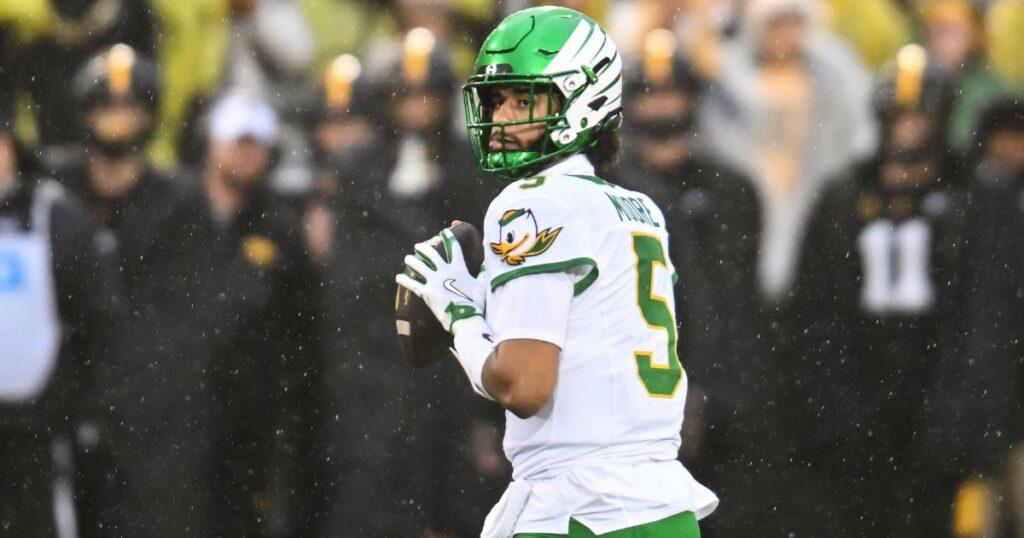
Oregon had a potent offense in 2025. They were ranked 10th for offensive SP+ and 6th in offensive efficiency on ESPN. They put up a lot of yards per game (15th) and they scored a lot of points (11th). Most of that production was against weaker opponents like Oklahoma State and Rutgers though. They continually struggled to score against teams like Indiana, Penn State, and Iowa.
The main problem was that this wasn’t a very efficient offense. They were 35th in first-downs per game and 60th in the country for Red Zone conversion at 85.48% on the season. They scored touchdowns in the red zone only 66.13% of the time (37th), which was frustrating to watch at times.
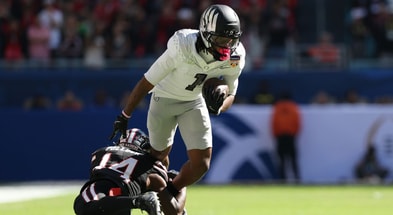
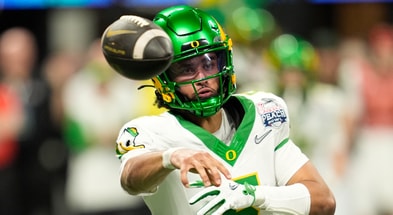
The team did generate a lot of explosive plays though. Moore completed 68 passes for more than 20 yards, which was 3rd in the country. When Moore wasn’t pressured, he was extremely accurate. The offense completed 71.6% of their throws (4th) and had a rating 163.58, which was 7th in the country.
The problem was that Oregon could not stay on schedule and stay ahead of the chains. They had a lot of explosives but struggled with consistency. That was a foundation that Kenny Dillingham and Will Stein had built with Bo Nix and Dillon Gabriel, but they lost it with Dante Moore.
Moore showed all of his youth and inexperience this year…. But Oregon is betting on a big boost for the 20 year old QB going into his third season with the Ducks.
Advanced Stats Paint Another Story

While SP+ and ESPN Offensive Efficiency metrics loved Oregon, other advanced stats like Expected Points Added (EPA) and Success Rate (SR%) did not rate them so highly.
EPA measures how much a single play increases or decreases a team’s expected points on a drive. It asks the question, “Did this play help or hurt the offense’s chance to score?” Every down, distance, and field position has an expected point value based on historical data.
I have chosen to use an EPA source that removes garbage time plays for this analysis. The adjusted data gave the Ducks an EPA per play of 0.08, which was the 30th best in the country. This was by far the worst of the Dan Lanning era (more on that later), but that makes sense. They had an extremely young roster and a QB with very little experience. There were growing pains.
For some context, here is where that would fit on the scale of EPA value.
| EPA Value | Performance Level |
|---|---|
| +0.30+ | Elite offense |
| +0.15 to +0.30 | Very good |
| 0.00 to +0.15 | Average |
| -0.05 to 0.00 | Below average |
| Below -0.10 | Poor |
Add in a metric like Success Rate to complete the picture. SR% measures how often an offense stays “on schedule.” It asks the question, “did the offense do what it needed to do on this down?” We also think of this as “staying ahead of the chains.”
Oregon had an SR% of 44.1% this season, which was 34th in the country. Put that with an EPA of 0.08 and some of the issues that Oregon faced in generating first downs and third down conversions, as well as Red Zone production starts to make a lot of sense.
How Does 2025 Compare to Previous Seasons?
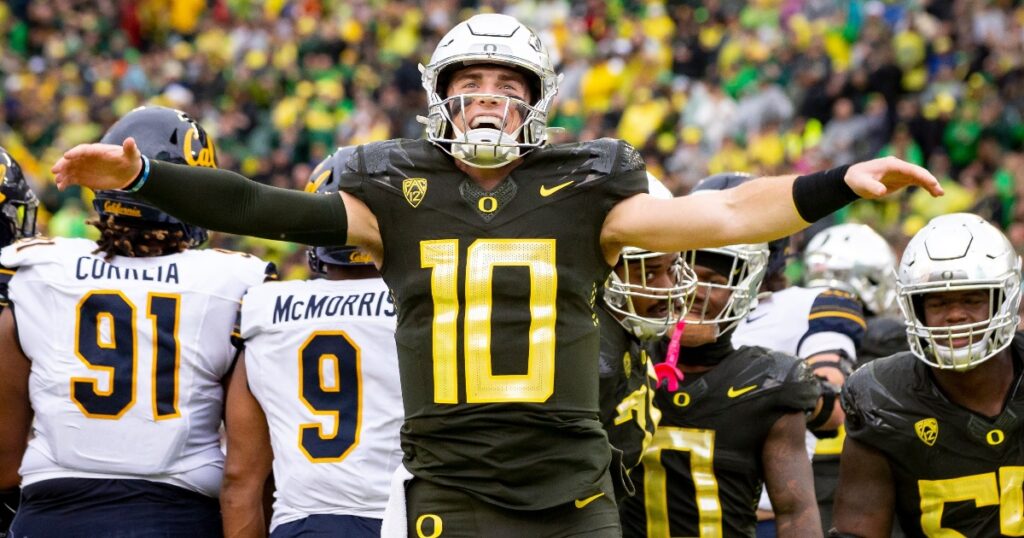
It’s hard to look at previous seasons because the data makes it clear that the 2023 offense was absolutely elite. That team should have won a championship.

Based on the table shared earlier, the 2023 EPA was at the very top of performance level. So was the Offensive Success Rate.

This was obvious across virtually every metric you can look at. It’s also clear that Oregon’s offensive production has taken a pretty massive step back since 2023.
| Metric | 2022 | Rank | 2023 | Rank | 2024 | Rank | 2025 | Rank |
| SP+ | 44.9 | 5 | 45 | 1 | 40.8 | 2 | 38.8 | 10 |
| Efficiency | 91.2 | 4 | 93.7 | 2 | 84.2 | 3 | 85.9 | 6 |
| Total Yds/G | 500.5 | 6 | 543.5 | 2 | 437.4 | 22 | 452.2 | 15 |
| Pass Yds/G | 284.8 | 17 | 346.9 | 1 | 279.5 | 13 | 253.6 | 40 |
| Rush Yds/G | 215.77 | 12 | 184.5 | 30 | 157.9 | 72 | 198.6 | 20 |
| Pts/G | 38.8 | 9 | 44.2 | 2 | 34.9 | 17 | 36.9 | 11 |
| TDs | 66 | 9 | 83 | 1 | 63 | 11 | 71 | 4 |
| Yds/Play | 6.92 | 9 | 8.4 | 2 | 6.39 | 20 | 6.87 | 10 |
That 2023 season with Bo Nix and Will Stein was truly outstanding. The only real weakness was the running game, but it was still good enough to be potent. You can also see how much the offense has steadily fallen off from that 2023 season.
Top 10
- 1Live
Bracketology
Selection Sunday Final Updates
- 2New
SEC Hoops
Title game set after OT thriller
- 3
Porter Moser
Oklahoma retains HC
- 4
Women's Tourney
Top 16 revealed
- 5
Big Ten Hoops
Title matchup set
Get the Daily On3 Newsletter in your inbox every morning
By clicking "Subscribe to Newsletter", I agree to On3's Privacy Notice, Terms, and use of my personal information described therein.
The one major strength of this current team, one that has been on a fairly consistent rise since 2022, is the number of explosives plays they generate. Dante Moore and Will Stein were able to take a massive step forward in that area this season.

Explosiveness is an efficiency metric that measures how much damage an offense does when it successfully moves the ball. Basically not how often it succeeds, but how big the gains are when it does. It captures chunk-play ability and vertical impact. 1.25 to 1.35 explosiveness is considered very good in college football. 1.35 or better is considered elite. Oregon is on the verge of being elite.
What Does This All Mean?

Oregon’s offensive data over the past four seasons shows a clear evolution. The Ducks peaked in 2023 under Will Stein and Bo Nix, ranking near the top nationally in both EPA per play and SR%. They displayed a rare combination of explosiveness and consistency that defines elite offenses.
In 2024, the offense remained highly efficient with Dillon Gabriel, but production dipped as Oregon leaned into controlled, rhythm-based football.
Then came 2025, which marked a dramatic shift. Explosive plays and touchdown totals rebounded, but efficiency collapsed. EPA per play and SR% both dropped sharply while Havoc% spiked, signaling more sacks, negative plays, and stalled drives.
What “went wrong” in 2025 wasn’t schematic failure, but more so quarterback volatility. Dante Moore’s first season brought vertical aggression back into the offense, which also increased risk. Young quarterbacks typically struggle with blitz recognition, pocket management, and red-zone execution, and Oregon’s data reflects exactly that.
The spike in Havoc-rate directly damaged EPA and Success Rate, creating a boom-or-bust profile. The offense had more big plays, but also fewer sustained drives and lower situational efficiency.
What Does the Future Hold?
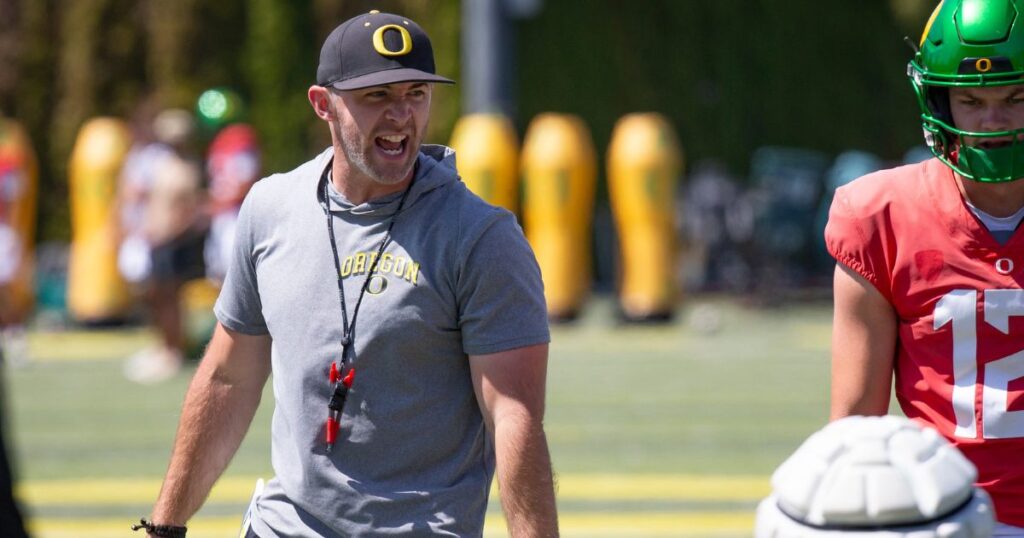
Looking ahead to 2026, the internal promotion of Drew Mehringer is a stabilizing factor. Because the offensive system remains intact, Moore avoids the learning curve that usually comes with coordinator changes.
Instead of relearning terminology and protections, he can focus on refining processing speed, pre-snap reads, and negative-play avoidance, which are the three areas that most reliably improve in Year-Two starters.
If Moore reduces Havoc exposure even slightly and improves red-zone efficiency, Oregon’s offense is in a good place to reclaim much of its lost efficiency while maintaining the explosive upside introduced in 2025.
Oregon enters 2026 with a maturing quarterback, schematic continuity, and a system already proven capable of elite production. The Ducks are no longer chasing foundational growth next season. They are targeting refinement.
If the data trends hold, Dante Moore’s second season under Mehringer could blend the efficiency peak of 2023 with the explosiveness of 2025, creating the most dangerous version of Oregon’s offense yet.